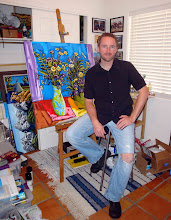
This week I am finishing a series of small 8 x 10 inch oil paintings depicting subjects in Santa Fe, New Mexico and various spots around southern Arizona. I am also working on a series of pastel studies - the first pastels I've done since I was a small kid. When I was maybe 8 or 10 years old my mom had me draw a bit in pastels and I even did a portrait of her, which I still have among my old collections of our drawings. I never forgot them, and decided just recently that, as an artist, I really needed the challenge of something new.
Another reason was that I bought a pastel of Venice, Italy from the Tucson artist Gabor Svagrik. This pastel was a gift for my wife for her 33rd birthday. I used to show work with Gabor at the Max Gallery, and my wife had frequently commented on his cityscape pastels - how they would remind her of her youth that she spent in her native Belgrade, Serbia. Though this piece by Gabor was a gift for my wife, I actually felt that it was a real benefit to me also - as I spent a long period of time looking at the subtlety of Gabor's handling of the pastel medium. The soft glow of the figures in the rain, brought out so well in the velvety haze of the pastel chalk. It made me remember toiling away for hours as a little boy, slashing colors and shapes in pastel onto the paper. It also made me remember the original thought that I'd had - that an artist strengthens his or her legitimacy by working in multiple mediums.
Of course, this does present it's own set of artistic challenges for me. A lot of my work is about the effect of the thick oil paints and bright colors; and neither can be reproduced exactly in pastel. Pastel does not posses the pure force and shine of oil colors, and if you lay pastel on the paper too thickly you are not doing yourself any great justice. In fact, as a medium, it seems to me to be much more about subtlety than force. Artists like Gabor, as well as masters from the past such as Monet, Manet and Degas all used pastel to enhance the warm glow of emotional effects. I, on the other hand, have to decide a crucial question, ie, "What does a Neil Myers pastel look like?"
As I've been doing these small studies over the past week, I was reminded of the greatest pastel that I'd ever seen - a phenomenal piece by Manet called "Madame Manet on a Blue Couch". When I saw the piece in 1996 in Paris, I was stunned. It was such a unique work because it was a portrait but not a portrait - in a peculiar sense. When I was looking at it, what struck me powerfully was Manet's soft portrayal of the couch itself, surrounding the central figure and almost becoming the object of the piece more than the figure. It felt like a couch that one could just collapse into. Inviting and soft, asking for repose.
When I began to think about artists changing mediums, I also remembered the late watercolors by Cezanne. These works, in my view, were utterly different than his oil paintings. What was so unusual about them was mostly that the paper was often nearly all white, and Cezanne only seemed to work to evolve certain details in the work. I have not studied his intentions behind the work sufficiently to resolve whether or not he considered most of his late watercolors finished or not. To me they look unfinished - but I do realize that he must have been bringing out what seemed to him to be essential elements; the arm of a tree, the spine of the Mont Sainte Victoire - and the images emerged as though through the white fog of the paper.
I think I will have to resolve, in the coming days, the debate over whether or not a Neil Myers pastel or watercolor will represent a break from his oil painting style. We shall see. I've always worked with a little bit of free experimentation spirit in the back of my mind, and frequently I too am along for the ride in seeing where these imagistic explorations go.
Stay tuned to http://www.neilmyersart.com/ and I'll post the first of the pastels on "the painter's closet" page as soon as they are ready.
Also, for those of you who love great music, I'd like to shamelessly plug a new self titled CD by Jason Isbell and the 400 Unit. I just downloaded it last night from itunes, and found myself sitting at my desk with my guitar, figuring out the song "Cigarettes and Wine", a beautiful tune that harkens back to other slow blues-rock songs of the past. The CD has already received praise from Rolling Stone and Spin magazine. For those of you who don't know him, the leader of the band Jason Isbell is a former guitarist/ singer / songwriter for the Drive-by Truckers - and he was responsible for penning some of DBT's most memorable songs like "The Day John Henry Died" and "Goddamn Lonely Love." I've met Jason twice when he and the 400 unit played shows in Tucson. The second time we met up he and I spent a cold half hour standing behind Club Congress in Tucson, talking about music and life. Jason's a really cool guy, a person who is very real and very level. He's a master songsmith, a real Southern-American poet. His band are a talented bunch of guys as well - the guitarist of the band Browan Lollar is an artist on the side, and he designed the graphics and images for the new 400 Unit CD. You can check Jason and the band out at http://www.jasonisbell.com/ , where you'll find all relevant info and links to their myspace where you can sample the music. I urge everyone to support great indie artists such as Jason and his band. And don't miss a chance to catch them live if they swing by your area.
Now I have go get busy getting my fingers covered in pastel dust!
http://www.neilmyersart.com/
Thursday, February 19, 2009

Tuesday, January 6, 2009
One the Eve of My First One-Man Show, A Chance to Say Thank You

This week, as I am nearing the January 16th opening of my first one-man show at the Max Gallery in Tucson, I wanted to take this moment to write a few lines to say thank you to those who helped me along the way. Not some academy awards roll the credits sort of thing, but name the people who I could not have done this without - and tell you why they have been important.
First and foremost is my wife Jelena. Many days I have worked alone in the studio all day, then she would come home and I would hear her reactions to the days work, unedited and honest. I always hope to hear that "heeeyyyyyyyy" that signals a good painting. And I land with a thud sometimes when I hear a hesitant "not bad...." as she quizzically sizes up a painting. Often I would feel insecure about some aspect of a work, a tree, a few brush strokes - but I would try to exercise a little painterly denial and put it out of my mind. Then Jelena would march right in and say "what's up with that tree?" And she would see the weak spot immediately. This criticism hurts sometimes, but a painter profits from it. The kind of loving, honest support that says you can do better. And another great gift my wife has given is the mere ability to do the work, the time to develop as a painter and the freedom to chase a dream that doesn't frequently make the one chasing it a rich man. I often tell people that we all know Vincent Van Gogh, but fewer people know Theo Van Gogh, his brother - who supported Vincent financially and emotionally, without whom he would not have been able to the beautiful paintings we all revere. My wife Jelena has been my Theo, and that freedom to paint has been the greatest gift anyone has ever given me. Thank you my dear wife, I love you very much, and I will always work as hard as possible to earn the faith you've put in me.
To my parents - I am sure that the fathers and mothers of lawyers and accountants never have to ask themselves the hard questions that the father or mother of an artist does. It is a difficult thing to assent to your child going into one of the most difficult ways of life that is out there. It would be easier to have a child do something conventional, and acceptable - and it is only great character that allows a parent to see that they have a little artist on their hands, and there is no use in fighting it. We should be thankful that Michelangelo's dad didn't steal his brushes and chisels, and instead sent him to study art. My study was my own, but my parents allowed me to do it. Thanks to my dad Billy Myers for always caring enough to make sure I was fed and out of trouble. For putting a few bucks in my pocket and some gas in the car and offering his encouragement. It was my dad who told me that "nobody who never quit ever failed" and I remembered it. Thanks dad. Thanks to my Mom also who allowed me to make my first sketches in her old sketchbooks from the 1970s. My mom was my first exposure to art, and she was never more at home than when she had a charcoal pencil in her hand and a sketchpad in front of her. My mom drew people too, not just silly sketches of stick figures. She did fine portraits that I still remember and look back on. Her paintings of flowers are always in my mind as I do my own. And in my studio, just above my easel is my mom's version of Van Gogh's famous Irises.
Thanks to my lovely grandma, Shirley Hoyle, who actually was brave enough to buy the first works that anyone ever paid me for. According to market prices on my paintings now - I dare say she made a pretty smart investment :), but she indulged my love of art and she introduced me to the fine feeling one gets when they learn that someone has paid their hard-earned money for one of your works.
To my brother, Will Myers - thanks for not killing me that day you rammed my head thru the bedroom wall. (In all fairness, we were fighting and I'm sure my big mouth had something to do with it) I've since been accused of being hard headed and can't really dispute that. It might just be that when I look at the world around me and see skies carved and brushed in thick paint - that I may be experiencing after effects of breaking a wall with my head. If so, I guess I should thank you Mr. Will. I may owe it all to you and not even know it :)
One a more serious note, I would have to make a special mention of thanks to my friend and mentor M. Jean-Claude Quilici. Jean-Claude provided the most useful thing a man in his position could have - he offered encouragement, support, good humor, and the shining example that painting is indeed a craft, which one learns over time, and often with difficulty. He clearly understood how much I loved his work, and did all he could to send me books, show invitations, posters, letters, cards, and much more. When I got the distinct feeling that other people felt that being an artist was a dead end deal - I always had the example of Jean-Claude to think of as a counterbalance - a man of great success who persisted in the search for his own path in the light of the Provencal masters. I am here to declare that I think that Jean-Claude Quilici is the greatest living artist, period - and I can not be convinced otherwise. Jean-Claude helped me to understand that something could be both beautiful and original - and that painting could be a great exultation of life and the world around us. I have been a very privileged person to actually know and be friends with my favorite artist I've ever discovered. What a great privilege to be able to say that.
Right next to Jean-Claude I must thank the other Quilici, M. Augustin Quilici, French professor at Lenoir-Rhyne University. He did more than just introduce me to his cousin's work, he also became a great friend and mentor. He offered his own generous but critical eye in the formative years of my experiments in oil painting. He bought some of my earliest works that were decent enough to look at, and I was greatly encouraged by him. He also nudged me to go to Europe, which I did in 1996 - an experience which I was not prepared for, but which I am very happy that I had. Because of that, I walked the streets of Arles, and St Remy, Paris and countless other amazing places. I saw works that blew my mind in the Musee d'Orsay and the Louvre. Most of all, what I learned from Augustin Quilici was a devoted passion for the creative arts, literary and artistic. I am also convinced that Augustin Quilici has a painter hibernating inside him - because I will let the world know that he too paints. His "Pont Neuf" that hung in his office at Lenoir Rhyne in North Carolina was a fine piece. And perhaps one day he will take up his palette and show us the other Quilici - artiste-peintre, that I know is out there.
Two other professors at Lenoir-Rhyne also provided great encouragement and friendship; Dr Bohdan Kuropas, and Dr Werner Schultz. I thank both of them for their friendship and love of art that they were all too kind in sharing. Both of these gentlemen have early Neil Myers works in their collections, and I hope they still enjoy them.
To Steven Morse; many thanks for the countless long conversations about art, for your passion for creativity and our friendship that has lasted since the 6th grade! Some artists are craftsmen with a hammer - and some with brushes.
To Judy Murphy; my entire Southwestern art career goes back to that day in 2003 when I showed a few images to her at Rosequist Gallery in Tucson, and she said immediately "Can you bring me these paintings this afternoon?" For all the "No's" that one gets in the art business, Judy had the foresight to say yes, and my success all traces back to her belief in me, when I was nothing but one more newcomer artist who had just arrived in Tucson.
I have to also thank the countless gallery directors who have shown and sold my work, who have supported me and offered me their encouragement and backing; firstly Max Mikesell, of the Max Gallery, who took me on board in 2005 staring at the works for a long time and saying "I would like to represent your work." Thanks also other gallery directors, Mesia Huttner, from Cobalt Fine Arts. Linda and David Sherer, from the LeKAE gallery, Drew from the LeKae Gallery, Anothny Sobin from Taos Fine Art - and others who have show my work around America.
One can have all the talent in the world, but they will not get all they can from it if they don't realize that their success has a lot to do with other people. When I look back over the last 6 years, that is the one thing that stands out. Time and time again, other people stepped forward and supported me and my work - and I dare say much of what I have done would not have been possible without all this wonderful support.
And I must save the last thank you for the collectors who have bought and supported my work. I once told a collector from Casa Grande, AZ, that the greatest gift someone gives the artist when they buy his or her work is that they put a little bread on the table and that allows an artist to keep working. I appreciate the passion of all the collectors around America who have been there for me year after year. You allow me to continue my work, and to me, there is no greater happiness that the new world created on blank canvas. Thank you all.
I hope everyone will come join me at the Max Gallery from 5-9pm on January 16th. This will be the largest group of works I've ever shown, and I'll be very happy to meet everyone and thank them myself for their support.
For a full online preview of the Max Gallery show, log on to http://www.neilmyersart.com/ .
Monday, December 29, 2008
Cave Paintings and Rock Art

This week I am working on a 20 x 24 vertical Saguaro landscape with blooming paloverdes in the distance. I'm also busy organizing the advertisements, invitations, and the special online exhibits that will go along with my January 16th show at the Max Gallery in Tucson. I hope everyone has had a wonderful holiday season, and we look forward to a happy and fruitful 2009. This coming year will see the birth of my son, in March - and on top of all the great things that have come to pass for my wife and I, we are the MOST excited about this little man who is soon to come into our lives.
I'm currently reading a book by Gregory Curtis called "The Cave Painters, Probing the Mysteries of the World's First Artists". This is a study of the primitive arts that existed in the Paleolithic era of early man. The books spends a great deal of time talking about world landmarks such as Lascaux, the beautiful painted cave in France that features the "Hall of Bulls", which I myself painted a rendering of last year. I've always been deeply fascinated by art of this kind, and only recently did a begin to ask myself why.
There is always in me a great love and respect of the primitive. That is to say - what art would be without any social conventions or training. Paul Gauguin sought such a place where he could establish his vision of art free of western social norms, in a raw, primitive environment. Picasso, after mastering representational painting by the age of 14, spent much of the rest of his life in a process of exploration that involved some drastic simplifications, and complexities, that strayed far from his classical training - and resulted in, at least on some of his canvases, very primitive works. Picasso had a great fascination with masks - and some of the Fauvist painters looked to African crafts for inspiration in the qualities of simplicity.
I think that I respect the primitive works on some level due to my own lack of training in the arts. I took one drawing class in college and absolutely hated it. Drawing was something I enjoyed all my life, even as a small boy - and to have the act reduced to something the professor wanted to see led me to the conclusion that most art professors want artists that will just paint or draw like them. They see themselves as an ideal, and thus seek to conform others to it. I dare say not all fall into this category, but I'm sure many do.
It seems to me that primitive artists very likely didn't have the hangups that come with the rigid formulations of training. None the less, many of them displayed a great deal of talent - the ability to render colors and shapes impressively, and the ability to have an eye for composition and perspective. That is what appeals to me on canvas. The seeking of something raw and beautiful - rough and luminous at the same time. I enjoy a perfect Michelangelo or Leonardo as much as the next guy - but it never gets to the root of my own artistic feeling. My feeling in front of the canvas is a feeling that is hard and rough. My work shows it, and that's certainly deliberate.
So when I discovered through books the wonderful painted caves of France I immediately felt a connection rooted from those early artists and running right up to contemporary painters like myself. I painted a large wall-sized work called "The Dawn of Painting" which depicts one scene from the Hall of Bulls at Lascaux. I've never shown the painting outside of my home, but countless friends have commented on it. It has simply my homage to those wonderful early artists whose works still survive.
I feel it is crucial to the artist to get down to the core of what art could be - art with no hangups or framework. To answer the question of what the soul would put on canvas before it asked the permission of a professor or classicist to feel what it is feeling. An honest urge - a true expression. The cave painters did not need a university or art school to make compelling images, they just did it. Let art be as natural as the rain. Let it speak in honest ways. Drop the filters and see the uncut version. That is the language of the human heart. The cages came after.
Thursday, December 11, 2008
Music, Art, and Originality

This week I have just finished my first painting of Aspens in yellow fall colors. I am now working on 20 x 24 inch study of the mountain peaks of the Grand Tetons. Having finished most of the Arizona works for my show on January 16th, I am letting loose with the urge to paint some other western subjects that I love.
I remember my French professor Dr Augustin Quilici relaying to me the phrase "le style est l'homme" (the style is the man), and as we can assume that this is always the case in art - I found myself thinking of how much it is also true in music. In the art I have tried to make, I have attempted to create painting that would be unmistakeably my own - that there would be no debate over who made them. It was very important to me not to have my work confused with anyone else's. In the years that I have been browsing galleries I have come to the conclusion that it is easier to be a strong draftsman and absorb the talents brought out by artistic training - than it is to have an original idea and relay that idea on canvas. That is to say, I think more people can draw and paint, than can dream something truly original. And even that depends on what one wants from painting. Some artists are hyper realists, and they get the most happiness from that.
It should also be remembered that nobody who is successful is without their roots. My own roots lie tangled between the work of Jean-Claude Quilici, Vincent Van Gogh, and Maurice de Vlaminck. That is to say, your own original ideas are built on the foundation of the discoveries of those you admire. My breakthrough was to try to apply a certain vision to the Southwest that I had not yet seen. But these ideas came from a fusion of those who inspired me.
For many years music helped me to understand the qualities of distinction that were necessary in a work of art. It occurred to me frequently that songs live by their quality of distinctness - how they stand out from a background of noise and jingles. I remember hearing an NPR interview with a Canadian singer / songwriter Justin Rutledge, and they played a clip from one of his songs where the line goes "They've got armchairs in Vienna, where a man would wanna die. They've got Ludwig Van in garbage cans where the poets go to cry..." and I thought "whoa!" I still remember where I was driving when those words struck me. They stood out as more poetic, more rich, perhaps even a little strange when you consider all the pop jingles and do da do da stuff that gets shuffled around today. It was poetry in music. I became an instant fan because I realized that Justin Rutledge had done in music what I will have hoped to have done in art. That is when you hear Justin's music, you know it. I would hope that when you see a Neil Myers - you know it.
I remember Jim Morrison saying that "the doors is just a white blues band". But even as he seemed to try to find a label for the Doors, it seems they defy anything even he might say. Amazing lyrics, powerful stage performances - a deep sense of drama and a poetry of the times. Unorthodox views of how a song should be created - one of the most distinct aspects being the way that Doors music was held together by Ray Manzerek's keyboards, giving the music the quality of organ like processional - dark and lyrical.
I would also rank KISS as one of the most original super groups ever devised. Take one look at those guys and it's not hard to see that they hit on something different. No doubt about that. But if KISS had only been about 4 goons in makeup, then it would not have lasted. Those same guys proved the ability to put on an astounding rock show, and they had the near infinite capacity to write dozens of songs that are now part of our rock lexicon. I got to see the original KISS in 1996 in Charlotte, NC, so I have seen this for myself and will vouch for it.
What's interesting in music today is that the most original artists are often on independent labels, because the larger labels have become so risk aversive, indie labels are almost all that's left. American music is too much industry and too little art, that's the reason we've not had a KISS, or Beatles, or Led Zeppelin emerge in the last number of years. Because the value of an original idea in music is lower now than it was in the 60s and 70s.
But I still have my Will Hoge, Justin Rutledge, Deanna Johnston, Kathleen Edwards, Drive by Truckers, and countless others to inspire me as I paint. They paint with chords, but to me they are all full of color.
Friday, November 14, 2008
"Support the Arts, Buy a Painting"

This week I am working on a variety of small paintings, 8 x 10s and one 5 x 7 inch landscape. I have been telling friends that every vision for a painting that I've had in my head recently has been huge - and that I had set myself the contrary challenge of trying to do high quality small works, with all the feel of my large ones.
This week I have found myself thinking a great deal about something Jon Linton, the publisher of "Artbook of the New West" has frequently said; "Support the Arts, Buy a Painting." Jon would sign off his publisher's column in the magazine with that phrase - and perhaps it has been token phrase before the current economic crisis in America, but now it is becoming a question of survival for American artists.
Frequently I am hearing the alarm bells from all corners. Galleries struggling to make rent, buyers very hesitant. When purchases are made clients are going for small works or small handcrafted items. And it seems that the current situation in America is not just news, it is real and true economic reality, with many fine arts galleries feeling the pinch, many artists feeling the flattening sales climate, and I have been reading that even high end auctions houses such as Sothebys have been seeing works by historic masters go unsold, or be sold for much less than previously expected.
I know in the past when thanking collectors for their purchases I have said "art is not bread", in the sense that I know how fortunate a situation it is to have the luxury of enjoying fine paintings. In a situation like we now find ourselves in, most normal people will resign themselves to thinking about the basics, food, gas, insurance - the essentials. And something like art is sometimes seen as an optional commodity.
But as I have continued reading about the U.S. government's efforts to bail out our struggling banks and industries, I found myself remembering a visit to San Francisco in 2006. While my wife and I were there, we visited the historic Coit tower, and saw the amazing murals created by artists employed by the WPA. Beautiful murals, painted in the spirit and style of Diego Rivera, but exhibiting themes of America and California. And I know that when I thought about these murals later, and learned that the WPA had employed lots of artists on projects around the country, I was nearly reduced to tears. I told my wife "in the worst of times, the WPA did not forget the nation's artists." I wonder today if any national recovery programs will include the country's artists. I'm not sure that the public and political attention span would even take the time to remember the great works of the WPA artists. Or does today's generation even know?
But now, as I have some tinge of fear for what may become of American arts during the economic troubles - I think perhaps I was wrong...art IS bread. It is possible that it is a luxury that we give little thought to when times are good. We partake, buy a painting or a sculpture, sometimes without fully realizing the contribution of artists to the culture and richness of the human experience. Yes, art IS essential. It is perhaps most essential at the times when it is in danger of being marginalized. When we are all worried about the state of things, art is also a great consolation on the story of the human experience, the love of nature, and the wonders of being alive in the world.
So I will end with the phrase I've borrowed from Jon Linton: "Support the arts, buy a painting."
Buy the bread. Buy the groceries. Put the gas in the car and pay the power bill. Take care of the family and do what you have to do. But if you are ok, and if you are able, NEVER forget that blank wall in your home that cries out for a great vision.
My sincere thanks to all my friends and collectors for their support!
Monday, September 22, 2008
The Beast of Abstraction

This week I am working on a large 38 x 48 in. painting of a row of cliffs at the Grand Canyon. It has been a helluva stretch to complete - I've always thought that the Grand Canyon was one of the hardest subjects in American landscape painting to do. It is a terribly beautiful and complicated arrangement of shapes and colors, and believe me, if you haven't seen it, I urge you to make a point to see this amazing natural wonder in your lifetime.
Ever since visiting New York City a couple of months ago, I've been thinking a great deal about abstract painting. Seeing some of the great works of Pollock, DeKooning, and Rothko was a special treat, but then I noticed something a little disturbing; for example when you visit the modern art wing of the National Gallery in Washington D.C., you'll see that it is one of the emptiest areas of the museum. After going there last year, and again this year, my wife was joking to me that it seemed cruel that they wouldn't let the security guards in those areas of the museum have ipods to break the boredom. I alone wandered through large rooms glowing with canvases by Jackson Pollock, Clyfford Styll, Barnett Newman, Robert Motherwell, Mark Rothko, and many others - and frequently I was the only one in the galleries. And that got me to questioning the value of art which is so strange that it, by it's very nature, alienates those it depends on for communication and meaning. What can a painter say of his or her work if they are an abstract artist, and their galleries get 3 visitors for every 50 the Impressionists attract?
Lots of questions follow. We'll, I ask myself, do I not understand the work? Do I not have the equipment? We'll I don't buy that exactly. If I or other people perhaps don't have the mental acuity to understand abstract work, then it may require interpretation from a 3rd party for us to reach some clarity regarding the work. And here is the biggie - if it requires interpretation, has it not failed it's goal of one to one visual communication?
Well, perhaps the best we can say about this is sometimes. Sometimes I, and perhaps others, have felt that we understood an abstract piece without some pince-nez scholar telling us what we should take away from the painting. I have always felt this about Pollock and his work. I never really needed anything from anyone to get Pollock. I felt all his power, his disturbances, his violence, and his eloquent beauty without ever hearing a lecture or art talk. However I puzzled for a long time over the work of Mark Rothko. With effort I did manage to get into the idea of his works, but they ask a lot of the viewer, and the connection from artist to viewer is a tenuous one.
We can surely say that what is popular in the creative arts is not always deeply meaningful. I don't think that you'll find anyone ready to put Miley Cyrus on the same level as Bob Dylan. However if something is so hard to understand that it impacts almost nobody - then can you call it good art or not? Again, sometimes. If further examination leads you to new horizons of feeling then the argument could be made that the art is effective. However I am convinced that many pure abstractionists are reveling in one thing - and one thing only - strangeness. Strangeness gets even harder to handle when there are no visual cues for the viewer to process. And then when the bulk of the viewing public walk away going "what the hell was that...?" then many such artists will feel confirmed in their originality, assured that they have confounded the average Joe on the street. I don't buy this at all. Because I know of countless artists who have very original styles and who are very popular. My mentor Quilici is one. Picasso was another. The question was floated during Jackson Pollock's lifetime "Is he the greatest living painter in America?" That alone was a huge creative compliment.
At the same time I was experiencing the empty abstract galleries in Washington D.C., I noticed the huge crowds flocking close to see original works of the Impressionists. That too set me to thinking - what was it about the Impressionists that still captivate audiences in 2008? I think that the answer had something to do with the photographic camera. That instrument had been invented in the years leading up to the arrival of the Impressionists, and many of them rightly deduced that if you wanted a perfect replication of a person or landscape - then the camera could do that - in black and white at least. So the Impressionists sought ways to personally express their own touch when painting an object, and their respective styles resulted in images that were joyfully painted, with the styles of the individual artists - but which didn't replicate perfect classical reality. So then, as it is today, people are greatly comforted by the Impressionists because they still know what they are looking at, but they still feel the expressions and color usage that were particular to each artist. In D.C. I saw groups of schoolkids, 7 or 8 years old, congregating in a room full of Monets. They clearly enjoyed them - as did the adults. And I saw no such cross section of people visiting the abstract artists.
Every artist has the free right to push painting or art in general in any direction they choose. However the viewing public has a right not to go with the artist on such tangents. And if I were to sound one warning - as I declare myself an admirer of at least SOME abstract artists - it would be to honestly say to them "don't project unreasonable expectations on the viewer of your work." The deeper one gets into strangeness, with nothing recognizable on the canvas and with no dispensation to care about artistic beauty - one may expect fewer viewers. One should never behave as if the viewers decide the works FOR the artist - however one should neither behave as if the viewer is irrelevant.
I've heard it said that some artists bristle at the insinuation that their work should be beautiful...I don't feel that way at all. I think beauty is a wonderful aspiration. That is my soul's release when I look at art. Because, hey, if I want to feel bad, I can always turn on the news instead.
Wednesday, July 30, 2008
For the Love of New York

This week I am working on a new Sunflowers painting commissioned by a local writer. For the past few months, after initially painting a previous Sunflowers work, I have been wrestling with myself mentally about how to tackle anew the idea of still life painting. When I initially completed the piece simply titled "Sunflowers" about a month ago, the response was overwhelming among those who visited my site, and the painting was quickly sold. Last night as my wife and I talked, I mentioned to her that both my recent Sunflowers paintings are spoken for, meaning I may need to a THIRD one to have one to show this fall. A good problem to have, for sure!
Last week I had the good fortune of going back east to visit New York City. It was the first time that I had been there, and I was looking forward to it if only for the museums and the many chances to see great art. Thankfully, during our quick visit we managed to see the MOMA, the Met, and the Guggenheim. The highlight for me was the Met, which I would rank among the finest large American museums. Whereas most collections may have 5 or 6 or a painter you like, the Met had 8, 10, or more. It was overkill in a good way, and a wonderful chance to charge the batteries while trying to absorb how the masters I admire tackled still life painting. While visiting I was riveted to a vertical Van Gogh canvas of white roses on a green background - and just nearby, another lovely Monet of Chrysanthemums. While looking at these I came to the conclusion that still life didn't necessarily need to be reinvented. It's one of the oldest genres of painting - and when people liked my sunflowers, I suspect they didn't like them because they were earth shatteringly original - but rather than they felt they were beautiful and interesting. The masters didn't seem to have reinvented the wheel, so perhaps neither should I.
But the most striking thing you take away from New York City is the impressions you have of the city itself. It is a big, crazy, wild, busy monolith of a city that has forever played an integral role in American identity as a nation. I was telling friends that at street level, the city didn't seem gargantuan - if you didn't look up. The moment you looked up you realized how crushing the skyline is, how massive and towering the verticals are. I remembered reading years ago that one of the only reasons that such large skyscrapers could be built on Manhattan Island is because of an extremely strong bedrock of granite below the surface of the soil on the island - and if you visit central park, as my wife and I did several times, you see giant granite slabs projecting up through the trees and grass - exactly as had been described to me in books.
Central Park is one of the great places to people-watch - a kind of meeting point for a cross section of the city. Everyone from bums to millionaires to professionals to upper east side nannies taking kids out for a stroll. The park is a nexus for the city, and I think that it was an amazing piece of foresight that the early founders of New York saw to make such a place, where citizens of the ultra-metropolis could temporarily get back the feeling that all people need from time to time - the feeling of trees over their head, leaves on the ground - the reflections of willows on the water, such as you see at Bow Bridge in the park. We had lunch there on a bench and listened to an accordion player - a memory I'll always treasure.
Artistically, New York City makes you want to go straight out and buy a large stack of vertical canvases and get straight to work! Then you come to the conclusion that even that would not do - that the results would only be a snapshot. In fact, you'd need a canvas the size of a barn wall to convey the immense weight and size of the New York skyline. Few painters, in my opinion, have come close to rendering the shapes and immensity of New York in such ways as to parallel how you feel when you are there. Painting the city is such an task that we all feel we'd like to try it, because it is visually so impressive and huge.
Another thing that doesn't seem to get mentioned is the wonderful individuality of the different areas of the city. The cool thing about the city is that countless ethnic, religious, and national groups have settled there, and their quarters often reflect those who live in them. Chinatown, Little Italy, being among the foremost that I visited. But there is more to it than that. The upper east side of the city feels entirely different than the upper west side. Greenwich Village feels different than Soho. Downtown feels different than them all. Midtown the same. And one surprise is the way that the city feels quite small when you are on the side streets in these enclaves. Sometimes it's even very quiet and peaceful. I think of lot of our views of the city have to do with waves of thousands passing up and down the sidewalks of fifth avenue, and downtown - but the city is by no means like that in every corner.
What was most impressive about it was that being in New York City was like looking in a mirror - that this kid with his roots in small town North Carolina could feel so happy and comfortable with being in New York, it really showed me how far a person can come, the amazing things that they can see, and the surprising places you can love - in defiance of your roots or the expectations of others. Travel is the great antidote for static life - and it is the one thing that keeps us sane and able to break free from routines that are exhausting. I always liked that quote from the movie American Beauty, where the narrator says "It's amazing when you realize you still have the ability to surprise yourself..." Places can have the same effect.
I didn't get the t-shirt that says "I Love New York", but it sure makes a lot more sense now.
Visit Neil's official website at: http://www.neilmyersart.com/
Subscribe to:
Comments (Atom)