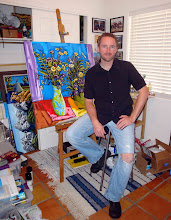
This week I am working on a large study of a Saguaro that was photographed at the Naranja town site, near where I live in Oro Valley. This piece promises to be one of a line of studies that I've done, featuring a large saguaro as a central point - a kind of consideration of our most iconic Southern Arizona image.
I thought that this week I would write about a subject most of us artists know pretty well right now - and that is how to try to succeed in these times of crisis.
I think that all artists must be honest with themselves and admit that when homes are being foreclosed on, jobs are being shed in the thousands, and many families are struggling just to cover medical bills and meet basic necessities - art is, naturally, one of the last things on their minds. Art is something that one has the luxury of enjoying only if the essentials of life are taken care of. And so I think that most artists must confront this issue and be ready for maximum flexibility in these leaner times.
Thankfully, I have been lucky in the fact that my own work is doing as well as ever. Sales in the early months of this year have been amazing, and I can only be grateful for the wonderful collectors who continue to buy my work and keep ME in the studio working. I have found that some essential things were necessary for keeping interest high, and for those artists who are curious, I'll share what's worked for me so far.
First of all, you have to be open to negotiate with the clients for discounts. Most luxury items like paintings are going to require this right now whether we like it or not, so you must be flexible if the client requires it. Back in October of last year when the full brunt of the credit crisis emerged - I emailed all 4 of the gallery directors that I work with and gave them a maximum possible leeway in cases where they were able to negotiate prices. Especially on larger paintings which have a higher price point. And I found that if the gallery directors and owners were quickly able to negotiate prices more freely, then they could secure the sale more easily without having to call me and ask if it was ok.
Second, my suggestion would be to think VERY hard before you raise prices in this economy. People are getting pinched hard - and it would be a bad move for sure if a painting or work of art was almost within someones range and the artist unnecessarily moved the price upward and lost sales because of it. In the current climate, the artist might have to be content with having his or her work HOLD its value, until better conditions made price increases more feasible. Another reason I would caution against this is because that if the economy got drastically worse, then you could potentially become even more out of reach for collectors of more middle class means.
Third, I think we all have to pay hard attention to our expenses with advertising. I found that one thing that has helped me immensely was the Arizona Collector's Guide. In late summer last year I bought a page ad in the Arizona Collector's Guide and it has paid good dividends for me during the entire exhibit season. I would strongly suggest this for an artist. If your area has a state collector's guide, as I know we have in Arizona and New Mexico, then you should try to buy an ad in it. The long shelf life of such things will work to your advantage. Of course advertisements in major magazines are helpful also, and I have found this to be true - but you have to allow for the fact that most of them have a shelf life of only one month. However you must remember that you typically can negotiate better deals with magazines if you run a series of ads, which is a possibility if you have the revenue to do so. From magazines, I've had the best results from ads in Southwest Art Magazine. SWA is one of the best magazines for connecting with collectors in the American Southwest. They also do a good job of fairly representing all forms of Southwestern Art, from the traditional, to the expressionist, to the more experimental work, and they have an interactive website that is easy to use for both artists and collectors.
Fourth, now this is a hard point to concede if you are an artist, but I'm going to be honest about it; this may not be the best time to go radical. Of course, all us artists are by nature people who love to experiment. But I think that for survival sake, you must temper that urge a little bit in these times. I don't think this is a time to do something that your clientele can't relate to. I know that I am working hard to find new images to paint within the contexts of the kinds of work that I am known for. This means a lot of Arizona and New Mexico, but that's ok - I love these places. I was quoted in Tucson Home Magazine as saying "I like to paint things people know in ways they've never seen before", and that's even more true now. I can only liken this to a concert performer agreeing to play most of the greatest hits for the crowd - I think a visual artist will probably do better to stay closer to their "greatest hits" themes right now.
Fifth - this is the greatest lesson of all: do great works! It bears repeating...DO GREAT WORKS! That is the first-best thing an artist can do. You must make your works as strong or stronger than they've ever been, so as to assuage the collector of any doubts he or she may have in these rough times. That is to say, make them fall in love with your work - hopefully make them feel so passionate about it that not even they let the doubts creep in. That is your one greatest move. That is the thing which is always in your control if you are an artist. So now is the best time ever to recommit yourself to doing great works. I told another Tucson based artist this and said "at least if they walk out of the gallery without buying a painting, we can make it bug them like crazy (in a good way) until they get something at a later date."
I offer these things as suggestion only. There is no single path to success in these times, and each person must find what works for them and do that to the n'th degree.
I also would like to reiterate to some politicians who see the arts as a waste - that, as another columnist said "arts jobs are American jobs". I have heard this idea being floated by nationally known political figures that funding for such wonderful organizations as the National Endowment for the Arts is unnecessary - and this literally makes my skin crawl. We have such a wonderful tradition in America of brilliant painters, writers, musicians, actors, photographers, documentary filmmakers, sculptors - and countless other artists - that if they were to be removed from American life, our tough days would be even more dull and infinitely less enjoyable. In this time where we hope we are all doing the right things to lift our people and our economy - American Arts deserve to be EQUALLY lifted, and not to be left behind. Besides, when I sell a painting, the arts supply store benefits, the UPS courier service benefits, taxes are paid on the sale, as well as income taxes by me, and the gallery and the artist and the UPS driver and the associates at Aaron Brothers art supplies and the writers and editors of the magazine where I advertise - and countless others are all employed and productive citizens because of it.
Lastly, as I sign off I would like to send heartfelt condolences to the family of actress Natasha Richardson. Her loss is a terrible tragedy for her husband Liam Neeson, her sons and her family. With her departure we have lost a wonderful actress, and a beautiful woman of breathtaking elegance, grace, and humor. Her films and performances will live on after her, and her contributions as an artist will remain with us.