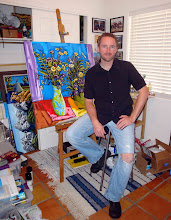
This week I am working on a painting that is slated to be a gift to the city of Oro Valley. Can't reveal much in the way of details…more to come later. I am also framing a group of works that will go to Cobalt Fine Arts for a small paintings show that I am in with my dear friend the artist Natasha Isenhour - called "Jewel Tones."
One thing that has been on my mind recently was a question put to me by a friend who is an aspiring writer…and that was the question about "selling out", i.e., having your art or what you do affected by selling. The question wasn't loaded, and it was well meant. But it did cut to the chase over the issue of the role of selling work and how that affect the creation of it.
I'll just come right out and say it, because the older I get the more honest I am - I LOVE selling work! I love it. The fact that people pay notable sums of money to collect my paintings is one of the most gratifying experiences in my life. It tells me many things - primarily that the modes of expression that I have tapped into are not just my own. And that when others see it something resonates inside of them, and they can then visualize the work in their homes or in some meaningful space. That is wonderful - and having galleries back you because you have a reputation of selling, also a great compliment.
As to whether selling works affects my work - I can also be honest and say YES it does cross my mind, the fact of wondering whether a work might sell or not. The way I see it, an accountant likes to get paid. A teacher likes to get paid. A doctor likes to get paid - why should an artist not like to make his or her modest sum? I think this is fine. It's totally normal. My wife once made the point that in the vast majority of cases when one of my works sells, she said it is obvious why. It is more detailed, more colorful, the contrasts are sharper - something is notable and raises the bar in those paintings, and as she said, those paintings are often the ones that sell.
However the caution that I work under is simple…I do not let the fact that certain works sell dominate the selection of new works. It's ok to do something that is your bread and butter kind of work - that's fine. But one must always keep an eye to the creation of new images. All the time. You have to remain an artist and the cash signs can't be the first things that decorate your goggles you see the world through. The creation of new images is important also because when you consider your work in retrospect, even those 'bread and butter' paintings that you know collectors want and buy - even they were original works dreamed up, composed, and painted out of nothingness. They too were new at some point, so you can't close down that regenerative process by which new works are made.
There is a sense that I have noticed - that an artist has to be so avant garde as to be a misunderstood pauper - and then they get some kind of stamp of legitimacy. I think that is a bunch of crap. I have seen artworks that don't communicate anything at all. That seems to me to be representative of a breakdown in the relationship with the viewer. And I am sure many such artists comfort themselves in the fact that they are doing something ahead of their time - so much so that nobody gets it. Again, I don't believe that. I have always said that an artist is free to go out on a limb if they want to; but that they can't turn around and blame everyone else if the crowd doesn't want to go out on the limb with them. And from my experience in the art world, sales are not terribly common out there on the limb. I stick a little closer to the tree…
Lastly I would say that it should not be unsaid that ART IS WORK. Maybe that's why they call it artwork. It is not gratuitous leisure. It is work. If anyone has the temptation to trivialize art, they probably have never wrestled with the difficulties of created a meaningful and complicated piece of work. After I have spent three or four weeks on a single painting I feel that it is a wonderful reward when the work finds a home and makes someone else's living or working space beautiful. I'm very happy that I can make a very modest living at it. No, visions of dollars signs shouldn't ever be allowed to dominate your process. But YES, selling is a great thing. It gives you the confidence to dream big - and in many ways, helps you be more creative, more fulfilled, and able to be full of faith that you can make something equally great to the things that have come before.
www.neilmyersart.com
Showing posts with label Art Collecting. Show all posts
Showing posts with label Art Collecting. Show all posts
Thursday, November 28, 2013

Tuesday, January 15, 2013
Saguaros of the Sonoran Desert, New Show Opening January 24

For me, Saguaros feel to me a bit like it must feel for those musicians who play greatest hits for the fans. Since I moved to Arizona, now nearly ten years ago, I have been captivated by these large desert dwellers. I have told friends that they seem to me to be one of the only plants that are almost anthropomorphic - I have always had the feeling that when I was around them, I was not alone. And I don't have a mystical bone in my body. The towering presence of these beautiful cacti have impressed on me something that could not help but come out in my paintings of this region. Once I remember a gallery director telling me that many artists paint saguaros "almost as if they have never even taken a look at them". He told me that I always captured something about their own individual uniqueness. (Picture those old Roadrunner and Coyote cartoons, and the saguaro by the road, two arms bent upwards. Typical!) It was quite a compliment. I went on to tell him that when I go out on a trail to take photos that I will later paint from - I always look for either single saguaros or groups of them that are unusual, or which strike my eye as a kind of curiosity. I don't look for the typical ones. Of course they do exist, but I have always preferred those that showed true originality of shape and natural design.
So this show is my tribute to those "Giants of the Desert" - those amazing and beautiful icons of natural Arizona. I have never tired of looking at them, nor have I ever tired of painting them. They have been created by the small progress of decades or even hundreds of years. To capture them with brush and canvas seems just as natural to me as those rocky hillsides they inhabit.
www.neilmyersart.com
Friday, October 8, 2010
Keeping it New

This week I am working on a large 30 x 40 in landscape from one of my favorite places in Arizona - Catalina State Park. As luck would have it, it seems that something is blooming there almost all the time, and some of the most extraordinary yellows can be found among the flowers lining trails like the Sutherland Trail.
Recently I finished reading the book "The Genius in all of us" by David Shenk, and in that book the author makes the very compelling argument that talent - or what some may call 'genius', is something that is much more the product of work, conditioning, and overall concerted effort - and that the old adages about a person being born with a certain ability are over exaggerated and often just plain wrong. He details sports figures, and countless others that had surprisingly humble beginnings, and who honed their crafts to such an extent that they become the best in their respective abilities.
With the information in this book, it seems to me that one could say that ability is something that is developed and made. Art is no different. I might concede that as a young man, I was moved by art on a level of instinct, before I had any other conceptions or ideas about it. But my own experience in becoming an artist, and becoming an exhibiting artist with some good credits to his name - that has been a product of nothing but work, work, work. I think sometimes people get the idea that the artist is a listless person who just daubs a few things on canvas and tries to swindle the world into thinking it's the work of genius. Nothing could be further from the truth. My mentor, the artist Jean-Claude Quilici, said in an interview that "painting is a manual craft, and you learn it by doing it." Well said. Sure there are prodigies in art, like anything else (I was not one of them :) however the book also details how prodigies are the result of people being in certain situations that allowed them to be taught well, and for their skills to grow at a very early age. Mozart's father was a music teacher...surprise surprise. Picasso's father exposed him to thorough lessons in art and draftsmanship. Even my mom taught me about drawing and shading and such - and I was not without some roots. Growing up as I did, looking at her drawings and paintings from the 1970s.
As I was thinking about this book, my conception of my own painting style lead me to conclude that it was horribly rigid. That is, what I do, I do the same way almost every single time. By no means is the image the same - but the execution, and my own learning about my craft had solidified into something like iron - inflexible. Always there but without the air of experimentation. So when I read in this book about how one of the characteristics of successful people is that they are never satisfied with their current skill level - I decided to devote at least a portion of my time to artistic experimentation. I bought pastels and have begun experimenting with them, and am looking to do both watercolors and a few figure paintings - mostly portraits. I've completed 3 portraits and 4 pastel paintings, and subsequently found myself enjoying what I was doing - because it was new and fresh, and for the fact that I was having to challenge myself to learn how to get adequate effects from the new mediums.
The other day as I was in the studio staring at the three portraits I had completed, our 18 month old son walked in and pointed straight at my self-portrait and said "Da da!" with a big smile on his face. And even though a tough assessment has led me to conclude that my portraits are a bit amateurish and need work - I find myself thinking that if my self portrait was immediately recognizable to an 18 month old boy, then there must be at least enough content there to keep working on it and refine it. Few people know that one of my first art sales ever was a portrait of the painter Renoir. Funny how we circle back to our roots, isn't it?
To me, the best artists adapt themselves to multiple mediums, and that is something that I want to continue to work on and explore. It goes without saying that my oil on canvas landscapes have built my art career - and I would not presume to know if galleries I show with would have the desire to show watercolors and pastels by me. But all I can know for now is that the experimental urge is good to for me, good for my sanity - and I believe that it will ultimately be good for my art.
www.neilmyersart.com
Friday, July 23, 2010
The Music of the Doors, A Statement of Art
 This week I have just finished a new painting of an orange tree dangling over Oak Creek in Sedona. A heavy, colorful piece that has all the peculiarity of one of my works - where even the water or the leaves give off the feeling of weighing a hundred tons.
Those who have read my blogs will know that I am a great appreciator of what seem to me to be true and powerful artistic statements, even if the aritsts in question are not oil painters or visual artists. I've long admired the Candyland-like fantasies of the architect Gaudi. And among a legion of amazing artists that I admire and respect are found countless musicians. One of which stands alone, The Doors.
The first and most obvious thing about The Doors is the persistence and the longevity of the music that they created. "Unknown Soldier" could tell the story of an American soldier in Afghanistan just as well as its implied references to soldiers and the militarism and violence of the Vietnam era. The cry "What have they done to the earth? What have they done to our fair sister?" that rings out in "When the Music's Over" could well tell the story of an oil-stained gulf coast beach today. It could well be a statement in agony over the destruction of so many irreplacable natural habitats on our planet.
Timelessness demonstrates the power of an artistic statement. Those statements that are too much a product of the time that they were expressed in tend to dissipate with the passing of that particular time. The music of the Doors is powerful because it is an inter-generational commentary by sensitive individuals, who were deeply concerned with the art of what they were saying. Some regard Jim Morrison as an American poet - and I share this feeling. Though it should not be overlooked that Robbie Krieger wrote some of the Doors' best known songs, most notably the immortal "Light my Fire." If you read Morrison's published notebooks and poems, such as "Wilderness" and "The American Night", then you realize that his sensations and words were not always a product of the rational, but in the images that they created, powerful visions were let loose on the consciousness of those who read them in print - and those who heard them in Doors concerts. Morrison was reported to have said that "real poetry doesn't say anything, it just ticks off the possibilities."
Frequently, when I allowed myself to think about my own paintings in a deeper way - I articulated in my mind a dual standard that I always wanted to strive for. That standard was beauty and originality. I think the Doors and their music also lines up nicely with this idea of a creative aspiration. Of course many of the lyrics and sentiments in the music of the Doors were dark, even darkened Dionysian visions of America and our reality. But I don't count that as ugly - I think that's beautiful. Disturbing images, or even disturbing songs can stir the mind to beauty just as much as an any other cliche of beauty can. And songs like "Summer's Almost Gone" as well as "Crystal Ship" are indeed quite beautiful on the surface. It has seemed to me that the poignant words of Morrison, and the carnavalesque feeling of Ray Manzarek's organ went hand in hand in making songs that could range you for the depths of joy, sadness, confusion, even apocalyptic sensations.
What does the music of the Doors say to artists of all varieties? Primarily, I think it drives home, with punishing insistence, the reality that there really is NO substitute for originality in the creative arts. When you realize how much timeless substance exists in the songs of the Doors, you realize that a true statement of creation - as I've mentioned above, is timeless and inter-generational. So if you wish to hang your hat with the gods of the creative arts - it should be obvious that you ought to aim for the timeless and the original. Take a lesson from the Doors, and the fact that we are still talking about them today.
www.neilmyersart.com
Sunday, April 25, 2010
Going Home

This week I have just finished up a lovely new painting called "Yellow Fields, Catalina Spring." After taking a hike with an old friend from college, and enjoying the particularly beautiful spring we've had here in Southern Arizona - I remembered standing by a trail and seeing what looked like a sea of yellow and gold poppies glittering in the sun. And I had the impression in my mind of just solid blocks of yellow - without reference to the thousands of individual poppies that made up the view. An overall effect of yellow settled on my vision and I thought it could be painted that way. I'm quite pleased with the result, though it is perhaps a bit more abstract than some of my other paintings of the same areas.
The other big news is that my wife and son and I are all getting ready to go back to North Carolina this Thursday. It has been around three and a half years since we have visited, and in that time I have not seen anyone from the North Carolina side of my family, except my mom and grandmother. It's going to be a lot of fun to introduce them to our son, who most of them have not met, and show him around the places where I grew up. I was explaining to him what green grass was the other day - telling him that it only grows in Arizona in places were there is sufficient water, usually irrigation. "Where daddy grew up, it grows everywhere!" I told him...a point largely lost on my busybody 1 year old.
One of the reasons for our visit is that I will be recieving the "Rising Star Award" from the alumni association of Lenoir-Rhyne University in Hickory, NC. I was a student at Lenoir-Rhyne and have my degree from there - and I had a wonderful four years of experiences that have always left me holding Lenoir-Rhyne in great esteem. So it is a fine compliment to receive an award from the University, and I am looking forward to visiting there again. I will also be donating a painting called "Rhyne Building, through the Trees" that will ship to Lenoir-Rhyne a little later in the summer to be featured at a spot on campus that is yet to be determined.
It is a funny feeling getting back to visit one's roots. For 11 years I have lived outside of my home state of North Carolina, and to be honest - life being what it is, there has been very little in me that looks back. Life, to me, always seemed to be primarily focused on where you are at the time - and for the years that we've been in Arizona this has been our reality. But still there is something you understand instinctively when you go back to the places where you once were; when you see the old high school football field where you watched Friday nite games. When you see the parks and places YOU played when you were a kid. When you see pink dogwoods blooming and remember climbing the trees. When you hear the soft southern drawl of the people from North Carolina and realize that you are back among your own. It can't help but be something understood, because I guess even the trees understand the roots and the ground that they came from.
Sometimes it's not lost on me that I have been the oddball son who disappeared into the American West! I think of the untold thousands who saw their family members get in wagons or on horses and make their way out to gold fields, ranches, and all manner of wild and open ranges. I have seen so many amazing things in my life and I wouldn't change any of it. Being from small town North Carolina was crucial in one particular way; that is, it made me intensely curious about the outside world. To other people, the small town life is more about comfort and familiarity and that's all they really need and that makes them happy. To me, on the other hand, it only made me want to know about the wider world.
So here is a toast to the Tarheel state and all the family and friends we are looking forward to seeing again. And OF COURSE I will have my camera ready, always on the lookout for a new landscape that I can paint.
As I sign off I do want to send condolences to my own extended family - we lost our uncle Brian Walters on the 22nd of April. Brian was a good man and he will be greatly missed.
And as that Bon Jovi song went - "Who says you can't go home?"
www.neilmyersart.com
Thursday, January 7, 2010
Ten Years After, a Decade Between Canvases

This week I have finished doing a touch up job on a painting of two bouquets of wildflowers. This 36 x 36 inch painting was actually done in 2008, but I had hung it on my wall, feeling that - even after it was signed and initially considered done, that it needed something else. Trouble was, I didn't know what it was then - so I put it on my living room wall for around a year and now that I've just done the rework, I'm glad I did. A very mediocre work is now a tolerably good work, and so naturally I found myself reassured that it would not have been the right thing to put the work out in a gallery in 2008.
We have just celebrated the holidays, and a hair's breath after came the new year that is also leading us into a new decade. Of course every self-indulgent blogger with a keyboard and an itch in their brains is gonna take a moment and be philosophical about where they've been, and what has happened in the course of the previous ten years. As I explained to my infant son, that a year is actually quite meaningless in the cosmological sense, or in the greater sense of the world. In the span of the universe, a year isn't even one zillionth of a grain of sand on the beach of existence - however it is the human mind that assigns meaning to time as it relates to time on earth. I always liked the line from the Kansas song "Dust in the Wind" where they sing "nothing lasts forever but the earth and sky." And when I think of this I think of the beautiful rock peaks of the Catalina Mountains that gaze down on our home - and I remember that they looked exactly the same, virtually unchanged, as they did in old historical photos taken over a hundred years ago. The mountains care very little for human time.
So when I rewind ten years and remember where I was as we entered the year 2000, I was actually standing in the middle of Quay Street in downtown Auckland, New Zealand, with my wife and two friends, screaming and yelling with the thousands of revelers - and toting around a bottle of 101 Southern Comfort. That night I saw a long parade of craziness - a drunk girl walking on broken glass on Queen street. Another guy hurling a whiskey bottle from to top of the Hobson street bridge - and it actually HIT a guy down below on the shoulder. I got kissed by some random girl yelling "Happy New Year!" (Jelena didn't hold that against me...I didn't have a chance to fight the girl off! ...Or did I even try :) And I remember calling my mom later that night to let her know that the Y2K business didn't mean anything - everything was still functioning, in New Zealand anyway - and so it seemed the world would continue after all.
Around that time I was doing a handful of paintings of the North Shore bays in Auckland, trying to fancy myself a new Monet who was going to capture the various times of day on canvas, as the light glanced off the sea. But I quickly bogged down in not being entirely satisfied with the effects I was getting. I then began to do more writing than painting, and this trend continued, for the most part, until sometime in 2002. Jelena had been giving me subtile hints, like buying me canvases and leaving them on the seat of our car - and I began to rethink painting and have some original ideas. And when I showed some paintings to friends where I worked at the Sebel Suites - they started immediately wanting to buy them. And I sold them for some almost criminal bargains - being only too flattered at the time that people were crazy enough to pay what they did for those works. One painting, a painting of Otago on the South Island of New Zealand - even caused a prolonged argument between Jelena and I because she insisted that we keep it, even after several friends wanted to buy it. And we still have it today; it hangs in our living room.
So I guess we can say the seed had been planted - or more correctly, RE-planted at the end of our stay in New Zealand, in 2002 and early 2003. When I came to New Mexico in 2003, there was something firmer and more determined, and more vibrant in my works. Even I noticed it, and found myself curious to move along with it and see how it went. Now after countless shows and sales and successes, it all seems like a million years ago. And it's only with effort that I realize that it was only 7 or 8 years ago.
I don't really know if I can look over the past decade and say that great leaps have been made in the world at large. In some respects that is always true, as science and technology advance, to whatever extent we secure our own lives, without really contributing to a fullness of life - or giving it deeper meaning. But I, like many Americans who took it personally - was a different person after the 9/11 attacks. After the shock of the experience wore off a bit, what remained was the lesson that human depravity was alive and well. And that for every brave soul who would save a friend, or even risk themselves for a stranger - the black heart of human cruelty abounds to this day. The more I thought about it, it became clear to me that if humanity persists in being unable or unwilling to surmount the differences of nation, tribe, religion, and cultural and lifestyle differences, then there is no reason to believe that the world will change in the slightest. At least not in the ways that really can affect human happiness. So in one sense we have indeed advanced ourselves with lots of groovy gadgetry and apps that turn our phones into portable back-scratchers, etc - but we have not managed to secure peace and understanding for future generations. As my writings and concerns are largely about Art, I think that only when societies stabilize and learn to coexist with some quality of understanding, then art will thrive. I should be pleased entirely if no artist ever had to paint about war again - no more "Third of May"s by Goya, no more glistening bayonets to the horizon. But I know better, and do not expect such a fortune anytime soon.
Art will go on. Jim Morrison said in an interview that the music of The Doors could not help but reflect that chaos surrounding it; a very true and profound statement when one considers he was talking about the late sixties and all the cultural and societal changes, and the Vietnam War. And the Art of 2010 will no doubt do the same. I, on the other hand, actually hope that somewhere in my own work there will be some grasp of the larger span of time, and if one looks at my work and feels the heat of nature and color, then I would be fine if no concept of time was applied to it. A mountain painting in 1910 of 2010 ought to glow in paint, so as to tell us something grander about life in general.
I've always appreciated this quote from John Adams:
"I must study politics and war that my sons may have liberty to study mathematics and philosophy. My sons ought to study mathematics and philosophy, geography, natural history, naval architecture, navigation, commerce, and agriculture, in order to give their children a right to study painting, poetry, music, architecture, statuary, tapestry, and porcelain."
So let's hope that a world of "painting, poetry, music, etc" can replace the fragmented world we know today. Not for the reiteration of pipe dreams of fantasies, but for a better life for our children, and the countless generations to come. Let us work towards a foundation upon which art can rest firmly, and do its part to contribute to human fulfillment and human happiness.
I wish everyone a happy, healthy, and peaceful 2010!
www.neilmyersart.com
Friday, November 20, 2009
It's Now or Never...And it Always Has Been!

This week I am working on a new painting of Courthouse Rock in Sedona, AZ. My wife and I visited Sedona for our 10 year wedding anniversary in October, and we had a chance to do some wonderful hikes and take our little son Liam along with us. For years I have been a little angry with myself that we'd always just driving through Sedona on the way to Flagstaff, but never really spent much time in Sedona or visited it's best sites. So this time we got it right, and it's no hollow irony because thats kind of thing is exactly what I was thinking about as a subject for this blog.
I remember a quote from Socrates that I read in college - he said something to the effect that the needs of the body always get in the way of true enlightenment. As I remember the context of the quote, Socrates actually meant the need for food, sleep, and shelter, basic things. And the seeking of those things took significant time away from reflection and / or the achievement of great things with the mind. After the year that I have had, with the discovery of the tumor in my back in late June, and the subsequent recovery process after surgery - I have thought about this a lot, and found myself wondering to what extent physical setbacks affect all of us, and keep us from grabbing hold of our dreams.
This question I floated to myself came right back at me just a few weeks ago, when my mom called. She sounded exhausted, and the tone of her voice told me that something was going on and it wasn't good. Of course your heart races when it's your mother - or anyone you love for that matter - and she told me that she had been diagnosed with Rheumatoid Arthritis, or R.A. as we commonly know it. She had had a lot of aches around the different joints of her body, and most especially nagging pain in one of her feet. She also told me that prior to the diagnosis, she was fearful that she was getting depressed - only to learn later that the intense feeling of depression is yet another symptom of R.A. Of course, we had a number of conversations about what to do from here, with me peppering her with questions for her doctors about her quality of life, and what could she physically expect down the road. But underlying all this, and it wasn't lost on my mom, was that she wanted me to know because, with her diagnosis, we now know that R.A. runs on BOTH sides of my family. My Grandfather on my dad's side had R.A. He was a very heavy drinker and had told family members that it was the only thing that numbed his pain. Of course in the years when he was alive, there was probably very little else BUT drinking that one could do. And we know that though my father and his brother do not have the disease, both of their sisters do. And now on the other side of the family, my mom as well.
Now of course only a selfish person would get lost in the "What does this mean for me?" question, but my mom put all this together immediately after her diagnosis, and wanted me to know because this serious condition is now, we know, on both sides of my family. My mom is 54 years old, and I am 34, so though there is an age gap - we are not talking an astronomical number of years. I had to ask myself, if R.A. were in my future, what does that mean for the here and now?
When you think of these things it goes without saying that you risk stumbling over a million overused cliches. That's why I thought of the title "It's Now or Never...and it Always has Been". Because its just true. Every one of us is guilty of banking a little bit on time. If we are 30 we say to ourselves "well I'm not 40 yet", or if we're 40 we say "I'm not 50", and so on and so on. Yet I keep thinking that we could only benefit by a redoubled effort to live in the here and now, and never to take one single moment for granted. No cliches necessary. We really, truly don't know what hazards lie in our bodies, or out there in the world waiting for us. And because we don't know, every ounce of experience should be squeezed from this day, today.
On a Monday in late June of this year, as some of you know, I had a call from a neurosurgeon telling me that I had a sizable tumor on my spinal chord. I learned all this on a Monday, and was going to be rushed to surgery on Friday of that same week. That Tuesday, I sat down to sketch out a large painting of the Gaudi cathedral in Barcelona, Spain - the "Sagrada Familia". I did it partially in anger at myself. I had been wanting to paint this amazing structure for two or three years. Over and over again it got put off so I could work on more conventional subjects that I was known for. But that Tuesday I made a promise to myself, that I would never put off things I love so long. I had all the irrational thoughts one might have just before surgery, like "If I never wake up from the anesthesia, I will have never painted that damned cathedral!" So I took that first step in keeping the promise to myself, and I am happy to report that the finished "Sagrada Familia" painting will be debuted at my December 10th show at the Tansey Gallery in Tucson.
And now, as I think of the promises I must keep to myself and my loved ones - I find myself thinking of those old photos of the painter Renoir, taken when he had begun to suffer severely from arthritis. His knuckles were huge knots, and his fingers were curled up underneath. Still he strapped his paintbrushes to his hands, and made some very beautiful works in his later life. R.A. is not the end of my mom either, and for her, like so many, the question is what to do now in order to have the best quality of life down the road.
Renoir probably would have told us, that down the line we might ALL be strapping our brushes to our hands, for one reason or another; but there is no reason that we can't still make great works. My mom, Paula Shores, still has many great works in her - of that I'm sure. And she has taught me that, no matter what, the NEXT "Sagrada Familia" ought not have to wait three years to be put on canvas.
Here's to my mom, and all the moms out there - little does it know, that R.A. doesn't stand a chance against a feisty little Southern lady. :)
www.neilmyersart.com
Friday, June 19, 2009
Art & Pain

This week I am working on a sketch for a new painting in my "Giants of the Desert" series. When I am out in a landscape I often look for stands of Saguaro cacti that are visually powerful, which set a strong image in the landscape. While walking in a field where there were no trails, I stumbled across just such a stand of Giant Saguaros on the Sutherland trail at Catalina State Park, and have set out to paint them.
This week I also wanted to take this chance to thank all my dear friends and collectors who have chimed in to wish me well as I have been trying to facilitate a recovery from my back ailments. In all honestly, I ended up getting so sick from my medications that I took myself off all of them two weeks ago - and to my own surprise, I feel 75% better! I am still struggling with some issues, but the improvement is significant. This week I also found myself thinking of a gentle rebuke from my wife; when she mentioned that I talk about my ailments too much! After thinking about it, I had to admit that she was probably right. But as I was kicking myself for such negligence towards my friends and their own lives...the reason WHY occurred to me immediately. I remember once telling my wife this scenario; imagine that every ten seconds a little creature in your shoe bit you on the foot. For days, months, weeks, even years - sure as clockwork, this little monster bit your foot. Naturally your attention span would be ruined. It would be hard to have a conversation. It would be hard to be fully present in the moment. It would be hard not to fear the future if again and again you got bit. So it seems to me that a chronic pain issue is much like that - it forces the person suffering this situation to be too much IN themselves...always turning the problem over in their minds, always waiting for the next bite. Always dreading the inevitability of it. But hers was a fair rebuke, and I accept the criticism openly.
Of course when I am thinking about art, I also got to thinking a lot about art and pain. One of the most poignant examples of this, we all know, is the struggle of Van Gogh, which is well known to most people. It always seemed to me that what Vincent did which is so incredibly heroic, was that despite all the turmoil in his personal life, his own battle with insanity, poverty, loneliness, lack of love, and art in general - he somehow managed to internalize all of that turmoil, and when it exited him thru his brushes, the resulting canvases were some of the most beautiful expressionist works done by anyone. I try to fathom the extent of his suffering and it boggles the mind - but it only boggles when one realizes that despite everything, Vincent created beautiful works that were full of energy, heat, passion, and a love of the beauty of the world. How many desperate individuals, locked in mental facilities around the world could find it in them to still create such breathtaking beauty? Perhaps more than we know...but it is only in the acknowledgement of this that we can appreciate Vincent's triumph over pain. True, the waves did crash in over him eventually - but he stood the force of the tide, internally and externally, for a long, long time. Long enough to leave a body of beautiful work, and many of the late ones especially - extracted from pain and re-rendered beautiful in the world. That, my friends, that is an accomplishment!
But, as I have discussed in earlier blogs, Van Gogh's case is not exactly unique in art. Just this week I saw a fantastic documentary on the abstract artist Mark Rothko, called "Rothko's Rooms". What was most interesting about Rothko is that, after many years of struggle, he did experience the taste of true success in the later part of his life. However the struggle that was integral in his work remained. He himself said that a sense of the tragic notion of the image was always present in his mind. When one begins to try to understand, in a worldly sense, why one still feels this strong sense of tragic, even when your works are going for big money, the answer reveals itself to be that the tragic, for Rothko, was a certain state of mind that could not be affected by anything external to it. So it would not be changed by success or the vestiges of it. And when one looks long and hard at the late, dark works of Rothko, notably some of the Seagram's murals and the black works that went into the Rothko Chapel - a real sense of beauty and subtle tragedy does emerge. As if the artist were making works that were the visual and emotional equivalent of the universe before the big bang. Perhaps it should be surprising that an artist, so much IN his own mind as Rothko was - should end his own life, much as Van Gogh did. Even I know that the struggle to create has a tendency to hollow out a person.
It could be said, perhaps, that struggle and art are the same thing. The attainment of great images does not generally deliver itself on a silver platter. Rather it is always in front of you as you go chasing after it. The thrill of the chase is enough for some people. For others, the thing must be captured to be enjoyed and expressed. But you go on after it because you don't know what else to do. Most of us know we can't turn back now. We are too far down the road - so we struggle on, with bad backs - sometimes with unhealthy minds - to try to shove it all aside for a deep breath of beauty.
Thursday, February 19, 2009
Pastel Dust, Manet's Blue Couch, and Isbell's Poetics
This week I am finishing a series of small 8 x 10 inch oil paintings depicting subjects in Santa Fe, New Mexico and various spots around southern Arizona. I am also working on a series of pastel studies - the first pastels I've done since I was a small kid. When I was maybe 8 or 10 years old my mom had me draw a bit in pastels and I even did a portrait of her, which I still have among my old collections of our drawings. I never forgot them, and decided just recently that, as an artist, I really needed the challenge of something new.
Another reason was that I bought a pastel of Venice, Italy from the Tucson artist Gabor Svagrik. This pastel was a gift for my wife for her 33rd birthday. I used to show work with Gabor at the Max Gallery, and my wife had frequently commented on his cityscape pastels - how they would remind her of her youth that she spent in her native Belgrade, Serbia. Though this piece by Gabor was a gift for my wife, I actually felt that it was a real benefit to me also - as I spent a long period of time looking at the subtlety of Gabor's handling of the pastel medium. The soft glow of the figures in the rain, brought out so well in the velvety haze of the pastel chalk. It made me remember toiling away for hours as a little boy, slashing colors and shapes in pastel onto the paper. It also made me remember the original thought that I'd had - that an artist strengthens his or her legitimacy by working in multiple mediums.
Of course, this does present it's own set of artistic challenges for me. A lot of my work is about the effect of the thick oil paints and bright colors; and neither can be reproduced exactly in pastel. Pastel does not posses the pure force and shine of oil colors, and if you lay pastel on the paper too thickly you are not doing yourself any great justice. In fact, as a medium, it seems to me to be much more about subtlety than force. Artists like Gabor, as well as masters from the past such as Monet, Manet and Degas all used pastel to enhance the warm glow of emotional effects. I, on the other hand, have to decide a crucial question, ie, "What does a Neil Myers pastel look like?"
As I've been doing these small studies over the past week, I was reminded of the greatest pastel that I'd ever seen - a phenomenal piece by Manet called "Madame Manet on a Blue Couch". When I saw the piece in 1996 in Paris, I was stunned. It was such a unique work because it was a portrait but not a portrait - in a peculiar sense. When I was looking at it, what struck me powerfully was Manet's soft portrayal of the couch itself, surrounding the central figure and almost becoming the object of the piece more than the figure. It felt like a couch that one could just collapse into. Inviting and soft, asking for repose.
When I began to think about artists changing mediums, I also remembered the late watercolors by Cezanne. These works, in my view, were utterly different than his oil paintings. What was so unusual about them was mostly that the paper was often nearly all white, and Cezanne only seemed to work to evolve certain details in the work. I have not studied his intentions behind the work sufficiently to resolve whether or not he considered most of his late watercolors finished or not. To me they look unfinished - but I do realize that he must have been bringing out what seemed to him to be essential elements; the arm of a tree, the spine of the Mont Sainte Victoire - and the images emerged as though through the white fog of the paper.
I think I will have to resolve, in the coming days, the debate over whether or not a Neil Myers pastel or watercolor will represent a break from his oil painting style. We shall see. I've always worked with a little bit of free experimentation spirit in the back of my mind, and frequently I too am along for the ride in seeing where these imagistic explorations go.
Stay tuned to http://www.neilmyersart.com/ and I'll post the first of the pastels on "the painter's closet" page as soon as they are ready.
Also, for those of you who love great music, I'd like to shamelessly plug a new self titled CD by Jason Isbell and the 400 Unit. I just downloaded it last night from itunes, and found myself sitting at my desk with my guitar, figuring out the song "Cigarettes and Wine", a beautiful tune that harkens back to other slow blues-rock songs of the past. The CD has already received praise from Rolling Stone and Spin magazine. For those of you who don't know him, the leader of the band Jason Isbell is a former guitarist/ singer / songwriter for the Drive-by Truckers - and he was responsible for penning some of DBT's most memorable songs like "The Day John Henry Died" and "Goddamn Lonely Love." I've met Jason twice when he and the 400 unit played shows in Tucson. The second time we met up he and I spent a cold half hour standing behind Club Congress in Tucson, talking about music and life. Jason's a really cool guy, a person who is very real and very level. He's a master songsmith, a real Southern-American poet. His band are a talented bunch of guys as well - the guitarist of the band Browan Lollar is an artist on the side, and he designed the graphics and images for the new 400 Unit CD. You can check Jason and the band out at http://www.jasonisbell.com/ , where you'll find all relevant info and links to their myspace where you can sample the music. I urge everyone to support great indie artists such as Jason and his band. And don't miss a chance to catch them live if they swing by your area.
Now I have go get busy getting my fingers covered in pastel dust!
http://www.neilmyersart.com/
Another reason was that I bought a pastel of Venice, Italy from the Tucson artist Gabor Svagrik. This pastel was a gift for my wife for her 33rd birthday. I used to show work with Gabor at the Max Gallery, and my wife had frequently commented on his cityscape pastels - how they would remind her of her youth that she spent in her native Belgrade, Serbia. Though this piece by Gabor was a gift for my wife, I actually felt that it was a real benefit to me also - as I spent a long period of time looking at the subtlety of Gabor's handling of the pastel medium. The soft glow of the figures in the rain, brought out so well in the velvety haze of the pastel chalk. It made me remember toiling away for hours as a little boy, slashing colors and shapes in pastel onto the paper. It also made me remember the original thought that I'd had - that an artist strengthens his or her legitimacy by working in multiple mediums.
Of course, this does present it's own set of artistic challenges for me. A lot of my work is about the effect of the thick oil paints and bright colors; and neither can be reproduced exactly in pastel. Pastel does not posses the pure force and shine of oil colors, and if you lay pastel on the paper too thickly you are not doing yourself any great justice. In fact, as a medium, it seems to me to be much more about subtlety than force. Artists like Gabor, as well as masters from the past such as Monet, Manet and Degas all used pastel to enhance the warm glow of emotional effects. I, on the other hand, have to decide a crucial question, ie, "What does a Neil Myers pastel look like?"
As I've been doing these small studies over the past week, I was reminded of the greatest pastel that I'd ever seen - a phenomenal piece by Manet called "Madame Manet on a Blue Couch". When I saw the piece in 1996 in Paris, I was stunned. It was such a unique work because it was a portrait but not a portrait - in a peculiar sense. When I was looking at it, what struck me powerfully was Manet's soft portrayal of the couch itself, surrounding the central figure and almost becoming the object of the piece more than the figure. It felt like a couch that one could just collapse into. Inviting and soft, asking for repose.
When I began to think about artists changing mediums, I also remembered the late watercolors by Cezanne. These works, in my view, were utterly different than his oil paintings. What was so unusual about them was mostly that the paper was often nearly all white, and Cezanne only seemed to work to evolve certain details in the work. I have not studied his intentions behind the work sufficiently to resolve whether or not he considered most of his late watercolors finished or not. To me they look unfinished - but I do realize that he must have been bringing out what seemed to him to be essential elements; the arm of a tree, the spine of the Mont Sainte Victoire - and the images emerged as though through the white fog of the paper.
I think I will have to resolve, in the coming days, the debate over whether or not a Neil Myers pastel or watercolor will represent a break from his oil painting style. We shall see. I've always worked with a little bit of free experimentation spirit in the back of my mind, and frequently I too am along for the ride in seeing where these imagistic explorations go.
Stay tuned to http://www.neilmyersart.com/ and I'll post the first of the pastels on "the painter's closet" page as soon as they are ready.
Also, for those of you who love great music, I'd like to shamelessly plug a new self titled CD by Jason Isbell and the 400 Unit. I just downloaded it last night from itunes, and found myself sitting at my desk with my guitar, figuring out the song "Cigarettes and Wine", a beautiful tune that harkens back to other slow blues-rock songs of the past. The CD has already received praise from Rolling Stone and Spin magazine. For those of you who don't know him, the leader of the band Jason Isbell is a former guitarist/ singer / songwriter for the Drive-by Truckers - and he was responsible for penning some of DBT's most memorable songs like "The Day John Henry Died" and "Goddamn Lonely Love." I've met Jason twice when he and the 400 unit played shows in Tucson. The second time we met up he and I spent a cold half hour standing behind Club Congress in Tucson, talking about music and life. Jason's a really cool guy, a person who is very real and very level. He's a master songsmith, a real Southern-American poet. His band are a talented bunch of guys as well - the guitarist of the band Browan Lollar is an artist on the side, and he designed the graphics and images for the new 400 Unit CD. You can check Jason and the band out at http://www.jasonisbell.com/ , where you'll find all relevant info and links to their myspace where you can sample the music. I urge everyone to support great indie artists such as Jason and his band. And don't miss a chance to catch them live if they swing by your area.
Now I have go get busy getting my fingers covered in pastel dust!
http://www.neilmyersart.com/
Friday, November 14, 2008
"Support the Arts, Buy a Painting"

This week I am working on a variety of small paintings, 8 x 10s and one 5 x 7 inch landscape. I have been telling friends that every vision for a painting that I've had in my head recently has been huge - and that I had set myself the contrary challenge of trying to do high quality small works, with all the feel of my large ones.
This week I have found myself thinking a great deal about something Jon Linton, the publisher of "Artbook of the New West" has frequently said; "Support the Arts, Buy a Painting." Jon would sign off his publisher's column in the magazine with that phrase - and perhaps it has been token phrase before the current economic crisis in America, but now it is becoming a question of survival for American artists.
Frequently I am hearing the alarm bells from all corners. Galleries struggling to make rent, buyers very hesitant. When purchases are made clients are going for small works or small handcrafted items. And it seems that the current situation in America is not just news, it is real and true economic reality, with many fine arts galleries feeling the pinch, many artists feeling the flattening sales climate, and I have been reading that even high end auctions houses such as Sothebys have been seeing works by historic masters go unsold, or be sold for much less than previously expected.
I know in the past when thanking collectors for their purchases I have said "art is not bread", in the sense that I know how fortunate a situation it is to have the luxury of enjoying fine paintings. In a situation like we now find ourselves in, most normal people will resign themselves to thinking about the basics, food, gas, insurance - the essentials. And something like art is sometimes seen as an optional commodity.
But as I have continued reading about the U.S. government's efforts to bail out our struggling banks and industries, I found myself remembering a visit to San Francisco in 2006. While my wife and I were there, we visited the historic Coit tower, and saw the amazing murals created by artists employed by the WPA. Beautiful murals, painted in the spirit and style of Diego Rivera, but exhibiting themes of America and California. And I know that when I thought about these murals later, and learned that the WPA had employed lots of artists on projects around the country, I was nearly reduced to tears. I told my wife "in the worst of times, the WPA did not forget the nation's artists." I wonder today if any national recovery programs will include the country's artists. I'm not sure that the public and political attention span would even take the time to remember the great works of the WPA artists. Or does today's generation even know?
But now, as I have some tinge of fear for what may become of American arts during the economic troubles - I think perhaps I was wrong...art IS bread. It is possible that it is a luxury that we give little thought to when times are good. We partake, buy a painting or a sculpture, sometimes without fully realizing the contribution of artists to the culture and richness of the human experience. Yes, art IS essential. It is perhaps most essential at the times when it is in danger of being marginalized. When we are all worried about the state of things, art is also a great consolation on the story of the human experience, the love of nature, and the wonders of being alive in the world.
So I will end with the phrase I've borrowed from Jon Linton: "Support the arts, buy a painting."
Buy the bread. Buy the groceries. Put the gas in the car and pay the power bill. Take care of the family and do what you have to do. But if you are ok, and if you are able, NEVER forget that blank wall in your home that cries out for a great vision.
My sincere thanks to all my friends and collectors for their support!
Subscribe to:
Posts (Atom)