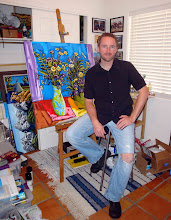
This week I am working on a painting that is slated to be a gift to the city of Oro Valley. Can't reveal much in the way of details…more to come later. I am also framing a group of works that will go to Cobalt Fine Arts for a small paintings show that I am in with my dear friend the artist Natasha Isenhour - called "Jewel Tones."
One thing that has been on my mind recently was a question put to me by a friend who is an aspiring writer…and that was the question about "selling out", i.e., having your art or what you do affected by selling. The question wasn't loaded, and it was well meant. But it did cut to the chase over the issue of the role of selling work and how that affect the creation of it.
I'll just come right out and say it, because the older I get the more honest I am - I LOVE selling work! I love it. The fact that people pay notable sums of money to collect my paintings is one of the most gratifying experiences in my life. It tells me many things - primarily that the modes of expression that I have tapped into are not just my own. And that when others see it something resonates inside of them, and they can then visualize the work in their homes or in some meaningful space. That is wonderful - and having galleries back you because you have a reputation of selling, also a great compliment.
As to whether selling works affects my work - I can also be honest and say YES it does cross my mind, the fact of wondering whether a work might sell or not. The way I see it, an accountant likes to get paid. A teacher likes to get paid. A doctor likes to get paid - why should an artist not like to make his or her modest sum? I think this is fine. It's totally normal. My wife once made the point that in the vast majority of cases when one of my works sells, she said it is obvious why. It is more detailed, more colorful, the contrasts are sharper - something is notable and raises the bar in those paintings, and as she said, those paintings are often the ones that sell.
However the caution that I work under is simple…I do not let the fact that certain works sell dominate the selection of new works. It's ok to do something that is your bread and butter kind of work - that's fine. But one must always keep an eye to the creation of new images. All the time. You have to remain an artist and the cash signs can't be the first things that decorate your goggles you see the world through. The creation of new images is important also because when you consider your work in retrospect, even those 'bread and butter' paintings that you know collectors want and buy - even they were original works dreamed up, composed, and painted out of nothingness. They too were new at some point, so you can't close down that regenerative process by which new works are made.
There is a sense that I have noticed - that an artist has to be so avant garde as to be a misunderstood pauper - and then they get some kind of stamp of legitimacy. I think that is a bunch of crap. I have seen artworks that don't communicate anything at all. That seems to me to be representative of a breakdown in the relationship with the viewer. And I am sure many such artists comfort themselves in the fact that they are doing something ahead of their time - so much so that nobody gets it. Again, I don't believe that. I have always said that an artist is free to go out on a limb if they want to; but that they can't turn around and blame everyone else if the crowd doesn't want to go out on the limb with them. And from my experience in the art world, sales are not terribly common out there on the limb. I stick a little closer to the tree…
Lastly I would say that it should not be unsaid that ART IS WORK. Maybe that's why they call it artwork. It is not gratuitous leisure. It is work. If anyone has the temptation to trivialize art, they probably have never wrestled with the difficulties of created a meaningful and complicated piece of work. After I have spent three or four weeks on a single painting I feel that it is a wonderful reward when the work finds a home and makes someone else's living or working space beautiful. I'm very happy that I can make a very modest living at it. No, visions of dollars signs shouldn't ever be allowed to dominate your process. But YES, selling is a great thing. It gives you the confidence to dream big - and in many ways, helps you be more creative, more fulfilled, and able to be full of faith that you can make something equally great to the things that have come before.
www.neilmyersart.com
Showing posts with label Painting. Show all posts
Showing posts with label Painting. Show all posts
Thursday, November 28, 2013

Sunday, February 10, 2013
Blinkers for an Artist
This week I am working on a new painting of Elephant Head Rock, a large formation in the Santa Rita Mountains just north of Tubac, AZ. Yesterday I was at Cobalt Fine Arts in Tubac, painting in gallery for the Tubac arts festival. A gloomy morning with snow on the ground gave way slowly to sunshine and a beautiful, cool day for the festival - which put smiles on the faces of most of the festival goers.
What I wanted to talk a bit about in this blog was something that has come up again and again in conversation with artists and collectors; and that's originality. Of course the seeking of originality is as old as the arts - and I do not pretend to cover new ground with it, rather only to share a bit more and maybe shed a little light.
For some time Bobby Lee Krajnik and I talked yesterday about originality in the arts, and she mentioned something that I found very interesting. She said that she had taken some workshops here and there, and heard some curious comments from instructors. One instructor who saw her work told her that he didn't want to change her style and work that style out of her. He felt that she had clearly arrived at something distinct, and he didn't want to change it by bending her too much to the instructor's will. Bobby Lee also relayed that another instructor had told her that frequently artists will take course after course and so many workshops that whatever instinct for personal style they had before gets diluted, and in the course of being affected by the styles of work demonstrated by the instructors - they never really find a personal style.
I shared with her what I have said to some other trusted people who were interested in how I devised the look of my own works; I told them that I do the reverse of taking courses and critiques and bouncing ideas off other artists. I put on blinkers and work like a monk. I try as hard as possible to shut out every other opinion of every other kind of art ever - and I try to answer the question: "How would I paint this scene?" Bobby Lee and I pretty much agreed that too much input from other artists allow them into your head, and at some point, if you don't clarify where your influences are coming from, you yourself are not painting - you and some other people are painting.
Of course, we all have our influences. When I look at other artist's work, I look primarily at Van Gogh and my friend Jean-Claude Quilici. I too glean something from those who came before me. I have found that other artists are wonderful in helping you learn the materiels needed to get certain effects, and with some of the kind of shop talk tips that are useful in the arts. But as regards to style, I still think that is a personal search - instruction can teach you a certain skill set. Style is a product of self reflection. It is not easy...
So my suggestion, if anyone might bother to ask - is that if you are one who likes to take courses, keep them in perspective in as much as they can increase your skill set and perhaps give you personal time with an excellent artist. But I would also suggest that you construct a kind of art that has a style that is built on your own self reflections - and visions that do not belong to anybody else.
So yes, spend some time shading and learning how to paint that eye, or head, or tree - but spend a little time dreaming. Spend some time, and a little paint and canvas, on that vision that is only yours. That thing only you can create - and only your neglect can supress.
www.neilmyersart.com
http://bobbyleekrajnik.blogspot.com/
What I wanted to talk a bit about in this blog was something that has come up again and again in conversation with artists and collectors; and that's originality. Of course the seeking of originality is as old as the arts - and I do not pretend to cover new ground with it, rather only to share a bit more and maybe shed a little light.
For some time Bobby Lee Krajnik and I talked yesterday about originality in the arts, and she mentioned something that I found very interesting. She said that she had taken some workshops here and there, and heard some curious comments from instructors. One instructor who saw her work told her that he didn't want to change her style and work that style out of her. He felt that she had clearly arrived at something distinct, and he didn't want to change it by bending her too much to the instructor's will. Bobby Lee also relayed that another instructor had told her that frequently artists will take course after course and so many workshops that whatever instinct for personal style they had before gets diluted, and in the course of being affected by the styles of work demonstrated by the instructors - they never really find a personal style.
I shared with her what I have said to some other trusted people who were interested in how I devised the look of my own works; I told them that I do the reverse of taking courses and critiques and bouncing ideas off other artists. I put on blinkers and work like a monk. I try as hard as possible to shut out every other opinion of every other kind of art ever - and I try to answer the question: "How would I paint this scene?" Bobby Lee and I pretty much agreed that too much input from other artists allow them into your head, and at some point, if you don't clarify where your influences are coming from, you yourself are not painting - you and some other people are painting.
Of course, we all have our influences. When I look at other artist's work, I look primarily at Van Gogh and my friend Jean-Claude Quilici. I too glean something from those who came before me. I have found that other artists are wonderful in helping you learn the materiels needed to get certain effects, and with some of the kind of shop talk tips that are useful in the arts. But as regards to style, I still think that is a personal search - instruction can teach you a certain skill set. Style is a product of self reflection. It is not easy...
So my suggestion, if anyone might bother to ask - is that if you are one who likes to take courses, keep them in perspective in as much as they can increase your skill set and perhaps give you personal time with an excellent artist. But I would also suggest that you construct a kind of art that has a style that is built on your own self reflections - and visions that do not belong to anybody else.
So yes, spend some time shading and learning how to paint that eye, or head, or tree - but spend a little time dreaming. Spend some time, and a little paint and canvas, on that vision that is only yours. That thing only you can create - and only your neglect can supress.
www.neilmyersart.com
http://bobbyleekrajnik.blogspot.com/
Wednesday, July 11, 2012
Saguaros - and NO I Don't Get Tired of Painting Them!
Hello everyone - sorry I've been a little absent. I tend not to blog like a madman. I prefer to write something when I actually have something to say, rather than all to the reams of drivel and blabber floating around out there on the internet.
This week I am working on a new 30 x 40 of Saguaros on a hillside of blooming brittle-brush. This painting, and a legion of others that are sitting and drying in the studio gave me the idea for this blog post - some thoughts about one of our great Arizona icons, the Saguaro cactus.
Since we are planning a saguaros show of my paintings at the Marshall-LeKAE Gallery in Scottsdale for March of 2013, I thought it might be nice to reflect a little on the giant cactus that has been so much the centerpiece of countless paintings by me - and other Arizona artists.
I remember once talking to Max Mikesell, who formerly ran the Max Gallery in Tucson some years back, and I remember Max saying that it seemed to him that some artists who paint saguaros hadn't even looked at them. Almost as if they had some general idea of what a saguaro should look like; two upturned arms, very "roadrunner and coyote" kind of landscape stereotype. And he mentioned that even though my saguaro themed works weren't strictly realistic, they still showed evidence that I had taken some time to look at them...and indeed I have.
What is most important if you are an artist painting Saguaros is the realization that they provide on of the most prominent verticals in a landscape dominated by big skies, small, round trees, and huge horizons. Saguaros cast your eyes up to the vertical, and thus balance a landscape much the way that a pine tree might well do back east in the woods. But the cool thing about saguaros is their amazing shapes and individual character. I've told people that they might well be one of the few plants that I think actually have personality. You see them swell with the summer rains. You see them hold up and hold firm when monsoon storms rip through the area. And you see them lord over the landscape like giants - standing tall and proud even in the hottest, most brutal parts of Arizona summer. I have called some among the series of saguaro paintings that I've done "Giants of the Desert", and it seems to me that they are indeed giants who stand over us in the fiery heat of our surroundings. When you come to know them and the fact that they grow so slowly that they are frequently 50 to 75 years old before they even sprout a single arm - you then realize that in mature saguaro forests, you may be looking at 150 or 200 year old plants. Plants whose duration dwarfs the lifetime of humans. I remember a biologist saying that was one of the problems of long term saguaro studies; that it is hard to study them in a sustained way because that might take three generations of scientists. Imagine...
(I'll note for the record also that people still get a laugh at me because I have the habit of saying "Sa-Guaros" with a hard "G". Whereas most of the locals say "sah-wa-ros". Oh well, I didn't grow up here, and some habits die hard.)
For me, I guess it's fair to say that I've set myself up and studied them as intently as Monet did Rouen Cathedral, or his poplars. I have never gotten tired of looking at them, and always been keen to understand the unique personality of the plants as I studied them.
I love the world in all it's landscapes and variety. But there will always be a soft spot in my heart for these wonderful "Giants of the Desert."
www.neilmyersart.com
This week I am working on a new 30 x 40 of Saguaros on a hillside of blooming brittle-brush. This painting, and a legion of others that are sitting and drying in the studio gave me the idea for this blog post - some thoughts about one of our great Arizona icons, the Saguaro cactus.
Since we are planning a saguaros show of my paintings at the Marshall-LeKAE Gallery in Scottsdale for March of 2013, I thought it might be nice to reflect a little on the giant cactus that has been so much the centerpiece of countless paintings by me - and other Arizona artists.
I remember once talking to Max Mikesell, who formerly ran the Max Gallery in Tucson some years back, and I remember Max saying that it seemed to him that some artists who paint saguaros hadn't even looked at them. Almost as if they had some general idea of what a saguaro should look like; two upturned arms, very "roadrunner and coyote" kind of landscape stereotype. And he mentioned that even though my saguaro themed works weren't strictly realistic, they still showed evidence that I had taken some time to look at them...and indeed I have.
What is most important if you are an artist painting Saguaros is the realization that they provide on of the most prominent verticals in a landscape dominated by big skies, small, round trees, and huge horizons. Saguaros cast your eyes up to the vertical, and thus balance a landscape much the way that a pine tree might well do back east in the woods. But the cool thing about saguaros is their amazing shapes and individual character. I've told people that they might well be one of the few plants that I think actually have personality. You see them swell with the summer rains. You see them hold up and hold firm when monsoon storms rip through the area. And you see them lord over the landscape like giants - standing tall and proud even in the hottest, most brutal parts of Arizona summer. I have called some among the series of saguaro paintings that I've done "Giants of the Desert", and it seems to me that they are indeed giants who stand over us in the fiery heat of our surroundings. When you come to know them and the fact that they grow so slowly that they are frequently 50 to 75 years old before they even sprout a single arm - you then realize that in mature saguaro forests, you may be looking at 150 or 200 year old plants. Plants whose duration dwarfs the lifetime of humans. I remember a biologist saying that was one of the problems of long term saguaro studies; that it is hard to study them in a sustained way because that might take three generations of scientists. Imagine...
(I'll note for the record also that people still get a laugh at me because I have the habit of saying "Sa-Guaros" with a hard "G". Whereas most of the locals say "sah-wa-ros". Oh well, I didn't grow up here, and some habits die hard.)
For me, I guess it's fair to say that I've set myself up and studied them as intently as Monet did Rouen Cathedral, or his poplars. I have never gotten tired of looking at them, and always been keen to understand the unique personality of the plants as I studied them.
I love the world in all it's landscapes and variety. But there will always be a soft spot in my heart for these wonderful "Giants of the Desert."
www.neilmyersart.com
Thursday, February 19, 2009
Pastel Dust, Manet's Blue Couch, and Isbell's Poetics
This week I am finishing a series of small 8 x 10 inch oil paintings depicting subjects in Santa Fe, New Mexico and various spots around southern Arizona. I am also working on a series of pastel studies - the first pastels I've done since I was a small kid. When I was maybe 8 or 10 years old my mom had me draw a bit in pastels and I even did a portrait of her, which I still have among my old collections of our drawings. I never forgot them, and decided just recently that, as an artist, I really needed the challenge of something new.
Another reason was that I bought a pastel of Venice, Italy from the Tucson artist Gabor Svagrik. This pastel was a gift for my wife for her 33rd birthday. I used to show work with Gabor at the Max Gallery, and my wife had frequently commented on his cityscape pastels - how they would remind her of her youth that she spent in her native Belgrade, Serbia. Though this piece by Gabor was a gift for my wife, I actually felt that it was a real benefit to me also - as I spent a long period of time looking at the subtlety of Gabor's handling of the pastel medium. The soft glow of the figures in the rain, brought out so well in the velvety haze of the pastel chalk. It made me remember toiling away for hours as a little boy, slashing colors and shapes in pastel onto the paper. It also made me remember the original thought that I'd had - that an artist strengthens his or her legitimacy by working in multiple mediums.
Of course, this does present it's own set of artistic challenges for me. A lot of my work is about the effect of the thick oil paints and bright colors; and neither can be reproduced exactly in pastel. Pastel does not posses the pure force and shine of oil colors, and if you lay pastel on the paper too thickly you are not doing yourself any great justice. In fact, as a medium, it seems to me to be much more about subtlety than force. Artists like Gabor, as well as masters from the past such as Monet, Manet and Degas all used pastel to enhance the warm glow of emotional effects. I, on the other hand, have to decide a crucial question, ie, "What does a Neil Myers pastel look like?"
As I've been doing these small studies over the past week, I was reminded of the greatest pastel that I'd ever seen - a phenomenal piece by Manet called "Madame Manet on a Blue Couch". When I saw the piece in 1996 in Paris, I was stunned. It was such a unique work because it was a portrait but not a portrait - in a peculiar sense. When I was looking at it, what struck me powerfully was Manet's soft portrayal of the couch itself, surrounding the central figure and almost becoming the object of the piece more than the figure. It felt like a couch that one could just collapse into. Inviting and soft, asking for repose.
When I began to think about artists changing mediums, I also remembered the late watercolors by Cezanne. These works, in my view, were utterly different than his oil paintings. What was so unusual about them was mostly that the paper was often nearly all white, and Cezanne only seemed to work to evolve certain details in the work. I have not studied his intentions behind the work sufficiently to resolve whether or not he considered most of his late watercolors finished or not. To me they look unfinished - but I do realize that he must have been bringing out what seemed to him to be essential elements; the arm of a tree, the spine of the Mont Sainte Victoire - and the images emerged as though through the white fog of the paper.
I think I will have to resolve, in the coming days, the debate over whether or not a Neil Myers pastel or watercolor will represent a break from his oil painting style. We shall see. I've always worked with a little bit of free experimentation spirit in the back of my mind, and frequently I too am along for the ride in seeing where these imagistic explorations go.
Stay tuned to http://www.neilmyersart.com/ and I'll post the first of the pastels on "the painter's closet" page as soon as they are ready.
Also, for those of you who love great music, I'd like to shamelessly plug a new self titled CD by Jason Isbell and the 400 Unit. I just downloaded it last night from itunes, and found myself sitting at my desk with my guitar, figuring out the song "Cigarettes and Wine", a beautiful tune that harkens back to other slow blues-rock songs of the past. The CD has already received praise from Rolling Stone and Spin magazine. For those of you who don't know him, the leader of the band Jason Isbell is a former guitarist/ singer / songwriter for the Drive-by Truckers - and he was responsible for penning some of DBT's most memorable songs like "The Day John Henry Died" and "Goddamn Lonely Love." I've met Jason twice when he and the 400 unit played shows in Tucson. The second time we met up he and I spent a cold half hour standing behind Club Congress in Tucson, talking about music and life. Jason's a really cool guy, a person who is very real and very level. He's a master songsmith, a real Southern-American poet. His band are a talented bunch of guys as well - the guitarist of the band Browan Lollar is an artist on the side, and he designed the graphics and images for the new 400 Unit CD. You can check Jason and the band out at http://www.jasonisbell.com/ , where you'll find all relevant info and links to their myspace where you can sample the music. I urge everyone to support great indie artists such as Jason and his band. And don't miss a chance to catch them live if they swing by your area.
Now I have go get busy getting my fingers covered in pastel dust!
http://www.neilmyersart.com/
Another reason was that I bought a pastel of Venice, Italy from the Tucson artist Gabor Svagrik. This pastel was a gift for my wife for her 33rd birthday. I used to show work with Gabor at the Max Gallery, and my wife had frequently commented on his cityscape pastels - how they would remind her of her youth that she spent in her native Belgrade, Serbia. Though this piece by Gabor was a gift for my wife, I actually felt that it was a real benefit to me also - as I spent a long period of time looking at the subtlety of Gabor's handling of the pastel medium. The soft glow of the figures in the rain, brought out so well in the velvety haze of the pastel chalk. It made me remember toiling away for hours as a little boy, slashing colors and shapes in pastel onto the paper. It also made me remember the original thought that I'd had - that an artist strengthens his or her legitimacy by working in multiple mediums.
Of course, this does present it's own set of artistic challenges for me. A lot of my work is about the effect of the thick oil paints and bright colors; and neither can be reproduced exactly in pastel. Pastel does not posses the pure force and shine of oil colors, and if you lay pastel on the paper too thickly you are not doing yourself any great justice. In fact, as a medium, it seems to me to be much more about subtlety than force. Artists like Gabor, as well as masters from the past such as Monet, Manet and Degas all used pastel to enhance the warm glow of emotional effects. I, on the other hand, have to decide a crucial question, ie, "What does a Neil Myers pastel look like?"
As I've been doing these small studies over the past week, I was reminded of the greatest pastel that I'd ever seen - a phenomenal piece by Manet called "Madame Manet on a Blue Couch". When I saw the piece in 1996 in Paris, I was stunned. It was such a unique work because it was a portrait but not a portrait - in a peculiar sense. When I was looking at it, what struck me powerfully was Manet's soft portrayal of the couch itself, surrounding the central figure and almost becoming the object of the piece more than the figure. It felt like a couch that one could just collapse into. Inviting and soft, asking for repose.
When I began to think about artists changing mediums, I also remembered the late watercolors by Cezanne. These works, in my view, were utterly different than his oil paintings. What was so unusual about them was mostly that the paper was often nearly all white, and Cezanne only seemed to work to evolve certain details in the work. I have not studied his intentions behind the work sufficiently to resolve whether or not he considered most of his late watercolors finished or not. To me they look unfinished - but I do realize that he must have been bringing out what seemed to him to be essential elements; the arm of a tree, the spine of the Mont Sainte Victoire - and the images emerged as though through the white fog of the paper.
I think I will have to resolve, in the coming days, the debate over whether or not a Neil Myers pastel or watercolor will represent a break from his oil painting style. We shall see. I've always worked with a little bit of free experimentation spirit in the back of my mind, and frequently I too am along for the ride in seeing where these imagistic explorations go.
Stay tuned to http://www.neilmyersart.com/ and I'll post the first of the pastels on "the painter's closet" page as soon as they are ready.
Also, for those of you who love great music, I'd like to shamelessly plug a new self titled CD by Jason Isbell and the 400 Unit. I just downloaded it last night from itunes, and found myself sitting at my desk with my guitar, figuring out the song "Cigarettes and Wine", a beautiful tune that harkens back to other slow blues-rock songs of the past. The CD has already received praise from Rolling Stone and Spin magazine. For those of you who don't know him, the leader of the band Jason Isbell is a former guitarist/ singer / songwriter for the Drive-by Truckers - and he was responsible for penning some of DBT's most memorable songs like "The Day John Henry Died" and "Goddamn Lonely Love." I've met Jason twice when he and the 400 unit played shows in Tucson. The second time we met up he and I spent a cold half hour standing behind Club Congress in Tucson, talking about music and life. Jason's a really cool guy, a person who is very real and very level. He's a master songsmith, a real Southern-American poet. His band are a talented bunch of guys as well - the guitarist of the band Browan Lollar is an artist on the side, and he designed the graphics and images for the new 400 Unit CD. You can check Jason and the band out at http://www.jasonisbell.com/ , where you'll find all relevant info and links to their myspace where you can sample the music. I urge everyone to support great indie artists such as Jason and his band. And don't miss a chance to catch them live if they swing by your area.
Now I have go get busy getting my fingers covered in pastel dust!
http://www.neilmyersart.com/
Friday, November 14, 2008
"Support the Arts, Buy a Painting"

This week I am working on a variety of small paintings, 8 x 10s and one 5 x 7 inch landscape. I have been telling friends that every vision for a painting that I've had in my head recently has been huge - and that I had set myself the contrary challenge of trying to do high quality small works, with all the feel of my large ones.
This week I have found myself thinking a great deal about something Jon Linton, the publisher of "Artbook of the New West" has frequently said; "Support the Arts, Buy a Painting." Jon would sign off his publisher's column in the magazine with that phrase - and perhaps it has been token phrase before the current economic crisis in America, but now it is becoming a question of survival for American artists.
Frequently I am hearing the alarm bells from all corners. Galleries struggling to make rent, buyers very hesitant. When purchases are made clients are going for small works or small handcrafted items. And it seems that the current situation in America is not just news, it is real and true economic reality, with many fine arts galleries feeling the pinch, many artists feeling the flattening sales climate, and I have been reading that even high end auctions houses such as Sothebys have been seeing works by historic masters go unsold, or be sold for much less than previously expected.
I know in the past when thanking collectors for their purchases I have said "art is not bread", in the sense that I know how fortunate a situation it is to have the luxury of enjoying fine paintings. In a situation like we now find ourselves in, most normal people will resign themselves to thinking about the basics, food, gas, insurance - the essentials. And something like art is sometimes seen as an optional commodity.
But as I have continued reading about the U.S. government's efforts to bail out our struggling banks and industries, I found myself remembering a visit to San Francisco in 2006. While my wife and I were there, we visited the historic Coit tower, and saw the amazing murals created by artists employed by the WPA. Beautiful murals, painted in the spirit and style of Diego Rivera, but exhibiting themes of America and California. And I know that when I thought about these murals later, and learned that the WPA had employed lots of artists on projects around the country, I was nearly reduced to tears. I told my wife "in the worst of times, the WPA did not forget the nation's artists." I wonder today if any national recovery programs will include the country's artists. I'm not sure that the public and political attention span would even take the time to remember the great works of the WPA artists. Or does today's generation even know?
But now, as I have some tinge of fear for what may become of American arts during the economic troubles - I think perhaps I was wrong...art IS bread. It is possible that it is a luxury that we give little thought to when times are good. We partake, buy a painting or a sculpture, sometimes without fully realizing the contribution of artists to the culture and richness of the human experience. Yes, art IS essential. It is perhaps most essential at the times when it is in danger of being marginalized. When we are all worried about the state of things, art is also a great consolation on the story of the human experience, the love of nature, and the wonders of being alive in the world.
So I will end with the phrase I've borrowed from Jon Linton: "Support the arts, buy a painting."
Buy the bread. Buy the groceries. Put the gas in the car and pay the power bill. Take care of the family and do what you have to do. But if you are ok, and if you are able, NEVER forget that blank wall in your home that cries out for a great vision.
My sincere thanks to all my friends and collectors for their support!
Friday, February 1, 2008
Tubac Arts Festival
This week I am working on two Sedona paintings. One is a dried tree with the red mountains of Sedona behind - the other is a series of three red-rock spires towering above a valley of pine trees. I've always enjoyed the color challenges brought out by painting landscapes of Sedona. You get every range of red to orange on your palette, and the colors are sometimes very hard to make. But if the paintings are forcibly executed and the harmonic qualities of the reds and ochres are achieved - then interesting images emerge.
At the moment I'm getting prepared for the Tubac Arts Festival, which runs from Feb. 6 - Feb. 10th in Tubac, AZ. Tubac is a lovely small town full of art galleries and a great history in our local art scene. It is situated just under an hour's driving south of Tucson, just above the Mexican border town of Nogales. I will be doing a demonstration tomorrow at Cobalt Fine Arts from 1-3pm. If you happen to be in Tubac tomorrow, drop by and say hello! There will also be an opening on the evening of Feb. 8th for myself, Fred Collins, and Natasha Isenhour.
I'm very happy that 4 of my paintings have sold before the opening has even happened - so I send my sincerest thanks to those collectors who've purchased my work.
And to give you all a bit of a scoop on one of my next projects, and I'm planning to do a painting of the Giant Sequoias of California. We had the pleasure of briefly visiting the Mariposa grove of Sequoias at Yosimite National Park in 2006. We walked down a path for a good distance to get to them, and as we did it had begun to rain. By the time we got there it was pouring rain, we were all soaking wet and the few photographs that we have from our time in the Sequoia grove have haunted me, and now my wife and I are trying to think of a way to sneak in another trip to the region to see Sequoia National Park. I see at least one painting - maybe more, of these great trees waiting to be done. And it occured to me that I'd seen photographers taking artful shots of the Sequoias, but I have never seen a painting of one. I have visions in my head of the giant bases of these trees rendered in thick paint, with their reddish-sienna colors shining through.
Thinking about the Sequoias, Redwoods, and the old growth forests of the west, one can easily see why such amazing forests MUST be preserved. I well remember those few minutes we spent in the pouring rain at the bases of these giant trees -and the feeling that I had, as if spending time among nature's gods. Everyone should feel this, and everyone should be concerned at the sound of chainsaws in our old growth forests.
http://www.neilmyers.homestead.com/
At the moment I'm getting prepared for the Tubac Arts Festival, which runs from Feb. 6 - Feb. 10th in Tubac, AZ. Tubac is a lovely small town full of art galleries and a great history in our local art scene. It is situated just under an hour's driving south of Tucson, just above the Mexican border town of Nogales. I will be doing a demonstration tomorrow at Cobalt Fine Arts from 1-3pm. If you happen to be in Tubac tomorrow, drop by and say hello! There will also be an opening on the evening of Feb. 8th for myself, Fred Collins, and Natasha Isenhour.
I'm very happy that 4 of my paintings have sold before the opening has even happened - so I send my sincerest thanks to those collectors who've purchased my work.
And to give you all a bit of a scoop on one of my next projects, and I'm planning to do a painting of the Giant Sequoias of California. We had the pleasure of briefly visiting the Mariposa grove of Sequoias at Yosimite National Park in 2006. We walked down a path for a good distance to get to them, and as we did it had begun to rain. By the time we got there it was pouring rain, we were all soaking wet and the few photographs that we have from our time in the Sequoia grove have haunted me, and now my wife and I are trying to think of a way to sneak in another trip to the region to see Sequoia National Park. I see at least one painting - maybe more, of these great trees waiting to be done. And it occured to me that I'd seen photographers taking artful shots of the Sequoias, but I have never seen a painting of one. I have visions in my head of the giant bases of these trees rendered in thick paint, with their reddish-sienna colors shining through.
Thinking about the Sequoias, Redwoods, and the old growth forests of the west, one can easily see why such amazing forests MUST be preserved. I well remember those few minutes we spent in the pouring rain at the bases of these giant trees -and the feeling that I had, as if spending time among nature's gods. Everyone should feel this, and everyone should be concerned at the sound of chainsaws in our old growth forests.
http://www.neilmyers.homestead.com/
Wednesday, January 16, 2008
Tubac Arts Festival & Jean-Claude Quilici

This week I am in the process of finishing a large 30 x 40 inch canvas of Taos Pueblo. This appealing symphony of ochre colors always serves as a reminder of what a challenge it is to paint a Pueblo structure and do it well. Many artists like to depict single Pueblo structures or homes of that style - I attempt, much like my mentor Jean-Claude Quilici, to capture the largesse of Taos and Acoma, and to pay proper homage to their beauty and uniqueness.
At this point in the exhibit season, many of us Southern Arizona artists turn our attention to the Tubac Arts festival. This year's festival runs February 6-10, and it features countless interesting attractions and artistic displays in historic Tubac, AZ. I will have paintings on display at Cobalt Fine Arts Gallery at 5 Camino Otero, so I encourage everyone to stop by. On display at Cobalt Fine Arts are some of the last remaining unsold pieces from a large group exhibited this past November - notably "Arizona The Beautiful" and "Saguaros Under a Monsoon Sky."
This week I had an interesting discussion with a musician friend of mine, and we were thinking about the issue of originality. I believe now, more than ever, true originality is urgently necessary for any kind of real creative success. With more than 6 billion people on planet earth , it is getting harder and harder to arrive at an idea that is truly new and invigorating - especially in the art world. Yet there are many cases in art history where painters actually drifted together, because they found they came to similar styles while working separately. Braque and Picasso realized that their own experiments in painting were leading them to analytical cubism - so they decided to collaborate. Monet and Renoir often placed their easels side by side in front of the subject, and came out with canvases that were in a similar spirit, but subtly different. The post-impressionists like Van Gogh and Gauguin and Toulouse-Lautrec drifted together as a sort of natural extension in deciding where to pick up from the impressionists. But I have never been a part of any group of artists, and in some sense I am happy for that. Working alone I feel I have managed to create something distinct - paintings that are not to be confused with any other Southern Arizona artist. And I have always been hyper-aware of how often I've walked in galleries in the west and seen a blur of indistinguishable paintings. It was sometimes as if the signatures on the paintings could have been inter-changed and nobody would notice.
That does not mean I have not had my own inspirations and my own master. From the very early days, around 1992 when I did my first oil paintings, I was always attracted to bright colored paint and the thick application of it. This occurred with no prompting, just a confirmation of instincts. And in about 1994 I had the pleasure of learning about contemporary French artist Jean-Claude Quilici. Quilici happened to be the cousin of one of my great friends, the French professor Dr. Augustin Quilici, from Lenoir-Rhyne College. Dr Quilici showed me Jean-Claude's work, and I was enthralled. This was it! This was the place to start.
Jean-Claude Quilici has garnered many accomplishments in his years of painting - for me, he offered regular friendship and encouragement, copies of books and of his works, as well as posters with full color reproductions. He was wise enough to offer encouragement and advice, but we never studied together and he never directed me to do this or that with my work. He did what a great artist should do, offer himself as an example if needed - but leave the student to find his or her own direction. I think Jean-Claude also knew that the discoveries that really matter are those we make alone in the studio, or in front of the subject - not something rambled over in a loud, raucous discussion of artists.
To this day, I can honestly admit that few things make me happier than seeing examples of Jean-Claude's work that I have not seen before. We've met twice, and we still keep in touch by mail. His work continues to soar in excellence and vibrancy - and I openly consider him my "maitre" and friend.
I do encourage everyone to make themselves familiar with the work of Jean-Claude Quilici, and by doing so, those of you with an interest in my work will see the seeds of inspiration that have given rise to my very own paintings.
Visit Neil's official paintings website at www.neilmyers.homestead.com
Subscribe to:
Posts (Atom)