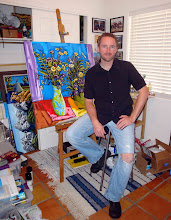
This week I am working on two new Saguaro paintings intended for a show in March of next year. Some of you guys may know that I have to work on paintings far in advance of their delivery date due to the fact that the paint is so thick that it needs extended time to dry. Good thing I have the super-dry Arizona air to help me there...
Recently I exchanged paintings with a wonderful California painter named Ken Christensen. Ken is a member of the "New Fauves" painters group; a group of contemporary artists working roughly in the Fauvist manner. ( you can visit Ken's website at http://kenchristensen.net/pages/art?section_id=2 ) When I saw the beautiful painting that Ken sent me, I found myself thinking about how much and how little detail is necessary in a painting. I found myself thinking this because Ken struck such a perfect balance of essentials - without feeling compelled to paint the hair on a fly's neck from a mile away.
This is what I refer to as the "tension" of details. It's a little like tuning a guitar or violin - the strings reach a point where they are of the right tension and the sound of an instrument in tune comes pleasantly to your ears. Ken's paintings do this very, very well. He may be one of the best I've seen yet. Though I am still a devoted admirer of my mentor Jean-Claude Quilici, who also strikes a beautiful balance of detail and non-detail in his work. Awhile back Ken mentioned to me via email that when he lived in France one of his favorite painters was Jean-Claude Quilici - a fact that put a smile on my face and perhaps told me that Ken too had taken a lesson in Quilici's own ideas about how much detail was essential for painting.
Much of this, I am sure, boils down to temperament. I am a painter who delights in essentials. Broad swaths of color, thick paint, etc. I get uncomfortable with smaller and smaller details - though the sensible side of me knows that details are essential. I would be most happy putting on paint with a trowel if I could - but I know that small touches can enhance the bigger ones. So I usually press on all the while trying to balance the little with the big. Though I see the big more prominently. I still marvel at painters who can do a painting in a day. Commonly I will work a week on a painting. I remember one December a few years ago, I worked on one painting all month. People tell me this is a long time - but I think about Michelangelo lying on his back working on the Sistine Ceiling for 4 years and it seems like nothing at all.
Too little detail in a painting can be irritating and unsatisfying, at least to my mind. Case in point, the longer I've lived the less I actually liked the great Fauvist master Matisse. A few years ago my wife and I saw a show of works at the Phoenix Museum of Art and there were several Matisse paintings featured; honestly, some of them looked like bad preliminary sketches. Like he had simply blobbed on some shapes with a turpentine wash coat and to my surprise - signed them! My wife even shaking her head. Mind you, that is not to say that Matisse's entire body of work is bad or irrelevant - not at all. But that those we saw were very low quality, and not reflective of some of the better Matisse paintings I've seen in the past. I've always believed that those artists we commonly consider "Masters" can't simply be considered so because their name is in the corner of the paintings. You must earn it every time. Every time. A true master, if he were a baseball player, for example, would step up to the plate and try to hit the ball over the fence every time. He would try to put it out of the stadium if he could. At no point should you step up to the artistic plate and think that you can maintain things if you only hit a double.
On the too much detail thing, I don't really feel the need to call anyone to account. Realists, if they are good at what they do, have already proven that they can paint and have excellent powers of observation. One that comes to mind who is a great talent is the artist Mario Robinson (http://marioarobinson.com/ What Mario can do with only his pencil - such portraits that will leave you breathless and amazed. Mario's work is more than realism because his portraits evoke a mood and sensibility which is hard to describe - but which is plainly evident when you see them. It is realism, yes, but MORE than realism, and that's a great feeling to evoke. Another "more than realist" painter who is well known but whose work I only just saw in person recently at the Scottsdale Salon, is Joseph Todorovitch. His painting "Receive" was breathtaking. Joseph is no secret in the art world, but it was the first that I had seen of one of his original oils with my own eyes, and it left a deep impression on me, even after viewing nearly 200 works at the Scottsdale Salon. Most realists who are good at what they do have proven that they can paint - though realism is not the temperament I seek in my own work, and I openly reject realists who think that those working in other forms of painting are not as skillful as they are. One can point out, in fairness, that there are realist artists who don't paint every hair and grain of wood - but who work in realism generally. They too have extended the frame of realism as it is sometimes considered.
The crux of this "tension of details" discussion is really this - that an artist must find the working style that aligns best with their temperament. Perhaps what is most enjoyable is seeing the variety of temperaments at work when you see the myriad of different ways that emotion is put down on canvas or paper. It's like looking for poetry. Too many words and it's prose - too few words and it's not poetry. That is the "tension". That's the beauty.
www.neilmyersart.com
Showing posts with label Realism. Show all posts
Showing posts with label Realism. Show all posts
Saturday, April 28, 2012

Wednesday, June 30, 2010
Expressionism vs. Realism
"The man who deals with originality is desperately needed, but seldom wanted. For along with his promise of victory he lets loose the shadows of chaos."
David Hare writing about Jackson Pollock
This week I have just returned from beautiful Bryce Canyon, Utah - and I am working on several new paintings including a new Pueblo and a New Mexico landscape derived from a photo taken near the Guadeloupe Mountains.
I have recently heard an open discussion, sometimes friendly and sometimes not - coming from artists who are vociferous in their defense of realism. Some are saying that what is needed is a new movement that has been tagged as "Novo Realism". Several things, I think, are going on here and are worthy of talking about further.
I think that what bugs many realists is the possibility that artists who work in either expressionistic or abstract styles are not well trained. Realists are mostly classically trained, they paint from life, they go out into the field and do plein air studies, etc. They are the ones that are toiling away on reproductions of plaster casts, and going to great trouble to hone their skills so that what emerges on canvas is a fair representation of the real world. Realists know what they have done to train themselves, and they feel that art is being sold short when somebody either abides too loosely to reality, or when they don't abide by it at all. There is a reason why Jackson Pollock, as an abstract expressionist, was on the receiving end of a ton of scorn when he pioneered his "all over" poured paintings. The same process goes on today when realists look at the world of art. You could think of this situation metaphorically by saying that realists are like classical musicians, trained in violin, piano etc. Such musicians may look at a Rock and Roll guitarist and think "How can he fill an arena with screaming fans with just a few barre chords?" Mr Rock and Roll taught himself, and people are going nuts over him. As a guitar player, I sympathize with this thought, when I think about guitarists like Toni Iommi of Black Sabbath, who wrote some of the greatest rock / metal songs with very simple progressions. Complexity does sometimes represent talent, but not always. Sometimes the forms in which one operates are so laden with previously held assumptions that there is little room for the artist themselves to get out. That is why I am an expressionist, and why it suits my temperament much more than realism.
Also, we should be a bit more honest about realism. What do people mean when they are painting realistically? In the most basic sense, they mean to say that they are painting something that is a fair representation of the way the thing they are depicting really looks. But when we see a beautiful woman stretched onto a sofa, with soft light coming thru the window and forms rendered like Sargent or Whistler may have done - I don't exactly subscribe to that being real in the purest sense. We look at the woman on the sofa, we know it's a woman on the sofa - fine. But while one might want to paint those wistful and comforting realism scenes, nobody is making much of an effort to paint an unemployment line. Nobody decides to do a portrait of a devastated family who has just lost their health insurance. Few people, some have done so - but few people have the courage to paint subjects from the wars in Afghanistan and Iraq. I don't see plein air artists lining up to paint large gobs of oil washing up on the shores of Florida, Alabama, and Louisiana. And I sure don't see galleries or collectors wanting to show and buy these things. So what is depicted, and what is most approved of for the viewer, is a style of work that is real in look, but rarely ever real in any situational sense. This is no crime, by the way. But I interpret realism in a pretty unrelenting sense. However, I assert that art is a free engagement process. If a collector wants to buy realistic works, and the artist wants to produce them - I hope all involved go away happy. But realism is only one kind of tree in the forest. There are others, and all make the colors and shades we adore.
Another way to think of a discussion of Expressionism and Realism is something like a filter. A realist uses a dense, heavy filter - for the look of the subject anyway - and the individual touch of the artist is usually minimized in realism. An Expressionist, like myself, prefers a filter that lets only some of the subject through, and the rest is a product of gesture, light, color, and the temperament of the artist. A Realist would say that much of that applies to them as well - but an Expressionist departs sharply from this mold by not worrying too much if the rock in the landscape doesn't look like any rock that one has seen before. The rock, for an Expressionist, is a product of gesture and feeling.
I would share with realists the fact that I too respect training in art - whether that be self training or proper studio or school training. However I don't insist on this as an absolute necessity. The ancient cave paintings as Lascaux, which I adore very much, were painted by people who carried with them nothing more than the wish to express something meaningful about the world around them. And of course there is a long line from those primitive people to the Michelangelos and Raphaels of the world. But all were operating on the same instinct to make art meaningful. I find no battle between them. Neither should there be any battles between realists and expressionists. Like the trees of the forests I had mentioned - you don't hear the Oaks telling the Bristlecones to go straighten their branches if they really want to be a tree. You don't hear the Cedars ask the Paloverdes why on earth their bark is green...all forms independent and meaningful are appreciated. All are trees, no matter what the difference of forms. And bear in mind I do not argue for artistic relativism. The ability to say "that's a bad painting" is crucial if we are ever going to know what a good one is. That why I draw the line at "meaningful" forms, and expressions of art that have communicative ability. That's also why I have struggled endlessly with artists such as Barnett Newman - because despite my clear expressionist sympathies, I smell a cop-out when I see a single stripe down a huge canvas - and I resent the implication that I'm not cultivated enough to get the meaning. I'm not even sure Newman knew what he meant, or even meant to express.
So, as mentioned, I see no conflict here - other than the one we stir up unnecessarily. But if I were to offer one thought, one little tinge of competitive spirit between Expressionists and Realists, this is what I would say; if one were to hold a major exhibit of Vincent Van Gogh, arguably the greatest expressionist and pioneer of the style - if one held a retrospective of Van Gogh's greatest works, I would suggest that it is very likely that Van Gogh would bring in more interest, more media coverage, and more attendance than any realist painter, living or dead. He at least proved the value of deeply held emotion, expression and love of color on canvas. And the crowds that follow his works prove his impact.
As an Expressionist, Van Gogh stands tall - with contemporary artists like Jean-Claude Quilici, to show the power, popularity, and creative energy of art when the painter departs from the path of realism, and plows into the wild forest beyond.
www.neilmyersart.com
David Hare writing about Jackson Pollock
This week I have just returned from beautiful Bryce Canyon, Utah - and I am working on several new paintings including a new Pueblo and a New Mexico landscape derived from a photo taken near the Guadeloupe Mountains.
I have recently heard an open discussion, sometimes friendly and sometimes not - coming from artists who are vociferous in their defense of realism. Some are saying that what is needed is a new movement that has been tagged as "Novo Realism". Several things, I think, are going on here and are worthy of talking about further.
I think that what bugs many realists is the possibility that artists who work in either expressionistic or abstract styles are not well trained. Realists are mostly classically trained, they paint from life, they go out into the field and do plein air studies, etc. They are the ones that are toiling away on reproductions of plaster casts, and going to great trouble to hone their skills so that what emerges on canvas is a fair representation of the real world. Realists know what they have done to train themselves, and they feel that art is being sold short when somebody either abides too loosely to reality, or when they don't abide by it at all. There is a reason why Jackson Pollock, as an abstract expressionist, was on the receiving end of a ton of scorn when he pioneered his "all over" poured paintings. The same process goes on today when realists look at the world of art. You could think of this situation metaphorically by saying that realists are like classical musicians, trained in violin, piano etc. Such musicians may look at a Rock and Roll guitarist and think "How can he fill an arena with screaming fans with just a few barre chords?" Mr Rock and Roll taught himself, and people are going nuts over him. As a guitar player, I sympathize with this thought, when I think about guitarists like Toni Iommi of Black Sabbath, who wrote some of the greatest rock / metal songs with very simple progressions. Complexity does sometimes represent talent, but not always. Sometimes the forms in which one operates are so laden with previously held assumptions that there is little room for the artist themselves to get out. That is why I am an expressionist, and why it suits my temperament much more than realism.
Also, we should be a bit more honest about realism. What do people mean when they are painting realistically? In the most basic sense, they mean to say that they are painting something that is a fair representation of the way the thing they are depicting really looks. But when we see a beautiful woman stretched onto a sofa, with soft light coming thru the window and forms rendered like Sargent or Whistler may have done - I don't exactly subscribe to that being real in the purest sense. We look at the woman on the sofa, we know it's a woman on the sofa - fine. But while one might want to paint those wistful and comforting realism scenes, nobody is making much of an effort to paint an unemployment line. Nobody decides to do a portrait of a devastated family who has just lost their health insurance. Few people, some have done so - but few people have the courage to paint subjects from the wars in Afghanistan and Iraq. I don't see plein air artists lining up to paint large gobs of oil washing up on the shores of Florida, Alabama, and Louisiana. And I sure don't see galleries or collectors wanting to show and buy these things. So what is depicted, and what is most approved of for the viewer, is a style of work that is real in look, but rarely ever real in any situational sense. This is no crime, by the way. But I interpret realism in a pretty unrelenting sense. However, I assert that art is a free engagement process. If a collector wants to buy realistic works, and the artist wants to produce them - I hope all involved go away happy. But realism is only one kind of tree in the forest. There are others, and all make the colors and shades we adore.
Another way to think of a discussion of Expressionism and Realism is something like a filter. A realist uses a dense, heavy filter - for the look of the subject anyway - and the individual touch of the artist is usually minimized in realism. An Expressionist, like myself, prefers a filter that lets only some of the subject through, and the rest is a product of gesture, light, color, and the temperament of the artist. A Realist would say that much of that applies to them as well - but an Expressionist departs sharply from this mold by not worrying too much if the rock in the landscape doesn't look like any rock that one has seen before. The rock, for an Expressionist, is a product of gesture and feeling.
I would share with realists the fact that I too respect training in art - whether that be self training or proper studio or school training. However I don't insist on this as an absolute necessity. The ancient cave paintings as Lascaux, which I adore very much, were painted by people who carried with them nothing more than the wish to express something meaningful about the world around them. And of course there is a long line from those primitive people to the Michelangelos and Raphaels of the world. But all were operating on the same instinct to make art meaningful. I find no battle between them. Neither should there be any battles between realists and expressionists. Like the trees of the forests I had mentioned - you don't hear the Oaks telling the Bristlecones to go straighten their branches if they really want to be a tree. You don't hear the Cedars ask the Paloverdes why on earth their bark is green...all forms independent and meaningful are appreciated. All are trees, no matter what the difference of forms. And bear in mind I do not argue for artistic relativism. The ability to say "that's a bad painting" is crucial if we are ever going to know what a good one is. That why I draw the line at "meaningful" forms, and expressions of art that have communicative ability. That's also why I have struggled endlessly with artists such as Barnett Newman - because despite my clear expressionist sympathies, I smell a cop-out when I see a single stripe down a huge canvas - and I resent the implication that I'm not cultivated enough to get the meaning. I'm not even sure Newman knew what he meant, or even meant to express.
So, as mentioned, I see no conflict here - other than the one we stir up unnecessarily. But if I were to offer one thought, one little tinge of competitive spirit between Expressionists and Realists, this is what I would say; if one were to hold a major exhibit of Vincent Van Gogh, arguably the greatest expressionist and pioneer of the style - if one held a retrospective of Van Gogh's greatest works, I would suggest that it is very likely that Van Gogh would bring in more interest, more media coverage, and more attendance than any realist painter, living or dead. He at least proved the value of deeply held emotion, expression and love of color on canvas. And the crowds that follow his works prove his impact.
As an Expressionist, Van Gogh stands tall - with contemporary artists like Jean-Claude Quilici, to show the power, popularity, and creative energy of art when the painter departs from the path of realism, and plows into the wild forest beyond.
www.neilmyersart.com
Subscribe to:
Posts (Atom)