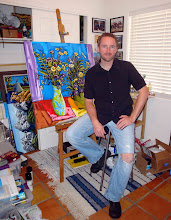
Welcome to creativity blog #3, this one featuring California based painter Ken Christensen. I have always been a great fan of Ken's work, and I even have one of his paintings hanging on the wall of our family room - alongside the best works of my artist friends. Ken has an extensive body of work and throughout his paintings I have always felt that he was one of the best at striking a near perfect 'tension of details', as I like to call it. By that I mean he adds just enough detail to preserve the visual scene, but his works still show traces of the joyful spontenaiety of a sketch. Ken was integral in the creation of the "New Fauves" group of artists - which I might add is the only group of artists that I have formally affilliated myself with in my entire art career. This is a group of painters who all feel their roots in Fauvism and Expressionism - who sense, as I do, the great debt that we owe to artists like Van Gogh and the Fauvist painters that followed him. I was also delighted to find that Ken knew of and appreciated the work of my mentor and friend, the artist Jean-Claude Quilici.
Here is the Q and A with Ken, enjoy!
Ken Christensen
Artist - Writer
http://www.kenchristensen.net/pages
1) What personal habits do you have that you feel make you more creative?
One of the things that keeps me creative is going for long walks.
Everything you need to know is in nature. Nature reveals its secrets
slowly so you have to be patient. You can pass by the same scene many
times but at one special moment a new vision of the same thing can be
revealed. It's impossible to find a subject to paint by driving around
in a car. I have to see things on foot, one step at a time. And in art
light is always the real subject. So at every time of day, when the
light is different there is always a different subject. There can be
nothing at one time of day to paint and at another time when the sun is
in a different position something remarkable may reveal itself.
We are always standing on the shoulder of
giants and most good ideas spring out of something earlier by someone
else.
Another habit that feeds my creativity is sketching. Sketching
is art in its purest form. When I sketch I'm not thinking of sales or
finished work; I'm just having fun. When you're having fun, good things
happen. When I sketch I am being more personal in what I choose to
portray. It is the personal in art that really sets
the greats apart. One must have a unique vision and art succeeds as
much as you are being yourself. Sketching whatever catches your eye
allows this personal vision to flourish.
2) Who are the creative artists, in any field, that inspire you the most?
I'm a huge Neil Young
fan. In literature Henry Miller has had a huge influence on me. In art,
Van Gogh has been my hero since childhood, not only for his art but for
his life and convictions. His letters are one of the great works of
world literature and very inspiring. The artist I've known personally
that has influenced me the most is my friend Manuel Gil in Paris. Manuel
is Spanish but has lived in Paris thirty years or more. He showed me
what a true artist is. He has an energy and enthusiasm for art that I
have rarely encountered. It reminds me of what I know of Picasso who
could create art out of anything, by picking up whatever was at hand.
Manuel turned me on to other techniques like woodblock printing, pastel
portraits, monotypes, and other things. Like Picasso,
Manuel is also an original thinker with surprising opinions on a wide
range of subjects. He is a wild bohemian but also a true nobleman who
has a sensitivity and insight beyond the majority.
3) What do you do when you are not feeling creative? Or - how to you get yourself back to a point where you are feeling creative?
As I was
saying, the first step in trying to find the urge to paint or some
creativity is to go for a long walk. A very long walk will always sort
things out. The other thing I do is to switch techniques. If I'm getting
burned out or bored with oil painting I will switch to watercolor for a
week or weeks. I also go back to sketching , the source for all further
creative endeavors. Lastly, if I'm still stuck I will force myself to
do something. Just working will release my creative juices. Without fail
I always feel better by doing something, anything. Just doing something
will snap you out of your lethargy and get the juices flowing.
4) What are some creative outlets that you enjoy outside your own respective creative field?
I write. I've written five books. I just finished another one, "Between the Covers: Reading, Writing, and Romance"
which is a memoir told through my connection to books, reading, collecting, running a bookstore, and writing.
5) For someone who has talent in a creative
field, how would you suggest they go about converting that talent into
something original - something that stands out from the crowd?
As
I said, great art is always personal. It sounds too simple but the
ultimate advice is to be yourself. Trust yourself that your idle
thoughts are worthy of developing. There is room at the top for any
style in any field if it is original. It depends if your goal is to
create art or to make money. They are often very different. In terms of
creativity and quality art then one must trust oneself and do whatever
you damn please.
Links
Official website: http://www.kenchristensen.net/pages
New Fauves website: http://www.newfauves.com/pages
Showing posts with label fauvism. Show all posts
Thursday, May 9, 2013
Saturday, April 28, 2012
The "Tension" of Details in a Painting
This week I am working on two new Saguaro paintings intended for a show in March of next year. Some of you guys may know that I have to work on paintings far in advance of their delivery date due to the fact that the paint is so thick that it needs extended time to dry. Good thing I have the super-dry Arizona air to help me there...
Recently I exchanged paintings with a wonderful California painter named Ken Christensen. Ken is a member of the "New Fauves" painters group; a group of contemporary artists working roughly in the Fauvist manner. ( you can visit Ken's website at http://kenchristensen.net/pages/art?section_id=2 ) When I saw the beautiful painting that Ken sent me, I found myself thinking about how much and how little detail is necessary in a painting. I found myself thinking this because Ken struck such a perfect balance of essentials - without feeling compelled to paint the hair on a fly's neck from a mile away.
This is what I refer to as the "tension" of details. It's a little like tuning a guitar or violin - the strings reach a point where they are of the right tension and the sound of an instrument in tune comes pleasantly to your ears. Ken's paintings do this very, very well. He may be one of the best I've seen yet. Though I am still a devoted admirer of my mentor Jean-Claude Quilici, who also strikes a beautiful balance of detail and non-detail in his work. Awhile back Ken mentioned to me via email that when he lived in France one of his favorite painters was Jean-Claude Quilici - a fact that put a smile on my face and perhaps told me that Ken too had taken a lesson in Quilici's own ideas about how much detail was essential for painting.
Much of this, I am sure, boils down to temperament. I am a painter who delights in essentials. Broad swaths of color, thick paint, etc. I get uncomfortable with smaller and smaller details - though the sensible side of me knows that details are essential. I would be most happy putting on paint with a trowel if I could - but I know that small touches can enhance the bigger ones. So I usually press on all the while trying to balance the little with the big. Though I see the big more prominently. I still marvel at painters who can do a painting in a day. Commonly I will work a week on a painting. I remember one December a few years ago, I worked on one painting all month. People tell me this is a long time - but I think about Michelangelo lying on his back working on the Sistine Ceiling for 4 years and it seems like nothing at all.
Too little detail in a painting can be irritating and unsatisfying, at least to my mind. Case in point, the longer I've lived the less I actually liked the great Fauvist master Matisse. A few years ago my wife and I saw a show of works at the Phoenix Museum of Art and there were several Matisse paintings featured; honestly, some of them looked like bad preliminary sketches. Like he had simply blobbed on some shapes with a turpentine wash coat and to my surprise - signed them! My wife even shaking her head. Mind you, that is not to say that Matisse's entire body of work is bad or irrelevant - not at all. But that those we saw were very low quality, and not reflective of some of the better Matisse paintings I've seen in the past. I've always believed that those artists we commonly consider "Masters" can't simply be considered so because their name is in the corner of the paintings. You must earn it every time. Every time. A true master, if he were a baseball player, for example, would step up to the plate and try to hit the ball over the fence every time. He would try to put it out of the stadium if he could. At no point should you step up to the artistic plate and think that you can maintain things if you only hit a double.
On the too much detail thing, I don't really feel the need to call anyone to account. Realists, if they are good at what they do, have already proven that they can paint and have excellent powers of observation. One that comes to mind who is a great talent is the artist Mario Robinson (http://marioarobinson.com/ What Mario can do with only his pencil - such portraits that will leave you breathless and amazed. Mario's work is more than realism because his portraits evoke a mood and sensibility which is hard to describe - but which is plainly evident when you see them. It is realism, yes, but MORE than realism, and that's a great feeling to evoke. Another "more than realist" painter who is well known but whose work I only just saw in person recently at the Scottsdale Salon, is Joseph Todorovitch. His painting "Receive" was breathtaking. Joseph is no secret in the art world, but it was the first that I had seen of one of his original oils with my own eyes, and it left a deep impression on me, even after viewing nearly 200 works at the Scottsdale Salon. Most realists who are good at what they do have proven that they can paint - though realism is not the temperament I seek in my own work, and I openly reject realists who think that those working in other forms of painting are not as skillful as they are. One can point out, in fairness, that there are realist artists who don't paint every hair and grain of wood - but who work in realism generally. They too have extended the frame of realism as it is sometimes considered.
The crux of this "tension of details" discussion is really this - that an artist must find the working style that aligns best with their temperament. Perhaps what is most enjoyable is seeing the variety of temperaments at work when you see the myriad of different ways that emotion is put down on canvas or paper. It's like looking for poetry. Too many words and it's prose - too few words and it's not poetry. That is the "tension". That's the beauty.
www.neilmyersart.com
Recently I exchanged paintings with a wonderful California painter named Ken Christensen. Ken is a member of the "New Fauves" painters group; a group of contemporary artists working roughly in the Fauvist manner. ( you can visit Ken's website at http://kenchristensen.net/pages/art?section_id=2 ) When I saw the beautiful painting that Ken sent me, I found myself thinking about how much and how little detail is necessary in a painting. I found myself thinking this because Ken struck such a perfect balance of essentials - without feeling compelled to paint the hair on a fly's neck from a mile away.
This is what I refer to as the "tension" of details. It's a little like tuning a guitar or violin - the strings reach a point where they are of the right tension and the sound of an instrument in tune comes pleasantly to your ears. Ken's paintings do this very, very well. He may be one of the best I've seen yet. Though I am still a devoted admirer of my mentor Jean-Claude Quilici, who also strikes a beautiful balance of detail and non-detail in his work. Awhile back Ken mentioned to me via email that when he lived in France one of his favorite painters was Jean-Claude Quilici - a fact that put a smile on my face and perhaps told me that Ken too had taken a lesson in Quilici's own ideas about how much detail was essential for painting.
Much of this, I am sure, boils down to temperament. I am a painter who delights in essentials. Broad swaths of color, thick paint, etc. I get uncomfortable with smaller and smaller details - though the sensible side of me knows that details are essential. I would be most happy putting on paint with a trowel if I could - but I know that small touches can enhance the bigger ones. So I usually press on all the while trying to balance the little with the big. Though I see the big more prominently. I still marvel at painters who can do a painting in a day. Commonly I will work a week on a painting. I remember one December a few years ago, I worked on one painting all month. People tell me this is a long time - but I think about Michelangelo lying on his back working on the Sistine Ceiling for 4 years and it seems like nothing at all.
Too little detail in a painting can be irritating and unsatisfying, at least to my mind. Case in point, the longer I've lived the less I actually liked the great Fauvist master Matisse. A few years ago my wife and I saw a show of works at the Phoenix Museum of Art and there were several Matisse paintings featured; honestly, some of them looked like bad preliminary sketches. Like he had simply blobbed on some shapes with a turpentine wash coat and to my surprise - signed them! My wife even shaking her head. Mind you, that is not to say that Matisse's entire body of work is bad or irrelevant - not at all. But that those we saw were very low quality, and not reflective of some of the better Matisse paintings I've seen in the past. I've always believed that those artists we commonly consider "Masters" can't simply be considered so because their name is in the corner of the paintings. You must earn it every time. Every time. A true master, if he were a baseball player, for example, would step up to the plate and try to hit the ball over the fence every time. He would try to put it out of the stadium if he could. At no point should you step up to the artistic plate and think that you can maintain things if you only hit a double.
On the too much detail thing, I don't really feel the need to call anyone to account. Realists, if they are good at what they do, have already proven that they can paint and have excellent powers of observation. One that comes to mind who is a great talent is the artist Mario Robinson (http://marioarobinson.com/ What Mario can do with only his pencil - such portraits that will leave you breathless and amazed. Mario's work is more than realism because his portraits evoke a mood and sensibility which is hard to describe - but which is plainly evident when you see them. It is realism, yes, but MORE than realism, and that's a great feeling to evoke. Another "more than realist" painter who is well known but whose work I only just saw in person recently at the Scottsdale Salon, is Joseph Todorovitch. His painting "Receive" was breathtaking. Joseph is no secret in the art world, but it was the first that I had seen of one of his original oils with my own eyes, and it left a deep impression on me, even after viewing nearly 200 works at the Scottsdale Salon. Most realists who are good at what they do have proven that they can paint - though realism is not the temperament I seek in my own work, and I openly reject realists who think that those working in other forms of painting are not as skillful as they are. One can point out, in fairness, that there are realist artists who don't paint every hair and grain of wood - but who work in realism generally. They too have extended the frame of realism as it is sometimes considered.
The crux of this "tension of details" discussion is really this - that an artist must find the working style that aligns best with their temperament. Perhaps what is most enjoyable is seeing the variety of temperaments at work when you see the myriad of different ways that emotion is put down on canvas or paper. It's like looking for poetry. Too many words and it's prose - too few words and it's not poetry. That is the "tension". That's the beauty.
www.neilmyersart.com
Subscribe to:
Comments (Atom)