Showing posts with label van gogh. Show all posts

Thursday, May 9, 2013

Creativity Blog # 3, Artist Ken Christensen

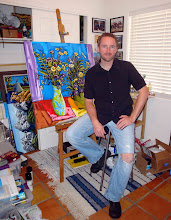
 Welcome to creativity blog #3, this one featuring California based painter Ken Christensen.  I have always been a great fan of Ken's work, and I even have one of his paintings hanging on the wall of our family room - alongside the best works of my artist friends.  Ken has an extensive body of work and throughout his paintings I have always felt that he was one of the best at striking a near perfect 'tension of details', as I like to call it.  By that I mean he adds just enough detail to preserve the visual scene, but his works still show traces of the joyful spontenaiety of a sketch.  Ken was integral in the creation of the "New Fauves" group of artists - which I might add is the only group of artists that I have formally affilliated myself with in my entire art career.  This is a group of painters who all feel their roots in Fauvism and Expressionism - who sense, as I do, the great debt that we owe to artists like Van Gogh and the Fauvist painters that followed him.  I was also delighted to find that Ken knew of and appreciated the work of my mentor and friend, the artist Jean-Claude Quilici.

Here is the Q and A with Ken, enjoy!


Ken Christensen
Artist - Writer

http://www.kenchristensen.net/pages


1) What personal habits do you have that you feel make you more creative?

One of the things that keeps me creative is going for long walks. Everything you need to know is in nature. Nature reveals its secrets slowly so you have to be patient. You can pass by the same scene many times but at one special moment a new vision of the same thing can be revealed. It's impossible to find a subject to paint by driving around in a car. I have to see things on foot, one step at a time. And in art light is always the real subject. So at every time of day, when the light is different there is always a different subject. There can be nothing at one time of day to paint and at another time when the sun is in a different position something remarkable may reveal itself.
We are always standing on the shoulder of giants and most good ideas spring out of something earlier by someone else.
Another habit that feeds my creativity is sketching. Sketching is art in its purest form. When I sketch I'm not thinking of sales or finished work; I'm just having fun. When you're having fun, good things happen. When I sketch I am being more personal in what I choose to portray. It is the personal in art that really sets the greats apart. One must have a unique vision and art succeeds as much as you are being yourself. Sketching whatever catches your eye allows this personal vision to flourish.

2) Who are the creative artists, in any field, that inspire you the most?

I'm a huge Neil Young fan. In literature Henry Miller has had a huge influence on me. In art, Van Gogh has been my hero since childhood, not only for his art but for his life and convictions. His letters are one of the great works of world literature and very inspiring. The artist I've known personally that has influenced me the most is my friend Manuel Gil in Paris. Manuel is Spanish but has lived in Paris thirty years or more. He showed me what a true artist is. He has an energy and enthusiasm for art that I have rarely encountered. It reminds me of what I know of Picasso who could create art out of anything, by picking up whatever was at hand. Manuel turned me on to other techniques like woodblock printing, pastel portraits, monotypes, and other things. Like Picasso, Manuel is also an original thinker with surprising opinions on a wide range of subjects. He is a wild bohemian but also a true nobleman who has a sensitivity and insight beyond the majority.

3)  What do you do when you are not feeling creative?  Or - how to you get yourself back to a point where you are feeling creative?

As I was saying, the first step in trying to find the urge to paint or some creativity is to go for a long walk. A very long walk will always sort things out. The other thing I do is to switch techniques. If I'm getting burned out or bored with oil painting I will switch to watercolor for a week or weeks. I also go back to sketching , the source for all further creative endeavors. Lastly, if I'm still stuck I will force myself to do something. Just working will release my creative juices. Without fail I always feel better by doing something, anything. Just doing something will snap you out of your lethargy and get the juices flowing.

4)  What are some creative outlets that you enjoy outside your own respective creative field?

I write. I've written five books. I just finished another one, "Between the Covers: Reading, Writing, and Romance" which is a memoir told through my connection to books, reading, collecting, running a bookstore, and writing.

5)  For someone who has talent in a creative field, how would you suggest they go about converting that talent into something original - something that stands out from the crowd?

As I said, great art is always personal. It sounds too simple but the ultimate advice is to be yourself. Trust yourself that your idle thoughts are worthy of developing. There is room at the top for any style in any field if it is original. It depends if your goal is to create art or to make money. They are often very different. In terms of creativity and quality art then one must trust oneself and do whatever you damn please.


Links 

Official website:  http://www.kenchristensen.net/pages

New Fauves website:  http://www.newfauves.com/pages


Thursday, October 18, 2012

Paris is for (Art) Lovers

This week I am gearing down a bit and retouching some works finished earlier in the year.  Most of the paintings for my January show at the Marshall-LeKAE Gallery are finished, and new paintings have just recently been delivered to Cobalt Fine Arts in Tubac.

However I did want to write a few lines about our recent trip to England and France.  Last month my wife and I decided to take the opportunity to visit England, where my wife's brother is currently living and working, and use that as a chance to see as much of London as possible - as well as to pay a quick visit Paris for a few days.

When it comes to art, I am a little firm in believing that you haven't even begun to get a taste for the greatest art out there, until you have been to Europe.  So much of the legacy of the greatest art ever made can be found in France, England, Italy, Germany, Spain, and countless other locations on the continent.  As a student in Aix-en Provence, France in 1996 I was fortunate enough to be able to both see many of the works of the great Impressionist masters that I so adored, and to also see many of the places they painted.  As my friend, the artist Jean-Claude Quilici remarked in an interview - many of the places where the greatest artists painted have hardly changed.  Many of the villages, for example, in southern France, where Van Gogh, Cezanne, and others worked - many of them have been altered very little with the passage of time.  So it presents the unique opportunity for an artist to both look at the best European works, and see the places where they are made.

Foremost in my mind, always, is Paris.  Paris has been a nexus for world art for a very long time.  It was the mecca of the Impressionist movement.  And though many artists didn't live in Paris itself, the city was a source of both inspiration and exhibition opportunities, and was ringed with towns and villages that artists called home.

For me, coming back to Paris in 2012 was especially sweet.  In 1996 I visited the city twice, pretty much taking the opportunity to see as many galleries and museums as possible.  And also to meet up with my friend Jean-Claude Quilici.  I was 20 years old then, a boy from small town North Carolina.  Now I am 37, with a wife and son and another son on the way - and with an art career I could scarcely have imagined during those days when I haunted the Louvre and Musee d'Orsay back in 1996.  I was pleased to find, on a personal note, that it was not as hard as I thought it was to speak French as well as I did back then.  I remembered probably 88% of what I knew while I was living there, and got many compliments on how well I spoke.  I probably shock people there because the feeling you get from the French is that they don't expect ANY American to speak French.  It's always a pleasant surprise for them.

However during three days in Paris and the remainder of our days in London, I was reminded very directly why the act of pilgrimage isn't just a religious act - artists too, I think, must show a certain devotion to knowing their roots, and wherever possible, must go to the places where great works are, and where they were inspired.  Though I am a self-taught artist, I have always thought that it is very important that you learn from the best.  So rather than worry about some somebody who is a passing fad - I have always told myself, if you are going to be a painter, go learn from Monet, Manet, Renoir, Sisley, Pissarro, Van Gogh, Quilici, Gary Ernest Smith, Vlaminck, Derain, Cassatt, and many others.  Start at the top and try to tap into the best.

At one point during this trip my wife and I went to take our 3 year old son to the restroom at the Musee d'Orsay, and in order to get back to the place where you can start your visit, you had to pass through the rooms that were stacked wall to wall with all the great masters of Impressionism.  We walked right up to Manet's "Luncheon on the Grass" and I told my wife "If you can catch a glance, look around you.  You are looking at the best of the best."

London also was not to be missed, and there were indeed some wonderful artistic gems to be found there.  We visited the National Gallery, which also had an exceptional display of impressionist work - and I caught glances of other amazing works during our hurried visit there.  One of Van Gogh's original "Sunflowers" is there, and when we walked in the door I was carrying our 3 year old son Liam - and Liam pointed to Van Gogh's Sunflowers and said "That painting looks like one of your paintings da da!" (He calls me 'da da' instead of dad)  I've gotten some nice compliments on my work through the years; this one might have been one of the best.

Another gem which is a little off the beaten path is the Courtauld Gallery.  This gallery touts itself as one of the finest small art museums in the world, and I think that title is WELL earned.  You will find such masterworks there at Manet's "Bar at the Folie Bergere", which was the last large Manet completed at the end of his life.  Van Gogh's self portrait with a bandaged ear was there also - which was very touching.  I told my wife that it was quite something than Vincent wanted to document even one of the worst moments...the self-inflicted mutilation of his ear.  He was so unsparing in his artistic view - even of himself.  It made me think of Monet painting his wife Camille on her deathbed.

So yes, if you believe in doing great work, or that you want to attempt to - you have to see the masters of Europe.  If you have to, see them at the best big-city gallery you can make it to, even in your own country.  (Here in the states, galleries like the National Gallery in Washington DC, the Art Institute of Chicago, and the Met in New York come to mind)  But if you can see those great works, and get the added uplift of walking those same cobblestone streets and enjoying making those footprints - your work and your life will ever be the wiser for it.  Mine sure is....

www.neilmyersart.com

Wednesday, January 19, 2011

Moving into 2011, New Horizons on the Canvas


This week I am working on the 2nd painting is a series of paintings themed on Provence and the South of France. This one is my first rendition of Olive Trees, a subject so beautiful, and so dear to the two painters I admire the most, Jean-Claude Quilici and Vincent Van Gogh. Along with the director of the Marshall-LeKAE Gallery, I've hit upon doing a small display - a small late summer show of 8 to 10 paintings, all themed along the lines of the places in Provence that were painted by Van Gogh and Cezanne. Some of you may know that I spent a six months in Aix-en Provence as a student in 1996, and have seen many of these places with my own eyes. I am excited to do some paintings inspired by this beautiful and historic region. I too have walked this hills and the alleyways frequented by Cezanne, Van Gogh, and many others - and their charm was not lost on me, and still affects me to this day. A lot of what I have done in my paintings of the American West was to take an inspirational spark from the Provencal colorists, and plant it here in the American soil.


We are also in the process of organizing a three artist show at Cobalt Fine Arts in Tubac, featuring myself, Paul Sheldon and Fred Collins. The opening reception is planned for March 26th, and one of my featured paintings, "The Flowers of Fall" is already sold, but will be on display for the opening.


Also, I'd like to remind everyone that I will be featured in the March issue of Phoenix Home and Garden Magazine, and I encourage you all to, pick up a copy. The staff and editors of Phoenix Home and Garden have been a delight to work with, and I am very happy to be featured in this sharp, beautiful publication.


As a last note, I wanted to take a moment to ask all of you to remember the recent victims of the terrible shooting here in Tucson. On that day, my wife and son were shopping at another store only 500 yards away and they saw emergency vehicles rushing past them as they were driving home. Typically, I'm not one given to big pronouncements on this blog - and it is pretty clear that there have been deep political underpinnings to both this act of murder as well as the consequent debate over what it has meant. But I am among the camp who believes, without a doubt, that we have calm down and learn to be civil to one another again. I always loved what Edward Murrow said, "we must not confuse dissent with disloyalty". I do believe that voilent speech does affect people who are already angry and disaffected - for whatever reason. We therefore owe it to our children and our neighbors to stop letting anger dominate our discourse. This great land of ours will survive the discussion. And let's do all we can to also assure that a duly elected official can fulfill the roles that they have been elected to do - without the threat of violence against them. Gabrielle Giffords and the other victims, both living and dead, did not deserve to have their lives shattered by bullets.


Our hearts and are with Mrs Giffords and the other victims, as they recover, and as the families of the lost mourn and make the effort to go on with thier lives.


Let's remember our neighbors in Tucson.


Wednesday, June 30, 2010

Expressionism vs. Realism

"The man who deals with originality is desperately needed, but seldom wanted. For along with his promise of victory he lets loose the shadows of chaos."

David Hare writing about Jackson Pollock


This week I have just returned from beautiful Bryce Canyon, Utah - and I am working on several new paintings including a new Pueblo and a New Mexico landscape derived from a photo taken near the Guadeloupe Mountains.

I have recently heard an open discussion, sometimes friendly and sometimes not - coming from artists who are vociferous in their defense of realism. Some are saying that what is needed is a new movement that has been tagged as "Novo Realism". Several things, I think, are going on here and are worthy of talking about further.

I think that what bugs many realists is the possibility that artists who work in either expressionistic or abstract styles are not well trained. Realists are mostly classically trained, they paint from life, they go out into the field and do plein air studies, etc. They are the ones that are toiling away on reproductions of plaster casts, and going to great trouble to hone their skills so that what emerges on canvas is a fair representation of the real world. Realists know what they have done to train themselves, and they feel that art is being sold short when somebody either abides too loosely to reality, or when they don't abide by it at all. There is a reason why Jackson Pollock, as an abstract expressionist, was on the receiving end of a ton of scorn when he pioneered his "all over" poured paintings. The same process goes on today when realists look at the world of art. You could think of this situation metaphorically by saying that realists are like classical musicians, trained in violin, piano etc. Such musicians may look at a Rock and Roll guitarist and think "How can he fill an arena with screaming fans with just a few barre chords?" Mr Rock and Roll taught himself, and people are going nuts over him. As a guitar player, I sympathize with this thought, when I think about guitarists like Toni Iommi of Black Sabbath, who wrote some of the greatest rock / metal songs with very simple progressions. Complexity does sometimes represent talent, but not always. Sometimes the forms in which one operates are so laden with previously held assumptions that there is little room for the artist themselves to get out. That is why I am an expressionist, and why it suits my temperament much more than realism.

Also, we should be a bit more honest about realism. What do people mean when they are painting realistically? In the most basic sense, they mean to say that they are painting something that is a fair representation of the way the thing they are depicting really looks. But when we see a beautiful woman stretched onto a sofa, with soft light coming thru the window and forms rendered like Sargent or Whistler may have done - I don't exactly subscribe to that being real in the purest sense. We look at the woman on the sofa, we know it's a woman on the sofa - fine. But while one might want to paint those wistful and comforting realism scenes, nobody is making much of an effort to paint an unemployment line. Nobody decides to do a portrait of a devastated family who has just lost their health insurance. Few people, some have done so - but few people have the courage to paint subjects from the wars in Afghanistan and Iraq. I don't see plein air artists lining up to paint large gobs of oil washing up on the shores of Florida, Alabama, and Louisiana. And I sure don't see galleries or collectors wanting to show and buy these things. So what is depicted, and what is most approved of for the viewer, is a style of work that is real in look, but rarely ever real in any situational sense. This is no crime, by the way. But I interpret realism in a pretty unrelenting sense. However, I assert that art is a free engagement process. If a collector wants to buy realistic works, and the artist wants to produce them - I hope all involved go away happy. But realism is only one kind of tree in the forest. There are others, and all make the colors and shades we adore.

Another way to think of a discussion of Expressionism and Realism is something like a filter. A realist uses a dense, heavy filter - for the look of the subject anyway - and the individual touch of the artist is usually minimized in realism. An Expressionist, like myself, prefers a filter that lets only some of the subject through, and the rest is a product of gesture, light, color, and the temperament of the artist. A Realist would say that much of that applies to them as well - but an Expressionist departs sharply from this mold by not worrying too much if the rock in the landscape doesn't look like any rock that one has seen before. The rock, for an Expressionist, is a product of gesture and feeling.

I would share with realists the fact that I too respect training in art - whether that be self training or proper studio or school training. However I don't insist on this as an absolute necessity. The ancient cave paintings as Lascaux, which I adore very much, were painted by people who carried with them nothing more than the wish to express something meaningful about the world around them. And of course there is a long line from those primitive people to the Michelangelos and Raphaels of the world. But all were operating on the same instinct to make art meaningful. I find no battle between them. Neither should there be any battles between realists and expressionists. Like the trees of the forests I had mentioned - you don't hear the Oaks telling the Bristlecones to go straighten their branches if they really want to be a tree. You don't hear the Cedars ask the Paloverdes why on earth their bark is green...all forms independent and meaningful are appreciated. All are trees, no matter what the difference of forms. And bear in mind I do not argue for artistic relativism. The ability to say "that's a bad painting" is crucial if we are ever going to know what a good one is. That why I draw the line at "meaningful" forms, and expressions of art that have communicative ability. That's also why I have struggled endlessly with artists such as Barnett Newman - because despite my clear expressionist sympathies, I smell a cop-out when I see a single stripe down a huge canvas - and I resent the implication that I'm not cultivated enough to get the meaning. I'm not even sure Newman knew what he meant, or even meant to express.

So, as mentioned, I see no conflict here - other than the one we stir up unnecessarily. But if I were to offer one thought, one little tinge of competitive spirit between Expressionists and Realists, this is what I would say; if one were to hold a major exhibit of Vincent Van Gogh, arguably the greatest expressionist and pioneer of the style - if one held a retrospective of Van Gogh's greatest works, I would suggest that it is very likely that Van Gogh would bring in more interest, more media coverage, and more attendance than any realist painter, living or dead. He at least proved the value of deeply held emotion, expression and love of color on canvas. And the crowds that follow his works prove his impact.

As an Expressionist, Van Gogh stands tall - with contemporary artists like Jean-Claude Quilici, to show the power, popularity, and creative energy of art when the painter departs from the path of realism, and plows into the wild forest beyond.

www.neilmyersart.com

Friday, June 19, 2009

Art & Pain


This week I am working on a sketch for a new painting in my "Giants of the Desert" series. When I am out in a landscape I often look for stands of Saguaro cacti that are visually powerful, which set a strong image in the landscape. While walking in a field where there were no trails, I stumbled across just such a stand of Giant Saguaros on the Sutherland trail at Catalina State Park, and have set out to paint them.


This week I also wanted to take this chance to thank all my dear friends and collectors who have chimed in to wish me well as I have been trying to facilitate a recovery from my back ailments. In all honestly, I ended up getting so sick from my medications that I took myself off all of them two weeks ago - and to my own surprise, I feel 75% better! I am still struggling with some issues, but the improvement is significant. This week I also found myself thinking of a gentle rebuke from my wife; when she mentioned that I talk about my ailments too much! After thinking about it, I had to admit that she was probably right. But as I was kicking myself for such negligence towards my friends and their own lives...the reason WHY occurred to me immediately. I remember once telling my wife this scenario; imagine that every ten seconds a little creature in your shoe bit you on the foot. For days, months, weeks, even years - sure as clockwork, this little monster bit your foot. Naturally your attention span would be ruined. It would be hard to have a conversation. It would be hard to be fully present in the moment. It would be hard not to fear the future if again and again you got bit. So it seems to me that a chronic pain issue is much like that - it forces the person suffering this situation to be too much IN themselves...always turning the problem over in their minds, always waiting for the next bite. Always dreading the inevitability of it. But hers was a fair rebuke, and I accept the criticism openly.


Of course when I am thinking about art, I also got to thinking a lot about art and pain. One of the most poignant examples of this, we all know, is the struggle of Van Gogh, which is well known to most people. It always seemed to me that what Vincent did which is so incredibly heroic, was that despite all the turmoil in his personal life, his own battle with insanity, poverty, loneliness, lack of love, and art in general - he somehow managed to internalize all of that turmoil, and when it exited him thru his brushes, the resulting canvases were some of the most beautiful expressionist works done by anyone. I try to fathom the extent of his suffering and it boggles the mind - but it only boggles when one realizes that despite everything, Vincent created beautiful works that were full of energy, heat, passion, and a love of the beauty of the world. How many desperate individuals, locked in mental facilities around the world could find it in them to still create such breathtaking beauty? Perhaps more than we know...but it is only in the acknowledgement of this that we can appreciate Vincent's triumph over pain. True, the waves did crash in over him eventually - but he stood the force of the tide, internally and externally, for a long, long time. Long enough to leave a body of beautiful work, and many of the late ones especially - extracted from pain and re-rendered beautiful in the world. That, my friends, that is an accomplishment!


But, as I have discussed in earlier blogs, Van Gogh's case is not exactly unique in art. Just this week I saw a fantastic documentary on the abstract artist Mark Rothko, called "Rothko's Rooms". What was most interesting about Rothko is that, after many years of struggle, he did experience the taste of true success in the later part of his life. However the struggle that was integral in his work remained. He himself said that a sense of the tragic notion of the image was always present in his mind. When one begins to try to understand, in a worldly sense, why one still feels this strong sense of tragic, even when your works are going for big money, the answer reveals itself to be that the tragic, for Rothko, was a certain state of mind that could not be affected by anything external to it. So it would not be changed by success or the vestiges of it. And when one looks long and hard at the late, dark works of Rothko, notably some of the Seagram's murals and the black works that went into the Rothko Chapel - a real sense of beauty and subtle tragedy does emerge. As if the artist were making works that were the visual and emotional equivalent of the universe before the big bang. Perhaps it should be surprising that an artist, so much IN his own mind as Rothko was - should end his own life, much as Van Gogh did. Even I know that the struggle to create has a tendency to hollow out a person.


It could be said, perhaps, that struggle and art are the same thing. The attainment of great images does not generally deliver itself on a silver platter. Rather it is always in front of you as you go chasing after it. The thrill of the chase is enough for some people. For others, the thing must be captured to be enjoyed and expressed. But you go on after it because you don't know what else to do. Most of us know we can't turn back now. We are too far down the road - so we struggle on, with bad backs - sometimes with unhealthy minds - to try to shove it all aside for a deep breath of beauty.