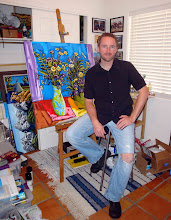
This week I am working on a new 36 x 48 inch painting of Organ Pipe Cacti...cacti that perhaps fall under that shadow of the more famous and iconic Saguaro, but one which is still very much a treasured part of the ecosystem of the Sonoran Desert. Also, it should be noted that Organ Pipe National Monument, which is home to many such cacti, has been long regarded as one of the more dangerous National Monuments to visit. It sits right on the border with Mexico, and I certainly hope that, in the future, it can become a more peaceful and visitor friendly place - where the whims of mankind would do better to give safer harbor to our natural treasures.
I should say also that I never write blogs to suit my own vanity. I write them when I feel that I have something worthy to say, or share about my work or the arts in general. And something that has occupied my mind more and more lately is a strange artistic comparison that I feel between airplanes, and creativity. I thought this might be worth exploring...
On the surface it might not appear that aircraft are acts of creativity. But I think that they very much are. Most especially military aircraft. When conditions present themselves where an airplane needs to have a certain kind of capability to do what is required of it, a great deal of creativity - and one might even say, counter-creativity is needed in order to make an airplane that can do things that have never been done before. Or one that does known things better, faster, or in wartime - a more lethal way. This is not to congratulate warmongers for the great rivers of misery and destruction that they have wrought on the world. That is an abhorrent feature of human nature. Rather, this is simply to contemplate how aircraft represent creative solutions to problems posed.
One of the most stirring examples is the World War II era German Messerschmidt 262, - the world's first fully operational jet fighter. In the dying throes of the Nazi regime in 1944-1945, it is well known that Hitler and his regime turned to what he called "Wonder weapons" that could somehow salvage a German victory against overwhelming odds. As German cities were pounded night and day by British and American bombers, German engineers pressed into service the Messerschmidt 262, in hopes that it could stem the tide that was then turning against Germany. With untold thousands of piston engined fighters and bombers numbering the skies all around the world at that time - suddenly there appeared the Me 262 jet fighter, which could outrun the American P-51 Mustang by a full 100 miles per hour.
I have long been fascinated by this airplane and even built a model of it. When I am in need of reflection I sometimes even hold it and look at it, and allow myself to think about it as a kind of catalyst for contemplating new solutions to problems - even in painting. It is a question worth thinking about; how then do we create new solutions that change the paradigm entirely - without borrowing from the past? What happens when we disregard the old rule book, throw that sucker out and just write a new one? The Me 262 is an interesting thing to contemplate because it represented, in aviation, the act of throwing the rule book out. That there have been essential and pivotal times when that act was necessary. There are countless aircraft that prove this.
Fortunately, the disgusting, racist, and inhuman regime of the Nazis did indeed suffer the inevitable defeat that was necessary for human civilization to stand a chance at flourishing. I can say with no hesitation that the marvels of German aircraft engineering in all their breadth and scope would never excuse or erase the terrible cruelty exhibited on Jews, and others, by the Nazi regime. I take great satisfaction in knowing the great fleets of Mustangs and Spitfires proved too much for even the modest numbers of Me-262s that saw combat. But the presence of that airplane did not go unnoticed, and some may not be aware that there were very well organized British, American, and Soviet efforts at procuring German technology, including the Me 262, after the war was over. The moment they had defeated Germany - they wanted to get their hands on this aircraft, and others.
Part of being a good artist is to be able to comfortably allow the flow of creative insights, from whatever source. Many artists I know are into music deeply, because they feel that cross pollination with musical inspiration. But when I hold my model of the Me-262 somehow I gain the courage to sometimes throw the rule book out, and try to rewrite a new one. The confidence to put that first line to that first new page, of a book that has not yet been written - that is what it really means to be an artist.
www.neilmyersart.com
Showing posts with label arizona art. Show all posts
Saturday, June 28, 2014
Thursday, November 28, 2013
Selling Art is Wonderful - It's NOT Selling Out
This week I am working on a painting that is slated to be a gift to the city of Oro Valley. Can't reveal much in the way of details…more to come later. I am also framing a group of works that will go to Cobalt Fine Arts for a small paintings show that I am in with my dear friend the artist Natasha Isenhour - called "Jewel Tones."
One thing that has been on my mind recently was a question put to me by a friend who is an aspiring writer…and that was the question about "selling out", i.e., having your art or what you do affected by selling. The question wasn't loaded, and it was well meant. But it did cut to the chase over the issue of the role of selling work and how that affect the creation of it.
I'll just come right out and say it, because the older I get the more honest I am - I LOVE selling work! I love it. The fact that people pay notable sums of money to collect my paintings is one of the most gratifying experiences in my life. It tells me many things - primarily that the modes of expression that I have tapped into are not just my own. And that when others see it something resonates inside of them, and they can then visualize the work in their homes or in some meaningful space. That is wonderful - and having galleries back you because you have a reputation of selling, also a great compliment.
As to whether selling works affects my work - I can also be honest and say YES it does cross my mind, the fact of wondering whether a work might sell or not. The way I see it, an accountant likes to get paid. A teacher likes to get paid. A doctor likes to get paid - why should an artist not like to make his or her modest sum? I think this is fine. It's totally normal. My wife once made the point that in the vast majority of cases when one of my works sells, she said it is obvious why. It is more detailed, more colorful, the contrasts are sharper - something is notable and raises the bar in those paintings, and as she said, those paintings are often the ones that sell.
However the caution that I work under is simple…I do not let the fact that certain works sell dominate the selection of new works. It's ok to do something that is your bread and butter kind of work - that's fine. But one must always keep an eye to the creation of new images. All the time. You have to remain an artist and the cash signs can't be the first things that decorate your goggles you see the world through. The creation of new images is important also because when you consider your work in retrospect, even those 'bread and butter' paintings that you know collectors want and buy - even they were original works dreamed up, composed, and painted out of nothingness. They too were new at some point, so you can't close down that regenerative process by which new works are made.
There is a sense that I have noticed - that an artist has to be so avant garde as to be a misunderstood pauper - and then they get some kind of stamp of legitimacy. I think that is a bunch of crap. I have seen artworks that don't communicate anything at all. That seems to me to be representative of a breakdown in the relationship with the viewer. And I am sure many such artists comfort themselves in the fact that they are doing something ahead of their time - so much so that nobody gets it. Again, I don't believe that. I have always said that an artist is free to go out on a limb if they want to; but that they can't turn around and blame everyone else if the crowd doesn't want to go out on the limb with them. And from my experience in the art world, sales are not terribly common out there on the limb. I stick a little closer to the tree…
Lastly I would say that it should not be unsaid that ART IS WORK. Maybe that's why they call it artwork. It is not gratuitous leisure. It is work. If anyone has the temptation to trivialize art, they probably have never wrestled with the difficulties of created a meaningful and complicated piece of work. After I have spent three or four weeks on a single painting I feel that it is a wonderful reward when the work finds a home and makes someone else's living or working space beautiful. I'm very happy that I can make a very modest living at it. No, visions of dollars signs shouldn't ever be allowed to dominate your process. But YES, selling is a great thing. It gives you the confidence to dream big - and in many ways, helps you be more creative, more fulfilled, and able to be full of faith that you can make something equally great to the things that have come before.
www.neilmyersart.com
One thing that has been on my mind recently was a question put to me by a friend who is an aspiring writer…and that was the question about "selling out", i.e., having your art or what you do affected by selling. The question wasn't loaded, and it was well meant. But it did cut to the chase over the issue of the role of selling work and how that affect the creation of it.
I'll just come right out and say it, because the older I get the more honest I am - I LOVE selling work! I love it. The fact that people pay notable sums of money to collect my paintings is one of the most gratifying experiences in my life. It tells me many things - primarily that the modes of expression that I have tapped into are not just my own. And that when others see it something resonates inside of them, and they can then visualize the work in their homes or in some meaningful space. That is wonderful - and having galleries back you because you have a reputation of selling, also a great compliment.
As to whether selling works affects my work - I can also be honest and say YES it does cross my mind, the fact of wondering whether a work might sell or not. The way I see it, an accountant likes to get paid. A teacher likes to get paid. A doctor likes to get paid - why should an artist not like to make his or her modest sum? I think this is fine. It's totally normal. My wife once made the point that in the vast majority of cases when one of my works sells, she said it is obvious why. It is more detailed, more colorful, the contrasts are sharper - something is notable and raises the bar in those paintings, and as she said, those paintings are often the ones that sell.
However the caution that I work under is simple…I do not let the fact that certain works sell dominate the selection of new works. It's ok to do something that is your bread and butter kind of work - that's fine. But one must always keep an eye to the creation of new images. All the time. You have to remain an artist and the cash signs can't be the first things that decorate your goggles you see the world through. The creation of new images is important also because when you consider your work in retrospect, even those 'bread and butter' paintings that you know collectors want and buy - even they were original works dreamed up, composed, and painted out of nothingness. They too were new at some point, so you can't close down that regenerative process by which new works are made.
There is a sense that I have noticed - that an artist has to be so avant garde as to be a misunderstood pauper - and then they get some kind of stamp of legitimacy. I think that is a bunch of crap. I have seen artworks that don't communicate anything at all. That seems to me to be representative of a breakdown in the relationship with the viewer. And I am sure many such artists comfort themselves in the fact that they are doing something ahead of their time - so much so that nobody gets it. Again, I don't believe that. I have always said that an artist is free to go out on a limb if they want to; but that they can't turn around and blame everyone else if the crowd doesn't want to go out on the limb with them. And from my experience in the art world, sales are not terribly common out there on the limb. I stick a little closer to the tree…
Lastly I would say that it should not be unsaid that ART IS WORK. Maybe that's why they call it artwork. It is not gratuitous leisure. It is work. If anyone has the temptation to trivialize art, they probably have never wrestled with the difficulties of created a meaningful and complicated piece of work. After I have spent three or four weeks on a single painting I feel that it is a wonderful reward when the work finds a home and makes someone else's living or working space beautiful. I'm very happy that I can make a very modest living at it. No, visions of dollars signs shouldn't ever be allowed to dominate your process. But YES, selling is a great thing. It gives you the confidence to dream big - and in many ways, helps you be more creative, more fulfilled, and able to be full of faith that you can make something equally great to the things that have come before.
www.neilmyersart.com
Thursday, June 20, 2013
Art Criticism From Other Artists, My View
This week I am working on a new 36 x 48 inch painting of Cathedral Rock, near the stunningly beautiful town of Sedona, Arizona. If you have never visited Sedona, I would strongly urge you to do so. For Arizona, it is OUR land of red and orange rocks. The mountains and formations are amazing - and the hikes are second to none.
This week I have also been thinking about art criticism and I thought that it might be a nice time to share my views on this subject. Reason being - I got into a heated argument with another person on facebook; and no we didn't solve the world's issues while arguing over the internet...it did bring to light my perhaps unusual views about art criticism. So I thought I would state them clearly here.
Here is the thing...if I don't like a piece of art, I generally keep my mouth shut. I feel that this is an act of trust on my part because I prefer to trust that an artist can, by themselves, iron out any of the rough patches or weak spots in their work. I feel that if an artist is doing this alone, they deserve the right to make that exploration without my soul-killing comments. I will be honest here, in my own art career, and in the development of my work, when it came to the fundamentals of how my work came to look as it did, I did not listen to anyone. What came out on canvas was pure inner voice. Nothing else. I was, as we all are, bouyed up by the fact that collectors bought my work, and that magazines wrote about it - but in the core of what has made the work, it was pure inner vision reacting to a landscape in front of me. I actually feel this was a benifit, not a detractor. I feel that because I shut out the noise of all other people - well meaning or not, I managed to arrive at something close to my own visions. Now I did frequently listen to other artists when it came down to mastering the materiels needed for the job. My artist friends have been wonderful in suggesting different things that would help get different effects.
I do believe that if one chooses a classroom environment, art school, or formal classes with a top level artist - then one does and should submit themselves to the kind of criticism that I find is, at the least, a distraction, and at worst - what I've described as a soul-killer. There are people who really do benifit from a classroom enviornment and an evironment with hard critqiues and such things. I freely accept that and I don't lose any sleep over that. However I am not one of those people. I told a friend yesterday, "The creative spark inside me, I don't let anyone else handle." So I shut out the noise and I DO NOT participate in art critiques, and I have never invited another artist to critique my work. I feel like if you like it, then great, thanks...if you don't, then move on to find yourself another wonderful artist that you can connect to. For some artists, however, they cannot let this be. They have to critique someone else's work because it is almost like their own act of conquest and appropriation. It is how they try to curve your work to their vision. I don't accept this, and I don't take a part in it. And I don't do it to other artists.
So, as this person on Facebook was left thinking - it might be easy to think that I only accept flattery. No, that is not what I am saying. I've been told to my face, and accepted with perfect serenity, someone saying they didn't really care for my work, or that it wasn't their thing. That's totally fine. What I don't accept is unwanted and unasked for desconstruction from other artists. I have said it before, there is only room for one artist in my head and he is the only one I let in. That is a monkish and solitary way to see things, perhaps - but that's how I see it.
Anyway, my heated conversation with the person on Facebook ended with the person saying that I was staying in my comfort zone - and they even called me "lazy". Expletives were hurled and one tactless and uncouth person was rapidly un-friended by me. Note to those who like to bash other people's artwork - if you crudely attack other people's work, expect a vigorous counterattack. If you have been so brash as to nominate yourself judge and jury over someone elses' work - then don't just expect them to sit there and take it. I don't. Art is the product of the heart - and when expressed truly it must be defended against those who either don't understand it, or wish to bring someone down from the heights of even modest accomplishment. I defended my work against this person I mentioned and I won't apologize for that. Am I prickly and sensitive about my work? You better believe I am. And then if a person calls me lazy...oh well, I always try to be a nice guy and I believe in compassion and seeking understanding but call me that and the gloves are off. Whatever I am - lazy is NOT one of them. Never has been. One could not keep the utterly ridiculous busy schedule I keep, and even dream of the word "lazy".
That is my view. I think life and art are a products of uplift. If one takes the chisel of destruction to everything, nothing is left but the pieces. I prefer to create, not revel in pulling apart the work of another. I offer my own work as a take it or leave it thing. There is so much beauty in the world, I want to spend my days holding that beauty up high - rather than chipping away at sincere creations, whatever their stage of development.
www.neilmyersart.com
This week I have also been thinking about art criticism and I thought that it might be a nice time to share my views on this subject. Reason being - I got into a heated argument with another person on facebook; and no we didn't solve the world's issues while arguing over the internet...it did bring to light my perhaps unusual views about art criticism. So I thought I would state them clearly here.
Here is the thing...if I don't like a piece of art, I generally keep my mouth shut. I feel that this is an act of trust on my part because I prefer to trust that an artist can, by themselves, iron out any of the rough patches or weak spots in their work. I feel that if an artist is doing this alone, they deserve the right to make that exploration without my soul-killing comments. I will be honest here, in my own art career, and in the development of my work, when it came to the fundamentals of how my work came to look as it did, I did not listen to anyone. What came out on canvas was pure inner voice. Nothing else. I was, as we all are, bouyed up by the fact that collectors bought my work, and that magazines wrote about it - but in the core of what has made the work, it was pure inner vision reacting to a landscape in front of me. I actually feel this was a benifit, not a detractor. I feel that because I shut out the noise of all other people - well meaning or not, I managed to arrive at something close to my own visions. Now I did frequently listen to other artists when it came down to mastering the materiels needed for the job. My artist friends have been wonderful in suggesting different things that would help get different effects.
I do believe that if one chooses a classroom environment, art school, or formal classes with a top level artist - then one does and should submit themselves to the kind of criticism that I find is, at the least, a distraction, and at worst - what I've described as a soul-killer. There are people who really do benifit from a classroom enviornment and an evironment with hard critqiues and such things. I freely accept that and I don't lose any sleep over that. However I am not one of those people. I told a friend yesterday, "The creative spark inside me, I don't let anyone else handle." So I shut out the noise and I DO NOT participate in art critiques, and I have never invited another artist to critique my work. I feel like if you like it, then great, thanks...if you don't, then move on to find yourself another wonderful artist that you can connect to. For some artists, however, they cannot let this be. They have to critique someone else's work because it is almost like their own act of conquest and appropriation. It is how they try to curve your work to their vision. I don't accept this, and I don't take a part in it. And I don't do it to other artists.
So, as this person on Facebook was left thinking - it might be easy to think that I only accept flattery. No, that is not what I am saying. I've been told to my face, and accepted with perfect serenity, someone saying they didn't really care for my work, or that it wasn't their thing. That's totally fine. What I don't accept is unwanted and unasked for desconstruction from other artists. I have said it before, there is only room for one artist in my head and he is the only one I let in. That is a monkish and solitary way to see things, perhaps - but that's how I see it.
Anyway, my heated conversation with the person on Facebook ended with the person saying that I was staying in my comfort zone - and they even called me "lazy". Expletives were hurled and one tactless and uncouth person was rapidly un-friended by me. Note to those who like to bash other people's artwork - if you crudely attack other people's work, expect a vigorous counterattack. If you have been so brash as to nominate yourself judge and jury over someone elses' work - then don't just expect them to sit there and take it. I don't. Art is the product of the heart - and when expressed truly it must be defended against those who either don't understand it, or wish to bring someone down from the heights of even modest accomplishment. I defended my work against this person I mentioned and I won't apologize for that. Am I prickly and sensitive about my work? You better believe I am. And then if a person calls me lazy...oh well, I always try to be a nice guy and I believe in compassion and seeking understanding but call me that and the gloves are off. Whatever I am - lazy is NOT one of them. Never has been. One could not keep the utterly ridiculous busy schedule I keep, and even dream of the word "lazy".
That is my view. I think life and art are a products of uplift. If one takes the chisel of destruction to everything, nothing is left but the pieces. I prefer to create, not revel in pulling apart the work of another. I offer my own work as a take it or leave it thing. There is so much beauty in the world, I want to spend my days holding that beauty up high - rather than chipping away at sincere creations, whatever their stage of development.
www.neilmyersart.com
Thursday, March 28, 2013
Creativity Blog # 2, Arizona Photographer Paul Gill
A few years ago when I stumbled across the photographs of Paul Gill, I was a bit overwhelmed. I had the feeling like I had discovered a photographer with something of the same sensibility as what I had hoped to bring to my own best paintings. A sense of design. A sense of the extreme variations of color captured in the desert - if one knew the land well enough to have a sense of timing and urgency to find the land at its highest point of expression. I actually felt like Paul saw the scenes that he photographed much like some of the best painters I knew. It was clear that to him an image is more than a digital click - it has all the potential to be a piece of art. Paul Gill, more than any other Arizona photographer I am aware of, makes photographs rise to the level of fine art.
He is also one of the very few photographers whom I have sought out for permission to paint from his images (A reminder to all artists, you should not be painting from other people's photographs without permission. Paul and I made an arrangement by which I could paint from his images ). A handful of some of my own best paintings of the desert, mostly in spring themes, have been highly stylized versions of Paul Gill images.
A short bio on his website says it best:
" A native of the Arizona desert, Paul’s photographs have appeared on the cover and pages of Arizona Highways magazine, calendars and books along with Natures Best magazine and many scenic publications, calendars and books as well as displayed in fine art galleries. Paul received his bachelors of fine arts from Arizona State University and had worked as a art director for 17 years. before turning all of his attention to photographing the grandeur of nature."
Paul Gill
Photographer
Official website:
http://paulgill.photoshelter. com
Below is the website for the book "Wild in Arizona" by Paul Gill and Colleen Miniuk-Sperry. I HIGHLY recommend this book. It is a great resource for everyone, whether you are interested in photography, or if you are a painter looking for amazing spring blooms! Click below:
http://www.wildinarizona.com/ index.htm
Facebook:
https://www.facebook.com/ paulgillphoto
Below are Paul's responses to my "creativity" questions...
1) What personal habits do you have that you feel make you more creative?
He is also one of the very few photographers whom I have sought out for permission to paint from his images (A reminder to all artists, you should not be painting from other people's photographs without permission. Paul and I made an arrangement by which I could paint from his images ). A handful of some of my own best paintings of the desert, mostly in spring themes, have been highly stylized versions of Paul Gill images.
A short bio on his website says it best:
" A native of the Arizona desert, Paul’s photographs have appeared on the cover and pages of Arizona Highways magazine, calendars and books along with Natures Best magazine and many scenic publications, calendars and books as well as displayed in fine art galleries. Paul received his bachelors of fine arts from Arizona State University and had worked as a art director for 17 years. before turning all of his attention to photographing the grandeur of nature."
Paul Gill
Photographer
Official website:
http://paulgill.photoshelter.
Below is the website for the book "Wild in Arizona" by Paul Gill and Colleen Miniuk-Sperry. I HIGHLY recommend this book. It is a great resource for everyone, whether you are interested in photography, or if you are a painter looking for amazing spring blooms! Click below:
http://www.wildinarizona.com/
Facebook:
https://www.facebook.com/
Below are Paul's responses to my "creativity" questions...
1) What personal habits do you have that you feel make you more creative?
Previsualization
is the key for me to take elements that I have seen from a location or
subject matter and find a story of what it is I want to say about it. I
then can create a image in my head making decisions about time of day
and light direction to tell the story. Sometimes I will remember past
images I have seen and will try and think of a ways to change the image
to fit my vision. This is always a driving force to get me to a place
where I want to create, funny thing is I almost never find that
previsualised image but it do’s influence how and what I see.
2) Who are the creative artists, in any field, that inspire you the most?
I
was originally inspired by Maxfield Parish and his great sense of
light. My photography is inspired by the Father of near-far David Munch
and Tucson's own Pulitzer prize photographer Jack Dykinga both of whom I
have had the great honor to photograph with in my earlier years.
3)
What do you do when you are not feeling creative? Or - how to you get
yourself back to a point where you are feeling creative?
To
be inspired I try and place myself into beautiful light locations and
that triggers the creative spark but that's not always possible so to
start creating I will make that first image this helps me get in touch
with my surroundings and I will start seeing line shape and light, which
leads to finding compositions that I can come back to when the optimal
light is on them. If nothing is working I will stop trying to force it
to happen then come back latter and take that first step by making an
image.
4) What are some creative outlets that you enjoy outside your own respective creative field?
Music
is always my catalyst with upbeat positive tunes to pump me up before a
shoot and relaxing background sounds to slow me down so I can
concentrate on what is in front of me giving me the ability to focus on
one subject at a time and break down a scene to its most simple
components. This helps me block out the world around me.
5)
For someone who has talent in a creative field, how would you suggest
they go about converting that talent into something original - something
that stands out from the crowd?
We all
have distinctive visions and directions to move our images but sometimes
seeing other artists work can help direct our own originality by
filtering out what we do and don't like. I found that the more time I
spent with professionals the more I developed my own look and
personality to my imagery. And it was only then that I was able to
explore and experiment with the talent I have which looks nothing like
the photographers that originally inspired me.
For someone just starting out in the creative field and not sure about their direction I like the book:
Steal Like an Artist: 10 Things Nobody Told You About Being Creative. Austin Kleon
I wish this book was out when I was just starting out.
(This image, "Ponderosa Bloom" is featured in the permanent collection of the Smithsonian)
http://paulgill.photoshelter. com
www.neilmyersart.com
(This image, "Ponderosa Bloom" is featured in the permanent collection of the Smithsonian)
www.neilmyersart.com
Tuesday, January 15, 2013
Saguaros of the Sonoran Desert, New Show Opening January 24
This week I am not as much in the studio as I am labeling, arranging, varnishing - etc, new works that will be featured in my upcoming show at the Marshall-LeKAE Gallery in Scottsdale, AZ. The new show is called Saguaros of the Sonoran Desert and it opens on January 24th. If you are in Scottsdale, please do drop by. I will be there and would love to meet anyone coming out - whether you love Saguaros or just love art...
For me, Saguaros feel to me a bit like it must feel for those musicians who play greatest hits for the fans. Since I moved to Arizona, now nearly ten years ago, I have been captivated by these large desert dwellers. I have told friends that they seem to me to be one of the only plants that are almost anthropomorphic - I have always had the feeling that when I was around them, I was not alone. And I don't have a mystical bone in my body. The towering presence of these beautiful cacti have impressed on me something that could not help but come out in my paintings of this region. Once I remember a gallery director telling me that many artists paint saguaros "almost as if they have never even taken a look at them". He told me that I always captured something about their own individual uniqueness. (Picture those old Roadrunner and Coyote cartoons, and the saguaro by the road, two arms bent upwards. Typical!) It was quite a compliment. I went on to tell him that when I go out on a trail to take photos that I will later paint from - I always look for either single saguaros or groups of them that are unusual, or which strike my eye as a kind of curiosity. I don't look for the typical ones. Of course they do exist, but I have always preferred those that showed true originality of shape and natural design.
So this show is my tribute to those "Giants of the Desert" - those amazing and beautiful icons of natural Arizona. I have never tired of looking at them, nor have I ever tired of painting them. They have been created by the small progress of decades or even hundreds of years. To capture them with brush and canvas seems just as natural to me as those rocky hillsides they inhabit.
www.neilmyersart.com
For me, Saguaros feel to me a bit like it must feel for those musicians who play greatest hits for the fans. Since I moved to Arizona, now nearly ten years ago, I have been captivated by these large desert dwellers. I have told friends that they seem to me to be one of the only plants that are almost anthropomorphic - I have always had the feeling that when I was around them, I was not alone. And I don't have a mystical bone in my body. The towering presence of these beautiful cacti have impressed on me something that could not help but come out in my paintings of this region. Once I remember a gallery director telling me that many artists paint saguaros "almost as if they have never even taken a look at them". He told me that I always captured something about their own individual uniqueness. (Picture those old Roadrunner and Coyote cartoons, and the saguaro by the road, two arms bent upwards. Typical!) It was quite a compliment. I went on to tell him that when I go out on a trail to take photos that I will later paint from - I always look for either single saguaros or groups of them that are unusual, or which strike my eye as a kind of curiosity. I don't look for the typical ones. Of course they do exist, but I have always preferred those that showed true originality of shape and natural design.
So this show is my tribute to those "Giants of the Desert" - those amazing and beautiful icons of natural Arizona. I have never tired of looking at them, nor have I ever tired of painting them. They have been created by the small progress of decades or even hundreds of years. To capture them with brush and canvas seems just as natural to me as those rocky hillsides they inhabit.
www.neilmyersart.com
Wednesday, July 11, 2012
Saguaros - and NO I Don't Get Tired of Painting Them!
Hello everyone - sorry I've been a little absent. I tend not to blog like a madman. I prefer to write something when I actually have something to say, rather than all to the reams of drivel and blabber floating around out there on the internet.
This week I am working on a new 30 x 40 of Saguaros on a hillside of blooming brittle-brush. This painting, and a legion of others that are sitting and drying in the studio gave me the idea for this blog post - some thoughts about one of our great Arizona icons, the Saguaro cactus.
Since we are planning a saguaros show of my paintings at the Marshall-LeKAE Gallery in Scottsdale for March of 2013, I thought it might be nice to reflect a little on the giant cactus that has been so much the centerpiece of countless paintings by me - and other Arizona artists.
I remember once talking to Max Mikesell, who formerly ran the Max Gallery in Tucson some years back, and I remember Max saying that it seemed to him that some artists who paint saguaros hadn't even looked at them. Almost as if they had some general idea of what a saguaro should look like; two upturned arms, very "roadrunner and coyote" kind of landscape stereotype. And he mentioned that even though my saguaro themed works weren't strictly realistic, they still showed evidence that I had taken some time to look at them...and indeed I have.
What is most important if you are an artist painting Saguaros is the realization that they provide on of the most prominent verticals in a landscape dominated by big skies, small, round trees, and huge horizons. Saguaros cast your eyes up to the vertical, and thus balance a landscape much the way that a pine tree might well do back east in the woods. But the cool thing about saguaros is their amazing shapes and individual character. I've told people that they might well be one of the few plants that I think actually have personality. You see them swell with the summer rains. You see them hold up and hold firm when monsoon storms rip through the area. And you see them lord over the landscape like giants - standing tall and proud even in the hottest, most brutal parts of Arizona summer. I have called some among the series of saguaro paintings that I've done "Giants of the Desert", and it seems to me that they are indeed giants who stand over us in the fiery heat of our surroundings. When you come to know them and the fact that they grow so slowly that they are frequently 50 to 75 years old before they even sprout a single arm - you then realize that in mature saguaro forests, you may be looking at 150 or 200 year old plants. Plants whose duration dwarfs the lifetime of humans. I remember a biologist saying that was one of the problems of long term saguaro studies; that it is hard to study them in a sustained way because that might take three generations of scientists. Imagine...
(I'll note for the record also that people still get a laugh at me because I have the habit of saying "Sa-Guaros" with a hard "G". Whereas most of the locals say "sah-wa-ros". Oh well, I didn't grow up here, and some habits die hard.)
For me, I guess it's fair to say that I've set myself up and studied them as intently as Monet did Rouen Cathedral, or his poplars. I have never gotten tired of looking at them, and always been keen to understand the unique personality of the plants as I studied them.
I love the world in all it's landscapes and variety. But there will always be a soft spot in my heart for these wonderful "Giants of the Desert."
www.neilmyersart.com
This week I am working on a new 30 x 40 of Saguaros on a hillside of blooming brittle-brush. This painting, and a legion of others that are sitting and drying in the studio gave me the idea for this blog post - some thoughts about one of our great Arizona icons, the Saguaro cactus.
Since we are planning a saguaros show of my paintings at the Marshall-LeKAE Gallery in Scottsdale for March of 2013, I thought it might be nice to reflect a little on the giant cactus that has been so much the centerpiece of countless paintings by me - and other Arizona artists.
I remember once talking to Max Mikesell, who formerly ran the Max Gallery in Tucson some years back, and I remember Max saying that it seemed to him that some artists who paint saguaros hadn't even looked at them. Almost as if they had some general idea of what a saguaro should look like; two upturned arms, very "roadrunner and coyote" kind of landscape stereotype. And he mentioned that even though my saguaro themed works weren't strictly realistic, they still showed evidence that I had taken some time to look at them...and indeed I have.
What is most important if you are an artist painting Saguaros is the realization that they provide on of the most prominent verticals in a landscape dominated by big skies, small, round trees, and huge horizons. Saguaros cast your eyes up to the vertical, and thus balance a landscape much the way that a pine tree might well do back east in the woods. But the cool thing about saguaros is their amazing shapes and individual character. I've told people that they might well be one of the few plants that I think actually have personality. You see them swell with the summer rains. You see them hold up and hold firm when monsoon storms rip through the area. And you see them lord over the landscape like giants - standing tall and proud even in the hottest, most brutal parts of Arizona summer. I have called some among the series of saguaro paintings that I've done "Giants of the Desert", and it seems to me that they are indeed giants who stand over us in the fiery heat of our surroundings. When you come to know them and the fact that they grow so slowly that they are frequently 50 to 75 years old before they even sprout a single arm - you then realize that in mature saguaro forests, you may be looking at 150 or 200 year old plants. Plants whose duration dwarfs the lifetime of humans. I remember a biologist saying that was one of the problems of long term saguaro studies; that it is hard to study them in a sustained way because that might take three generations of scientists. Imagine...
(I'll note for the record also that people still get a laugh at me because I have the habit of saying "Sa-Guaros" with a hard "G". Whereas most of the locals say "sah-wa-ros". Oh well, I didn't grow up here, and some habits die hard.)
For me, I guess it's fair to say that I've set myself up and studied them as intently as Monet did Rouen Cathedral, or his poplars. I have never gotten tired of looking at them, and always been keen to understand the unique personality of the plants as I studied them.
I love the world in all it's landscapes and variety. But there will always be a soft spot in my heart for these wonderful "Giants of the Desert."
www.neilmyersart.com
Saturday, April 28, 2012
The "Tension" of Details in a Painting
This week I am working on two new Saguaro paintings intended for a show in March of next year. Some of you guys may know that I have to work on paintings far in advance of their delivery date due to the fact that the paint is so thick that it needs extended time to dry. Good thing I have the super-dry Arizona air to help me there...
Recently I exchanged paintings with a wonderful California painter named Ken Christensen. Ken is a member of the "New Fauves" painters group; a group of contemporary artists working roughly in the Fauvist manner. ( you can visit Ken's website at http://kenchristensen.net/pages/art?section_id=2 ) When I saw the beautiful painting that Ken sent me, I found myself thinking about how much and how little detail is necessary in a painting. I found myself thinking this because Ken struck such a perfect balance of essentials - without feeling compelled to paint the hair on a fly's neck from a mile away.
This is what I refer to as the "tension" of details. It's a little like tuning a guitar or violin - the strings reach a point where they are of the right tension and the sound of an instrument in tune comes pleasantly to your ears. Ken's paintings do this very, very well. He may be one of the best I've seen yet. Though I am still a devoted admirer of my mentor Jean-Claude Quilici, who also strikes a beautiful balance of detail and non-detail in his work. Awhile back Ken mentioned to me via email that when he lived in France one of his favorite painters was Jean-Claude Quilici - a fact that put a smile on my face and perhaps told me that Ken too had taken a lesson in Quilici's own ideas about how much detail was essential for painting.
Much of this, I am sure, boils down to temperament. I am a painter who delights in essentials. Broad swaths of color, thick paint, etc. I get uncomfortable with smaller and smaller details - though the sensible side of me knows that details are essential. I would be most happy putting on paint with a trowel if I could - but I know that small touches can enhance the bigger ones. So I usually press on all the while trying to balance the little with the big. Though I see the big more prominently. I still marvel at painters who can do a painting in a day. Commonly I will work a week on a painting. I remember one December a few years ago, I worked on one painting all month. People tell me this is a long time - but I think about Michelangelo lying on his back working on the Sistine Ceiling for 4 years and it seems like nothing at all.
Too little detail in a painting can be irritating and unsatisfying, at least to my mind. Case in point, the longer I've lived the less I actually liked the great Fauvist master Matisse. A few years ago my wife and I saw a show of works at the Phoenix Museum of Art and there were several Matisse paintings featured; honestly, some of them looked like bad preliminary sketches. Like he had simply blobbed on some shapes with a turpentine wash coat and to my surprise - signed them! My wife even shaking her head. Mind you, that is not to say that Matisse's entire body of work is bad or irrelevant - not at all. But that those we saw were very low quality, and not reflective of some of the better Matisse paintings I've seen in the past. I've always believed that those artists we commonly consider "Masters" can't simply be considered so because their name is in the corner of the paintings. You must earn it every time. Every time. A true master, if he were a baseball player, for example, would step up to the plate and try to hit the ball over the fence every time. He would try to put it out of the stadium if he could. At no point should you step up to the artistic plate and think that you can maintain things if you only hit a double.
On the too much detail thing, I don't really feel the need to call anyone to account. Realists, if they are good at what they do, have already proven that they can paint and have excellent powers of observation. One that comes to mind who is a great talent is the artist Mario Robinson (http://marioarobinson.com/ What Mario can do with only his pencil - such portraits that will leave you breathless and amazed. Mario's work is more than realism because his portraits evoke a mood and sensibility which is hard to describe - but which is plainly evident when you see them. It is realism, yes, but MORE than realism, and that's a great feeling to evoke. Another "more than realist" painter who is well known but whose work I only just saw in person recently at the Scottsdale Salon, is Joseph Todorovitch. His painting "Receive" was breathtaking. Joseph is no secret in the art world, but it was the first that I had seen of one of his original oils with my own eyes, and it left a deep impression on me, even after viewing nearly 200 works at the Scottsdale Salon. Most realists who are good at what they do have proven that they can paint - though realism is not the temperament I seek in my own work, and I openly reject realists who think that those working in other forms of painting are not as skillful as they are. One can point out, in fairness, that there are realist artists who don't paint every hair and grain of wood - but who work in realism generally. They too have extended the frame of realism as it is sometimes considered.
The crux of this "tension of details" discussion is really this - that an artist must find the working style that aligns best with their temperament. Perhaps what is most enjoyable is seeing the variety of temperaments at work when you see the myriad of different ways that emotion is put down on canvas or paper. It's like looking for poetry. Too many words and it's prose - too few words and it's not poetry. That is the "tension". That's the beauty.
www.neilmyersart.com
Recently I exchanged paintings with a wonderful California painter named Ken Christensen. Ken is a member of the "New Fauves" painters group; a group of contemporary artists working roughly in the Fauvist manner. ( you can visit Ken's website at http://kenchristensen.net/pages/art?section_id=2 ) When I saw the beautiful painting that Ken sent me, I found myself thinking about how much and how little detail is necessary in a painting. I found myself thinking this because Ken struck such a perfect balance of essentials - without feeling compelled to paint the hair on a fly's neck from a mile away.
This is what I refer to as the "tension" of details. It's a little like tuning a guitar or violin - the strings reach a point where they are of the right tension and the sound of an instrument in tune comes pleasantly to your ears. Ken's paintings do this very, very well. He may be one of the best I've seen yet. Though I am still a devoted admirer of my mentor Jean-Claude Quilici, who also strikes a beautiful balance of detail and non-detail in his work. Awhile back Ken mentioned to me via email that when he lived in France one of his favorite painters was Jean-Claude Quilici - a fact that put a smile on my face and perhaps told me that Ken too had taken a lesson in Quilici's own ideas about how much detail was essential for painting.
Much of this, I am sure, boils down to temperament. I am a painter who delights in essentials. Broad swaths of color, thick paint, etc. I get uncomfortable with smaller and smaller details - though the sensible side of me knows that details are essential. I would be most happy putting on paint with a trowel if I could - but I know that small touches can enhance the bigger ones. So I usually press on all the while trying to balance the little with the big. Though I see the big more prominently. I still marvel at painters who can do a painting in a day. Commonly I will work a week on a painting. I remember one December a few years ago, I worked on one painting all month. People tell me this is a long time - but I think about Michelangelo lying on his back working on the Sistine Ceiling for 4 years and it seems like nothing at all.
Too little detail in a painting can be irritating and unsatisfying, at least to my mind. Case in point, the longer I've lived the less I actually liked the great Fauvist master Matisse. A few years ago my wife and I saw a show of works at the Phoenix Museum of Art and there were several Matisse paintings featured; honestly, some of them looked like bad preliminary sketches. Like he had simply blobbed on some shapes with a turpentine wash coat and to my surprise - signed them! My wife even shaking her head. Mind you, that is not to say that Matisse's entire body of work is bad or irrelevant - not at all. But that those we saw were very low quality, and not reflective of some of the better Matisse paintings I've seen in the past. I've always believed that those artists we commonly consider "Masters" can't simply be considered so because their name is in the corner of the paintings. You must earn it every time. Every time. A true master, if he were a baseball player, for example, would step up to the plate and try to hit the ball over the fence every time. He would try to put it out of the stadium if he could. At no point should you step up to the artistic plate and think that you can maintain things if you only hit a double.
On the too much detail thing, I don't really feel the need to call anyone to account. Realists, if they are good at what they do, have already proven that they can paint and have excellent powers of observation. One that comes to mind who is a great talent is the artist Mario Robinson (http://marioarobinson.com/ What Mario can do with only his pencil - such portraits that will leave you breathless and amazed. Mario's work is more than realism because his portraits evoke a mood and sensibility which is hard to describe - but which is plainly evident when you see them. It is realism, yes, but MORE than realism, and that's a great feeling to evoke. Another "more than realist" painter who is well known but whose work I only just saw in person recently at the Scottsdale Salon, is Joseph Todorovitch. His painting "Receive" was breathtaking. Joseph is no secret in the art world, but it was the first that I had seen of one of his original oils with my own eyes, and it left a deep impression on me, even after viewing nearly 200 works at the Scottsdale Salon. Most realists who are good at what they do have proven that they can paint - though realism is not the temperament I seek in my own work, and I openly reject realists who think that those working in other forms of painting are not as skillful as they are. One can point out, in fairness, that there are realist artists who don't paint every hair and grain of wood - but who work in realism generally. They too have extended the frame of realism as it is sometimes considered.
The crux of this "tension of details" discussion is really this - that an artist must find the working style that aligns best with their temperament. Perhaps what is most enjoyable is seeing the variety of temperaments at work when you see the myriad of different ways that emotion is put down on canvas or paper. It's like looking for poetry. Too many words and it's prose - too few words and it's not poetry. That is the "tension". That's the beauty.
www.neilmyersart.com
Wednesday, February 29, 2012
'Master', Signal of Achievement, or Meaningless Word in the Arts?
This week I am working on a new 36 x 48 in. painting of poppies in bloom at the foot of the Catalinas. On Saturday of this week I'll be doing a paint in gallery demonstration at Cobalt Fine Arts in Tubac. Anyone free to stop in will be most welcome - the Cobalt Gallery has some of the best contemporary artists in Southern Arizona.
Today I wanted to write a brief bit on a word that has echoed in my head for years - the word 'master'. In the arts, the term is used, in it's most basic sense, as a kind of reverence for someone who is generally accepted to be extremely skillful, unique, original - or all of these things. Of course when we speak of "the old masters" we know that we are talking about those artists who have filled the museums that we all enjoy. Yes, the term is a kind of reverence, and in MOST cases, at least with regards to the artists of the past, it is a term that is justified.
But what about today? I must admit that the word 'master' as it relates to living artists is a term that is frequently misused. One of the prime ways that it is misused is when an artist refers to themselves as one. When you call yourself a master, in your promo materials, in your bio materials, etc - you are claiming to be both the soapbox and the person standing on it. I think that being deemed a 'master', if the word is to be used at all, is a designation that should be left to others, not to the artist themselves.
It seems to me that if you call yourself a 'master' then you are greasing the slopes towards arrogance. I once told a friend about the day that I realized what the difference was between arrogance and confidence; it's simply the manner. An arrogant person believes that they are great and seems intent to tell you all about it - and to surround themselves with people who may be cowed into uncritical adoration. A confident person offers up the fruit of their abilities, will defend their visions with equal gusto - but a confident person will never beat another person over the head with what they have done. They will simply say "Here it is. I believe in this. I believe in myself." I have heard, firsthand and second hand, the diatribes of arrogant so called-masters. Some so self-assured as to insult those who disagree with them on matters like politics. This is nuts for an artist, because art is a kind of middle ground where people of all backgrounds and all beliefs can stroll the same turf. Art is truly a unifier. Even myself, I will admit to a rare comment or two on politics, but the last time I did speak on a particular matter, I also said that I know I am speaking to people with lots of different views, and I want my friends to know I respect our differences. I trust that as long as we are civil, we can even profit from the discussion. A great piece of art doesn't have party affiliations. And it shouldn't.
There is only one man I would call a 'master', and that is Jean-Claude Quilici. He has been my dear friend, cohort, and inspiration for many years. He is my master, and as long as I live I don't suspect that I'll have another. But one of the main reasons I call him my 'maitre' as we'd say in French, is that I have NEVER heard him refer to himself that way. He is a painter. Many think he is a master. But I would dare say he spends probably not an second of his time thinking of himself that way. That's the key.
It's a little like the explanation I remember Jean-Paul Sartre gave when he refused the Nobel Prize for Literature. He said that it was a way in which the literary establishment kills your career by saying that you are, in essence, finished, and that you have nothing more to say. He later said that he believed his work was more alive in his later years because he refused the prize. I.e., he refused to admit he had reached any kind of plateau - and he just kept working. I feel that the use of the world 'master' in art represents the same kind of plateau effect. And I still think it is more sensible term for others to consider when one's life's work is finished.
Whether or not people will one day call me a master, I don't worry about that. I don't want to let anyone kill what I hope is an upward progression in my work by admitting that I've reached some pinnacle. All that is illusory, in my mind. I only concern myself that I should put my head down when one painting is finished, and then start thinking about the next thing - and so on and so forth. Art is many paths - many trails. I am only on one of them. My fellow artists on are others. (Some insist that their trail is the only one in the woods - but some of us know better.) Where I started and where I end up is really only something that others will decide when my life is over. So it's best not to worry about being a 'master', or putting people into a state of hollow adoration while you are alive. There will be a point, of course, when my life and all the paintings are done - then people can say whatever they want!
Today I wanted to write a brief bit on a word that has echoed in my head for years - the word 'master'. In the arts, the term is used, in it's most basic sense, as a kind of reverence for someone who is generally accepted to be extremely skillful, unique, original - or all of these things. Of course when we speak of "the old masters" we know that we are talking about those artists who have filled the museums that we all enjoy. Yes, the term is a kind of reverence, and in MOST cases, at least with regards to the artists of the past, it is a term that is justified.
But what about today? I must admit that the word 'master' as it relates to living artists is a term that is frequently misused. One of the prime ways that it is misused is when an artist refers to themselves as one. When you call yourself a master, in your promo materials, in your bio materials, etc - you are claiming to be both the soapbox and the person standing on it. I think that being deemed a 'master', if the word is to be used at all, is a designation that should be left to others, not to the artist themselves.
It seems to me that if you call yourself a 'master' then you are greasing the slopes towards arrogance. I once told a friend about the day that I realized what the difference was between arrogance and confidence; it's simply the manner. An arrogant person believes that they are great and seems intent to tell you all about it - and to surround themselves with people who may be cowed into uncritical adoration. A confident person offers up the fruit of their abilities, will defend their visions with equal gusto - but a confident person will never beat another person over the head with what they have done. They will simply say "Here it is. I believe in this. I believe in myself." I have heard, firsthand and second hand, the diatribes of arrogant so called-masters. Some so self-assured as to insult those who disagree with them on matters like politics. This is nuts for an artist, because art is a kind of middle ground where people of all backgrounds and all beliefs can stroll the same turf. Art is truly a unifier. Even myself, I will admit to a rare comment or two on politics, but the last time I did speak on a particular matter, I also said that I know I am speaking to people with lots of different views, and I want my friends to know I respect our differences. I trust that as long as we are civil, we can even profit from the discussion. A great piece of art doesn't have party affiliations. And it shouldn't.
There is only one man I would call a 'master', and that is Jean-Claude Quilici. He has been my dear friend, cohort, and inspiration for many years. He is my master, and as long as I live I don't suspect that I'll have another. But one of the main reasons I call him my 'maitre' as we'd say in French, is that I have NEVER heard him refer to himself that way. He is a painter. Many think he is a master. But I would dare say he spends probably not an second of his time thinking of himself that way. That's the key.
It's a little like the explanation I remember Jean-Paul Sartre gave when he refused the Nobel Prize for Literature. He said that it was a way in which the literary establishment kills your career by saying that you are, in essence, finished, and that you have nothing more to say. He later said that he believed his work was more alive in his later years because he refused the prize. I.e., he refused to admit he had reached any kind of plateau - and he just kept working. I feel that the use of the world 'master' in art represents the same kind of plateau effect. And I still think it is more sensible term for others to consider when one's life's work is finished.
Whether or not people will one day call me a master, I don't worry about that. I don't want to let anyone kill what I hope is an upward progression in my work by admitting that I've reached some pinnacle. All that is illusory, in my mind. I only concern myself that I should put my head down when one painting is finished, and then start thinking about the next thing - and so on and so forth. Art is many paths - many trails. I am only on one of them. My fellow artists on are others. (Some insist that their trail is the only one in the woods - but some of us know better.) Where I started and where I end up is really only something that others will decide when my life is over. So it's best not to worry about being a 'master', or putting people into a state of hollow adoration while you are alive. There will be a point, of course, when my life and all the paintings are done - then people can say whatever they want!
Monday, August 22, 2011
Oasis by the Shore
This week I am working on a painting of the Saint Francis of Assisi church in Taos, New Mexico. The amazing photographer Paul Gill granted me permission to attempt some paintings from his photos, and this painting is one derived from his photo. Paul is one of the most talented photographers in our region, and has a wonderful knack for finding the most drama and color in our Southwestern Landscape. Visit his website at: http://paulgillphoto.zenfolio.com/
I wanted to write a brief note to share a wonderful place that I was fortunate enough to visit a few weeks ago; Torrey Pines State Reserve. ( www.torreypine.org ) This is a stunning place where a large stretch of Southern California coastline has been set aside because it is one of the few remaining habitats of the rarest pine tree in the United States, the Torrey Pine. This 2,000 acre preserve sits right on the coastline within the city limits of San Diego, CA. My wife and son and I went there in the early morning and hiked several trails - one leading down to the coast, above beautiful cliffs that plunged right down into the blue of the sea. It was really special - and all the while I was there I kept telling my wife what a great treasure it is to have an unspoiled stretch of Southern California coastline - very valuable real estate - kept wild and natural as it would have appeared before the rapid development of the area. I urge anyone with some time to visit Torrey Pines and take a walk there. It was a beautiful little oasis in a Southern California that is frequently little more than a sea of cars and fumes and crowds of people.
Also, for those of you who are closer to my area, you should try to visit Catalina State Park - the Arizona Poppies are blooming along with several other species of wildflowers and the banks of washes and other areas are now coated with lovely shades of pale-pastel orange and yellow. Even some purples and whites mixed in. If you can brave the heat before the monsoon rains, there are some amazing scenes to be sketched, painted, or photographed.
www.neilmyersart.com
I wanted to write a brief note to share a wonderful place that I was fortunate enough to visit a few weeks ago; Torrey Pines State Reserve. ( www.torreypine.org ) This is a stunning place where a large stretch of Southern California coastline has been set aside because it is one of the few remaining habitats of the rarest pine tree in the United States, the Torrey Pine. This 2,000 acre preserve sits right on the coastline within the city limits of San Diego, CA. My wife and son and I went there in the early morning and hiked several trails - one leading down to the coast, above beautiful cliffs that plunged right down into the blue of the sea. It was really special - and all the while I was there I kept telling my wife what a great treasure it is to have an unspoiled stretch of Southern California coastline - very valuable real estate - kept wild and natural as it would have appeared before the rapid development of the area. I urge anyone with some time to visit Torrey Pines and take a walk there. It was a beautiful little oasis in a Southern California that is frequently little more than a sea of cars and fumes and crowds of people.
Also, for those of you who are closer to my area, you should try to visit Catalina State Park - the Arizona Poppies are blooming along with several other species of wildflowers and the banks of washes and other areas are now coated with lovely shades of pale-pastel orange and yellow. Even some purples and whites mixed in. If you can brave the heat before the monsoon rains, there are some amazing scenes to be sketched, painted, or photographed.
www.neilmyersart.com
Wednesday, October 27, 2010
Fiji, From the Eyes of an Artist
I have heard it said that travel is lethal to every form of ignorance known to humankind. True enough. When I was a small boy I was fascinated by the globe at my great-grandmother's house, so much so that she wrote my name on the bottom of it and promised it to me when she passed on. Today that same old brown globe sits on a shelf just to right of my desk, where I am writing this, and it is currently turned in such as way as to show the vast South Pacific, with New Zealand, Fiji, New Caledonia, Vanuatu, the Solomons, and countless other islands featured. As some of you may know, my wife and I lived in New Zealand for four years, and we both share a love and fascination with the locales of the South Pacific. Such a love of the region took us to Fiji just a week and a half ago - and I though it might be nice to recap some of the sights and sounds of Fiji for the readers of this column.
Let me first say that as it happens that you have to sometimes get thru the nightmare to arrive at the dream - this was the case in our trip down to Fiji. A short time after takeoff from Los Angeles, a man on the airplane had a violent seizure. Doctors were called for (luckily 4 of them were on the plane), they consulted and advised the captain to turn the plane around back towards LA, where the nearest hospital could be found. So what was supposed to be a 10 hour ride to Fiji turned into a 15 hour ordeal with a cranky toddler. For all those parents out there, you can well imagine what that was like with an 18 month old boy! However there was one shining spot on the trip itself - my wife and I thought we recognized a lady who was on our flight from Tucson to LA. Both of us tossed it around in our minds, and then as we were about to get off the aircraft it hit us...she was one of the actresses on the show "Private Practice". It was Amy Brenneman. At some point when we were at baggage claim at LAX we ended up again beside her and her family; both she and her daughter were watching our son Liam take his chance to run around and play with the luggage and she said "He's so cute!" At that point I said "Pardon me Ma'am, but are my wife and I imagining things or are you one of the ladies from 'Private Practice?' She nodded yes with a smile. I shook her hand and said "Nice to meet you", and told her how much we enjoyed the show. I've never been one to gush over celebs or actors, but running into someone like Amy Brenneman makes life interesting from time to time. I worked in hotels for many years, and enjoyed meeting some pretty interesting people in entertainment and politics.
In any event, after the 15 hour ordeal from LAX to Nadi, Fiji, we finally arrived. Wiped out but wide eyed, as you can imagine. The taxi ride in from the airport to the resort was one of the most eye opening things - and it reminded me a lot of Vanuatu. Though Fiji clearly had better infrastructure that Vanuatu, many part of it were still quite poor and many Fijians life without comforts that we all take for granted. Even as simple as running water. It's also eye opening to see how dirty and unkept poor towns can be. With little money to keep things clean or pave sidewalks and do necessary repairs, again these are all things we don't even think about in America and many western style countries. But if the towns may have been a little rough and life rudimentary - Fijian's more than made up for it by their warm welcome and beautifully friendly attitude.
Of course we stayed on a resort at Denarau Island, so yes we enjoyed Fiji on the high end. But there were many acts big and small that even resort employees didn't need to do. For example, the Fijian greeting "Bula" was common among everyone you'd meet on the resorts and other places. It was such a warm greeting that after awhile, you'd hear the guests children saying "Bula!" to staff and to others. Another amazing thing about Fijians is their love of family. Our son got kissed by more strangers during his week in Fiji than in his entire life before! Passing security on the way OUT of the country, he got kissed on the cheeks twice by ladies working there. At the resort, one of the doormen actually learned the baby sign for "more" so that he could ask Liam if he wanted to ride on the golf cart with him! One of my best memories of Fiji will always be standing with Liam in front of the Sheraton at Denarau Island and seeing this big, dark Fijian man pull up on a golf cart, look at Liam right in the face and put his hands together making the baby sign for "more"! What was clear was how much the people of the island love children, even those who are not their own. Quite a contrast to how kids are sometimes treated as nothing more than a nuisance to some in our culture.
Of course, being a landscape artist, it was the landscape that filled my eyes everywhere we visited. Fiji was green in many places, but still parched brown and dry in others. The islands were in desperate need of rain by the time we arrived, and the rains that plagued us for the first 3 days of the trip were quite welcome to the locals. In the countryside stretched near endless fields of sugarcane, a huge part of the Fijian economy. Cassava and others things were grown as well. But sugarcane, by it's very presence, appeared to be king. During the days when it rained the entire landscape took on a bit of a foreboding aspect - and when you looked on the fields and mountains in the dark, ominous clouds, it looked almost scary. But the break of the rains after the 3rd day opened up the Fiji that all the tourists know - gleaming and beautiful. Tropical, green, and alive.
We took 2 day trips that got us off the resort and out into the Fijian countryside. One was a trip to the Garden of the Sleeping Giant, a lovely botanical garden nestled in next to dark, volcanic mountains. There we browsed some of the most lovely orchids you've ever seen, as well as a lily pond in the middle of the jungle - something that seemed more a product of a fairy tale that realty. Even in the rain, the scene was beautiful. With dark, volcanic hills towering above the dripping wet jungle below.
Our 2nd day trip was out to a resort island called Robinson Crusoe Island. Here was a long, lovely island that was still quite small and quaint. The boat ride out there, winding its was through mangroves and other lovely scenes was equally memorable. The island itself is a small tourist island, and when we arrived we were treated to traditional greetings as well as a Kava ceremony. Kava, as some of you may know, is a drink that is enjoyed my many different island cultures in the South Pacific, but it has the most ritualistic significance for Fijians. Kava is offered as a gift of respect between tribes, and also when one wants to visit a Fijian village it is considered proper to offer a gift of Kava to the chief. In the old days, if the chief accepted you were safe - if he did not, then you better run like hell because you might be dinner for the tribe later that evening!
While on the island I went out for a snorkel while my wife and son enjoyed the beach. Snorkling was difficult on the reef which was probably a mile or so offshore, however it was still a great experience even when fighting the currents. All the colors of the fish and corals below were wilder and more intense than any artist's palette.
While I was there, I found myself thinking of something that I had told art lovers before - that I love lots of different scenes that I find around the world. I love the jungles equally as I do the deserts. Mountains as much as the seashores. I have been called a Southwestern painter because of where I live, and I don't altogether reject that notion - because my work has blossomed best in Arizona, New Mexico, and the American West in general. Just the same, though - a jungle in Fiji or a seashore in New Zealand are equally beautiful and interesting to me. Many people aren't aware that I've done 2 paintings of the giant Moai of Easter Island - and they were some of my favorites - both sold. I once told my wife when we were discussing unusual or exotic landscapes how much I enjoyed strange places, or visually challenging places, but I also said "of course the most radical landsapes aren't here, they are on other planets." Which might well explain my own fasciantions with the pictures taken by space probes of Venus's surface, and those on Mars, the moon, and Saturn's moon Titan.
Overall, I would rate Fiji an incredible experience. Travel is something that is good for the soul, and I'm sure that it's absolutely necessary for an artist. The challenge to the eye that travel brings for an artist is crucial to helping them understand their own work, and rise to the challenges of tackling new scenes that they have the good fortune to experience. Stagnation is an enemy for an artist, and the thrill of new places is often the perfect antidote. Fiji did that for me, and I hope to go back again.
www.neilmyersart.com
Let me first say that as it happens that you have to sometimes get thru the nightmare to arrive at the dream - this was the case in our trip down to Fiji. A short time after takeoff from Los Angeles, a man on the airplane had a violent seizure. Doctors were called for (luckily 4 of them were on the plane), they consulted and advised the captain to turn the plane around back towards LA, where the nearest hospital could be found. So what was supposed to be a 10 hour ride to Fiji turned into a 15 hour ordeal with a cranky toddler. For all those parents out there, you can well imagine what that was like with an 18 month old boy! However there was one shining spot on the trip itself - my wife and I thought we recognized a lady who was on our flight from Tucson to LA. Both of us tossed it around in our minds, and then as we were about to get off the aircraft it hit us...she was one of the actresses on the show "Private Practice". It was Amy Brenneman. At some point when we were at baggage claim at LAX we ended up again beside her and her family; both she and her daughter were watching our son Liam take his chance to run around and play with the luggage and she said "He's so cute!" At that point I said "Pardon me Ma'am, but are my wife and I imagining things or are you one of the ladies from 'Private Practice?' She nodded yes with a smile. I shook her hand and said "Nice to meet you", and told her how much we enjoyed the show. I've never been one to gush over celebs or actors, but running into someone like Amy Brenneman makes life interesting from time to time. I worked in hotels for many years, and enjoyed meeting some pretty interesting people in entertainment and politics.
In any event, after the 15 hour ordeal from LAX to Nadi, Fiji, we finally arrived. Wiped out but wide eyed, as you can imagine. The taxi ride in from the airport to the resort was one of the most eye opening things - and it reminded me a lot of Vanuatu. Though Fiji clearly had better infrastructure that Vanuatu, many part of it were still quite poor and many Fijians life without comforts that we all take for granted. Even as simple as running water. It's also eye opening to see how dirty and unkept poor towns can be. With little money to keep things clean or pave sidewalks and do necessary repairs, again these are all things we don't even think about in America and many western style countries. But if the towns may have been a little rough and life rudimentary - Fijian's more than made up for it by their warm welcome and beautifully friendly attitude.
Of course we stayed on a resort at Denarau Island, so yes we enjoyed Fiji on the high end. But there were many acts big and small that even resort employees didn't need to do. For example, the Fijian greeting "Bula" was common among everyone you'd meet on the resorts and other places. It was such a warm greeting that after awhile, you'd hear the guests children saying "Bula!" to staff and to others. Another amazing thing about Fijians is their love of family. Our son got kissed by more strangers during his week in Fiji than in his entire life before! Passing security on the way OUT of the country, he got kissed on the cheeks twice by ladies working there. At the resort, one of the doormen actually learned the baby sign for "more" so that he could ask Liam if he wanted to ride on the golf cart with him! One of my best memories of Fiji will always be standing with Liam in front of the Sheraton at Denarau Island and seeing this big, dark Fijian man pull up on a golf cart, look at Liam right in the face and put his hands together making the baby sign for "more"! What was clear was how much the people of the island love children, even those who are not their own. Quite a contrast to how kids are sometimes treated as nothing more than a nuisance to some in our culture.
Of course, being a landscape artist, it was the landscape that filled my eyes everywhere we visited. Fiji was green in many places, but still parched brown and dry in others. The islands were in desperate need of rain by the time we arrived, and the rains that plagued us for the first 3 days of the trip were quite welcome to the locals. In the countryside stretched near endless fields of sugarcane, a huge part of the Fijian economy. Cassava and others things were grown as well. But sugarcane, by it's very presence, appeared to be king. During the days when it rained the entire landscape took on a bit of a foreboding aspect - and when you looked on the fields and mountains in the dark, ominous clouds, it looked almost scary. But the break of the rains after the 3rd day opened up the Fiji that all the tourists know - gleaming and beautiful. Tropical, green, and alive.
We took 2 day trips that got us off the resort and out into the Fijian countryside. One was a trip to the Garden of the Sleeping Giant, a lovely botanical garden nestled in next to dark, volcanic mountains. There we browsed some of the most lovely orchids you've ever seen, as well as a lily pond in the middle of the jungle - something that seemed more a product of a fairy tale that realty. Even in the rain, the scene was beautiful. With dark, volcanic hills towering above the dripping wet jungle below.
Our 2nd day trip was out to a resort island called Robinson Crusoe Island. Here was a long, lovely island that was still quite small and quaint. The boat ride out there, winding its was through mangroves and other lovely scenes was equally memorable. The island itself is a small tourist island, and when we arrived we were treated to traditional greetings as well as a Kava ceremony. Kava, as some of you may know, is a drink that is enjoyed my many different island cultures in the South Pacific, but it has the most ritualistic significance for Fijians. Kava is offered as a gift of respect between tribes, and also when one wants to visit a Fijian village it is considered proper to offer a gift of Kava to the chief. In the old days, if the chief accepted you were safe - if he did not, then you better run like hell because you might be dinner for the tribe later that evening!
While on the island I went out for a snorkel while my wife and son enjoyed the beach. Snorkling was difficult on the reef which was probably a mile or so offshore, however it was still a great experience even when fighting the currents. All the colors of the fish and corals below were wilder and more intense than any artist's palette.
While I was there, I found myself thinking of something that I had told art lovers before - that I love lots of different scenes that I find around the world. I love the jungles equally as I do the deserts. Mountains as much as the seashores. I have been called a Southwestern painter because of where I live, and I don't altogether reject that notion - because my work has blossomed best in Arizona, New Mexico, and the American West in general. Just the same, though - a jungle in Fiji or a seashore in New Zealand are equally beautiful and interesting to me. Many people aren't aware that I've done 2 paintings of the giant Moai of Easter Island - and they were some of my favorites - both sold. I once told my wife when we were discussing unusual or exotic landscapes how much I enjoyed strange places, or visually challenging places, but I also said "of course the most radical landsapes aren't here, they are on other planets." Which might well explain my own fasciantions with the pictures taken by space probes of Venus's surface, and those on Mars, the moon, and Saturn's moon Titan.
Overall, I would rate Fiji an incredible experience. Travel is something that is good for the soul, and I'm sure that it's absolutely necessary for an artist. The challenge to the eye that travel brings for an artist is crucial to helping them understand their own work, and rise to the challenges of tackling new scenes that they have the good fortune to experience. Stagnation is an enemy for an artist, and the thrill of new places is often the perfect antidote. Fiji did that for me, and I hope to go back again.
www.neilmyersart.com
Friday, October 8, 2010
Keeping it New

This week I am working on a large 30 x 40 in landscape from one of my favorite places in Arizona - Catalina State Park. As luck would have it, it seems that something is blooming there almost all the time, and some of the most extraordinary yellows can be found among the flowers lining trails like the Sutherland Trail.
Recently I finished reading the book "The Genius in all of us" by David Shenk, and in that book the author makes the very compelling argument that talent - or what some may call 'genius', is something that is much more the product of work, conditioning, and overall concerted effort - and that the old adages about a person being born with a certain ability are over exaggerated and often just plain wrong. He details sports figures, and countless others that had surprisingly humble beginnings, and who honed their crafts to such an extent that they become the best in their respective abilities.
With the information in this book, it seems to me that one could say that ability is something that is developed and made. Art is no different. I might concede that as a young man, I was moved by art on a level of instinct, before I had any other conceptions or ideas about it. But my own experience in becoming an artist, and becoming an exhibiting artist with some good credits to his name - that has been a product of nothing but work, work, work. I think sometimes people get the idea that the artist is a listless person who just daubs a few things on canvas and tries to swindle the world into thinking it's the work of genius. Nothing could be further from the truth. My mentor, the artist Jean-Claude Quilici, said in an interview that "painting is a manual craft, and you learn it by doing it." Well said. Sure there are prodigies in art, like anything else (I was not one of them :) however the book also details how prodigies are the result of people being in certain situations that allowed them to be taught well, and for their skills to grow at a very early age. Mozart's father was a music teacher...surprise surprise. Picasso's father exposed him to thorough lessons in art and draftsmanship. Even my mom taught me about drawing and shading and such - and I was not without some roots. Growing up as I did, looking at her drawings and paintings from the 1970s.
As I was thinking about this book, my conception of my own painting style lead me to conclude that it was horribly rigid. That is, what I do, I do the same way almost every single time. By no means is the image the same - but the execution, and my own learning about my craft had solidified into something like iron - inflexible. Always there but without the air of experimentation. So when I read in this book about how one of the characteristics of successful people is that they are never satisfied with their current skill level - I decided to devote at least a portion of my time to artistic experimentation. I bought pastels and have begun experimenting with them, and am looking to do both watercolors and a few figure paintings - mostly portraits. I've completed 3 portraits and 4 pastel paintings, and subsequently found myself enjoying what I was doing - because it was new and fresh, and for the fact that I was having to challenge myself to learn how to get adequate effects from the new mediums.
The other day as I was in the studio staring at the three portraits I had completed, our 18 month old son walked in and pointed straight at my self-portrait and said "Da da!" with a big smile on his face. And even though a tough assessment has led me to conclude that my portraits are a bit amateurish and need work - I find myself thinking that if my self portrait was immediately recognizable to an 18 month old boy, then there must be at least enough content there to keep working on it and refine it. Few people know that one of my first art sales ever was a portrait of the painter Renoir. Funny how we circle back to our roots, isn't it?
To me, the best artists adapt themselves to multiple mediums, and that is something that I want to continue to work on and explore. It goes without saying that my oil on canvas landscapes have built my art career - and I would not presume to know if galleries I show with would have the desire to show watercolors and pastels by me. But all I can know for now is that the experimental urge is good to for me, good for my sanity - and I believe that it will ultimately be good for my art.
www.neilmyersart.com
Friday, July 23, 2010
The Music of the Doors, A Statement of Art
This week I have just finished a new painting of an orange tree dangling over Oak Creek in Sedona. A heavy, colorful piece that has all the peculiarity of one of my works - where even the water or the leaves give off the feeling of weighing a hundred tons.Those who have read my blogs will know that I am a great appreciator of what seem to me to be true and powerful artistic statements, even if the aritsts in question are not oil painters or visual artists. I've long admired the Candyland-like fantasies of the architect Gaudi. And among a legion of amazing artists that I admire and respect are found countless musicians. One of which stands alone, The Doors.
The first and most obvious thing about The Doors is the persistence and the longevity of the music that they created. "Unknown Soldier" could tell the story of an American soldier in Afghanistan just as well as its implied references to soldiers and the militarism and violence of the Vietnam era. The cry "What have they done to the earth? What have they done to our fair sister?" that rings out in "When the Music's Over" could well tell the story of an oil-stained gulf coast beach today. It could well be a statement in agony over the destruction of so many irreplacable natural habitats on our planet.
Timelessness demonstrates the power of an artistic statement. Those statements that are too much a product of the time that they were expressed in tend to dissipate with the passing of that particular time. The music of the Doors is powerful because it is an inter-generational commentary by sensitive individuals, who were deeply concerned with the art of what they were saying. Some regard Jim Morrison as an American poet - and I share this feeling. Though it should not be overlooked that Robbie Krieger wrote some of the Doors' best known songs, most notably the immortal "Light my Fire." If you read Morrison's published notebooks and poems, such as "Wilderness" and "The American Night", then you realize that his sensations and words were not always a product of the rational, but in the images that they created, powerful visions were let loose on the consciousness of those who read them in print - and those who heard them in Doors concerts. Morrison was reported to have said that "real poetry doesn't say anything, it just ticks off the possibilities."
Frequently, when I allowed myself to think about my own paintings in a deeper way - I articulated in my mind a dual standard that I always wanted to strive for. That standard was beauty and originality. I think the Doors and their music also lines up nicely with this idea of a creative aspiration. Of course many of the lyrics and sentiments in the music of the Doors were dark, even darkened Dionysian visions of America and our reality. But I don't count that as ugly - I think that's beautiful. Disturbing images, or even disturbing songs can stir the mind to beauty just as much as an any other cliche of beauty can. And songs like "Summer's Almost Gone" as well as "Crystal Ship" are indeed quite beautiful on the surface. It has seemed to me that the poignant words of Morrison, and the carnavalesque feeling of Ray Manzarek's organ went hand in hand in making songs that could range you for the depths of joy, sadness, confusion, even apocalyptic sensations.
What does the music of the Doors say to artists of all varieties? Primarily, I think it drives home, with punishing insistence, the reality that there really is NO substitute for originality in the creative arts. When you realize how much timeless substance exists in the songs of the Doors, you realize that a true statement of creation - as I've mentioned above, is timeless and inter-generational. So if you wish to hang your hat with the gods of the creative arts - it should be obvious that you ought to aim for the timeless and the original. Take a lesson from the Doors, and the fact that we are still talking about them today.
www.neilmyersart.com
Sunday, April 25, 2010
Going Home

This week I have just finished up a lovely new painting called "Yellow Fields, Catalina Spring." After taking a hike with an old friend from college, and enjoying the particularly beautiful spring we've had here in Southern Arizona - I remembered standing by a trail and seeing what looked like a sea of yellow and gold poppies glittering in the sun. And I had the impression in my mind of just solid blocks of yellow - without reference to the thousands of individual poppies that made up the view. An overall effect of yellow settled on my vision and I thought it could be painted that way. I'm quite pleased with the result, though it is perhaps a bit more abstract than some of my other paintings of the same areas.
The other big news is that my wife and son and I are all getting ready to go back to North Carolina this Thursday. It has been around three and a half years since we have visited, and in that time I have not seen anyone from the North Carolina side of my family, except my mom and grandmother. It's going to be a lot of fun to introduce them to our son, who most of them have not met, and show him around the places where I grew up. I was explaining to him what green grass was the other day - telling him that it only grows in Arizona in places were there is sufficient water, usually irrigation. "Where daddy grew up, it grows everywhere!" I told him...a point largely lost on my busybody 1 year old.
One of the reasons for our visit is that I will be recieving the "Rising Star Award" from the alumni association of Lenoir-Rhyne University in Hickory, NC. I was a student at Lenoir-Rhyne and have my degree from there - and I had a wonderful four years of experiences that have always left me holding Lenoir-Rhyne in great esteem. So it is a fine compliment to receive an award from the University, and I am looking forward to visiting there again. I will also be donating a painting called "Rhyne Building, through the Trees" that will ship to Lenoir-Rhyne a little later in the summer to be featured at a spot on campus that is yet to be determined.
It is a funny feeling getting back to visit one's roots. For 11 years I have lived outside of my home state of North Carolina, and to be honest - life being what it is, there has been very little in me that looks back. Life, to me, always seemed to be primarily focused on where you are at the time - and for the years that we've been in Arizona this has been our reality. But still there is something you understand instinctively when you go back to the places where you once were; when you see the old high school football field where you watched Friday nite games. When you see the parks and places YOU played when you were a kid. When you see pink dogwoods blooming and remember climbing the trees. When you hear the soft southern drawl of the people from North Carolina and realize that you are back among your own. It can't help but be something understood, because I guess even the trees understand the roots and the ground that they came from.
Sometimes it's not lost on me that I have been the oddball son who disappeared into the American West! I think of the untold thousands who saw their family members get in wagons or on horses and make their way out to gold fields, ranches, and all manner of wild and open ranges. I have seen so many amazing things in my life and I wouldn't change any of it. Being from small town North Carolina was crucial in one particular way; that is, it made me intensely curious about the outside world. To other people, the small town life is more about comfort and familiarity and that's all they really need and that makes them happy. To me, on the other hand, it only made me want to know about the wider world.
So here is a toast to the Tarheel state and all the family and friends we are looking forward to seeing again. And OF COURSE I will have my camera ready, always on the lookout for a new landscape that I can paint.
As I sign off I do want to send condolences to my own extended family - we lost our uncle Brian Walters on the 22nd of April. Brian was a good man and he will be greatly missed.
And as that Bon Jovi song went - "Who says you can't go home?"
www.neilmyersart.com
Thursday, February 25, 2010
My Favorite Artists Who are Not Oil Painters

This week I am working on a painting of the Rhyne building at Lenoir-Rhyne University in Hickory, North Carolina. I learned just recently that Lenoir-Rhyne, which is the university both I and my wife graduated from - that they are going to be awarding me their "Rising Star Award" for young alumni. After having such wonderful memories of my 4 years at Lenoir-Rhyne, from 1993 - 1997, I told them I would like to give them a painting provided that it would be well displayed. It is not certain as of yet, but it may end up in their library or alumni house.
Just the other day I was talking to the artist Paul Sheldon, and concluded that it was not really an accident that so many artists play music. For many of us it's a way to blow off steam. However it can also feel like what comes out thru music is the same kind of feeling that comes out through the paintings - only the means of expression are different. I've played guitar since I was about 13 years old. When my grandpa David Walters died in 1987, I was given his guitar - which I still have today, and I learned to play on it. He was quite a player and I heard that he used to play on radio shows with his friends.
So thinking about other artists who are NOT oil painters, here are some of my favorites...
1) Justin Rutledge. This guy is a poet with a guitar. I don't know anyone who would dispute this. A number of years ago I heard him on NPR, looked him up, and have been an admirer of his music ever since. Turns out, he enjoys art - and he and I are now friends by correspondence. If you were to describe Justin's music to anyone it would be difficult, because I've never heard anyone like him - but when you hear songs like "This Too Shall Pass", "Penny for the Band" and "Everyone's in Love" etc, it's easy to get hooked. He has a masterful sense of music and melody, with hands down the best lyrics that I've heard in music today. He has a new CD that will be released on May 4th called "The Early Windows", and I urge everyone to check it out. www.justinrutledge.com . You can find him on Myspace and Facebook as well.
2) Ansel Adams. I suspect that there are some people who have a kind of nostalgic view of Ansel Adams, as his images have become so much a part of Americana. But behind those stunning black and white photographs was a deeply complicated, sensitive, and extremely artistic person. I feel that all landscape painters, like myself, should do a study of Ansel and his way of working - his way of framing an image in the picture and his keen eye for granduer both big and small. Some of his images are so clear, so sharp and lucid - and then you can look at the date and see something like "1939" or "1941". It's astounding he got such images from old photographic technology. And his legacy of activism and environmentalism is truly inspirational, as he was one of those people who took it as a personal thing to fight hard for the preservation of our pristine wild places in America. Here is one of America's finest artists period, and I suggest all landscape artists make a good study of Ansel and it will make them better painters. www.anseladams.com .
3) Antoni Gaudi. My main feeling with regards to Gaudi is a true reverence for someone who bucked the conventional in the most extreme of ways - often in one of the most conservative art forms, that of architecture. Gaudi's structures seem to go from candy land childlike visions to the towering and awe inspiring "Sagrada Familia" in Barcelona. The fact that one could make buildings that seemed to undulate and flow like liquid - and that these were viable buildings that could stand the test of time - that is extraordinary. He is a true original.
4) Frank Lloyd Wright. Another true original in the field of archetecture. His homes and structures have frequently given me the feeling that I was looking at buildings that were easily 50, 75, or even a 100 years ahead of their times. Like Gaudi, Wright allowed himself the full reign of his imagination, and even though I hear that some of his buildings are not structurally stable, they leak, and have other problems - as an artist and an individual he was incredibly significant. It also emerges, once you learn a bit about him, that he was not always a nice guy - especially with regards to his family life. But the artist is there, and though I wouldn't want him for a dad and probably not even for a friend, he was unique and therefore notable.
5) KISS. The rock band Kiss has been a cultural phenomenon in America since the early 1970's. The reason I mention them as an artistic inspiration, is that they were the biggest and most flamboyant proponents of a kind of rock-theatre, the idea in general being to heighten the experience of a rock and roll concert by making the performance theatrical. Face makeup, explosions, dripping blood, flaming and smoking guitars, drum risers, etc - Kiss took some of the things they loved best about the act of performance and did it to the n'th degree. And to their credit they have countless fantastic songs that have stood the test of time even without regard to their performance style. I must admit, I've always preferred the original Kiss with members Paul Stanley, Gene Simmons, Ace Frehley, and Peter Criss. And I've recently soured a bit on Kiss recently because it has become abundantly clear that Gene Simmons is a massive egoist, who seems much more interested in stuffing dollars into his pockets than being a musical artist. This is not an issue of confidence, mind you. Most of us creative artists have to be stubbornly confident in order to create things. Arrogance, or, one could say, the belief that gravity doesn't affect you anymore - that does not make you a good artist. That makes you a bullheaded primadonna. But despite all this, I rank KISS very high on that list of original creative artists.
6) Carl Sandburg. The poetry of Carl Sandburg took a grip on me when I was in college, and that grip has never let go. His beautiful free verse style seemed to me to be an improvement on the groundbreaking work of Walt Whitman. Sandburg's work is something rooted very firmly in the soil of America, in the city streets of our towns and deeply connected to us generally. His work comes across, to me anyway, as a hybrid of prose and poetry. Sandburg once offered a definition of love as "The touch of two hands that foils all dictionaries." He was a true creative person, and someone who was dedicated to their own vision of poetry.
7) Jack Kerouac. I must admit that I go back and forth on Kerouac's work. And by that I mean that his form of spontaneous prose seemed at times to be rambling and rolling along with so little object as to just be words - and at other times it seemed to be some of the most sensitive and descriptive work since Proust. (Truman Capote once said of Keroauc's work "That's not writing! That's typing...") However the entire spectre of bop prosody was very original. It was at its best in works like "On the Road", "Big Sur" and "October and the Railroad Earth" and was less effective in other works. But it was original and thus retained an inherent power and freshness which has assured Kerouac legacy. Ginsberg, the poet, does get credit in this same spirit of work - but Kerouac was the most visionary of that group of writers. In 2008, a stroke of luck allowed me to see the original "On the Road" scroll that Kerouac wrote the book on - at the Palace of the Governors in Santa Fe, New Mexico. What a pleasure to see the breathless stream of words that Kerouac produced, that went on to be one of America's legendary books.
8) The Drive by Truckers . Around 2003 a good friend of mine gave me a CD by an Alabama band called the Drive by Truckers. I put it in the player in my car and immediately fell in love. I've since seen DBT twice in concert, met and spoke to Patterson Hood (who has a painting of mine that I sent him awhile back) and have not ceased to be impressed by this roughshod group of Southerners who seem to embody intelligent rock music with biting social commentary. DBT music is often narrative driven and full of stories - quite the antidote to a world full of jingles. Via DBT I also learned of an amazing songwriter who ranks equally good named Jason Isbell. I've spent time with Jason at two of his shows, and he's a great guy and a terrific songwriter. He used to be a member of DBT where he penned such knockouts as "The Day John Henry Died" and "Never Gonna Change," and he now tours and records with his band the 400 Unit.
9) Deanna Johnston. Back in 2005 my wife and I were watching the TV show "Rockstar INXS" and a blond lady stepped up to the mike to do the song "Should I Stay or Should I Go" by the Clash. When I heard this lady sing, I sat up straight. This woman had a power, a force like I'd not seen or felt since listening to Janis Joplin for the first time. Her voice had a punch that hit me immediately, subtle, powerful, and memorable. Her later performance of the song "Long Train Running" on the show literally blew the roof off the place. Sometime later I got in contact with Deanna and we have been friends by correspondence for around 4 years. Deanna continues to make great music and I would especially suggest you check out her EP of original songs "GFN", available at www.deannajohnston.net .
These are just a few musical, literary, and architectural artists that inspire me. All of them have a quality of distinction that is important to appreciate in the creative act. I've long believed that the impulse to create is more or less universal in most of us - however some grab a mike, or a guitar, or a drafting board or a pen to express it. Art is vast, for sure, and that's a fertile and beautiful landscape we can all appreciate.
www.neilmyersart.com
Thursday, January 7, 2010
Ten Years After, a Decade Between Canvases

This week I have finished doing a touch up job on a painting of two bouquets of wildflowers. This 36 x 36 inch painting was actually done in 2008, but I had hung it on my wall, feeling that - even after it was signed and initially considered done, that it needed something else. Trouble was, I didn't know what it was then - so I put it on my living room wall for around a year and now that I've just done the rework, I'm glad I did. A very mediocre work is now a tolerably good work, and so naturally I found myself reassured that it would not have been the right thing to put the work out in a gallery in 2008.
We have just celebrated the holidays, and a hair's breath after came the new year that is also leading us into a new decade. Of course every self-indulgent blogger with a keyboard and an itch in their brains is gonna take a moment and be philosophical about where they've been, and what has happened in the course of the previous ten years. As I explained to my infant son, that a year is actually quite meaningless in the cosmological sense, or in the greater sense of the world. In the span of the universe, a year isn't even one zillionth of a grain of sand on the beach of existence - however it is the human mind that assigns meaning to time as it relates to time on earth. I always liked the line from the Kansas song "Dust in the Wind" where they sing "nothing lasts forever but the earth and sky." And when I think of this I think of the beautiful rock peaks of the Catalina Mountains that gaze down on our home - and I remember that they looked exactly the same, virtually unchanged, as they did in old historical photos taken over a hundred years ago. The mountains care very little for human time.
So when I rewind ten years and remember where I was as we entered the year 2000, I was actually standing in the middle of Quay Street in downtown Auckland, New Zealand, with my wife and two friends, screaming and yelling with the thousands of revelers - and toting around a bottle of 101 Southern Comfort. That night I saw a long parade of craziness - a drunk girl walking on broken glass on Queen street. Another guy hurling a whiskey bottle from to top of the Hobson street bridge - and it actually HIT a guy down below on the shoulder. I got kissed by some random girl yelling "Happy New Year!" (Jelena didn't hold that against me...I didn't have a chance to fight the girl off! ...Or did I even try :) And I remember calling my mom later that night to let her know that the Y2K business didn't mean anything - everything was still functioning, in New Zealand anyway - and so it seemed the world would continue after all.
Around that time I was doing a handful of paintings of the North Shore bays in Auckland, trying to fancy myself a new Monet who was going to capture the various times of day on canvas, as the light glanced off the sea. But I quickly bogged down in not being entirely satisfied with the effects I was getting. I then began to do more writing than painting, and this trend continued, for the most part, until sometime in 2002. Jelena had been giving me subtile hints, like buying me canvases and leaving them on the seat of our car - and I began to rethink painting and have some original ideas. And when I showed some paintings to friends where I worked at the Sebel Suites - they started immediately wanting to buy them. And I sold them for some almost criminal bargains - being only too flattered at the time that people were crazy enough to pay what they did for those works. One painting, a painting of Otago on the South Island of New Zealand - even caused a prolonged argument between Jelena and I because she insisted that we keep it, even after several friends wanted to buy it. And we still have it today; it hangs in our living room.
So I guess we can say the seed had been planted - or more correctly, RE-planted at the end of our stay in New Zealand, in 2002 and early 2003. When I came to New Mexico in 2003, there was something firmer and more determined, and more vibrant in my works. Even I noticed it, and found myself curious to move along with it and see how it went. Now after countless shows and sales and successes, it all seems like a million years ago. And it's only with effort that I realize that it was only 7 or 8 years ago.
I don't really know if I can look over the past decade and say that great leaps have been made in the world at large. In some respects that is always true, as science and technology advance, to whatever extent we secure our own lives, without really contributing to a fullness of life - or giving it deeper meaning. But I, like many Americans who took it personally - was a different person after the 9/11 attacks. After the shock of the experience wore off a bit, what remained was the lesson that human depravity was alive and well. And that for every brave soul who would save a friend, or even risk themselves for a stranger - the black heart of human cruelty abounds to this day. The more I thought about it, it became clear to me that if humanity persists in being unable or unwilling to surmount the differences of nation, tribe, religion, and cultural and lifestyle differences, then there is no reason to believe that the world will change in the slightest. At least not in the ways that really can affect human happiness. So in one sense we have indeed advanced ourselves with lots of groovy gadgetry and apps that turn our phones into portable back-scratchers, etc - but we have not managed to secure peace and understanding for future generations. As my writings and concerns are largely about Art, I think that only when societies stabilize and learn to coexist with some quality of understanding, then art will thrive. I should be pleased entirely if no artist ever had to paint about war again - no more "Third of May"s by Goya, no more glistening bayonets to the horizon. But I know better, and do not expect such a fortune anytime soon.
Art will go on. Jim Morrison said in an interview that the music of The Doors could not help but reflect that chaos surrounding it; a very true and profound statement when one considers he was talking about the late sixties and all the cultural and societal changes, and the Vietnam War. And the Art of 2010 will no doubt do the same. I, on the other hand, actually hope that somewhere in my own work there will be some grasp of the larger span of time, and if one looks at my work and feels the heat of nature and color, then I would be fine if no concept of time was applied to it. A mountain painting in 1910 of 2010 ought to glow in paint, so as to tell us something grander about life in general.
I've always appreciated this quote from John Adams:
"I must study politics and war that my sons may have liberty to study mathematics and philosophy. My sons ought to study mathematics and philosophy, geography, natural history, naval architecture, navigation, commerce, and agriculture, in order to give their children a right to study painting, poetry, music, architecture, statuary, tapestry, and porcelain."
So let's hope that a world of "painting, poetry, music, etc" can replace the fragmented world we know today. Not for the reiteration of pipe dreams of fantasies, but for a better life for our children, and the countless generations to come. Let us work towards a foundation upon which art can rest firmly, and do its part to contribute to human fulfillment and human happiness.
I wish everyone a happy, healthy, and peaceful 2010!
www.neilmyersart.com
Friday, November 20, 2009
It's Now or Never...And it Always Has Been!

This week I am working on a new painting of Courthouse Rock in Sedona, AZ. My wife and I visited Sedona for our 10 year wedding anniversary in October, and we had a chance to do some wonderful hikes and take our little son Liam along with us. For years I have been a little angry with myself that we'd always just driving through Sedona on the way to Flagstaff, but never really spent much time in Sedona or visited it's best sites. So this time we got it right, and it's no hollow irony because thats kind of thing is exactly what I was thinking about as a subject for this blog.
I remember a quote from Socrates that I read in college - he said something to the effect that the needs of the body always get in the way of true enlightenment. As I remember the context of the quote, Socrates actually meant the need for food, sleep, and shelter, basic things. And the seeking of those things took significant time away from reflection and / or the achievement of great things with the mind. After the year that I have had, with the discovery of the tumor in my back in late June, and the subsequent recovery process after surgery - I have thought about this a lot, and found myself wondering to what extent physical setbacks affect all of us, and keep us from grabbing hold of our dreams.
This question I floated to myself came right back at me just a few weeks ago, when my mom called. She sounded exhausted, and the tone of her voice told me that something was going on and it wasn't good. Of course your heart races when it's your mother - or anyone you love for that matter - and she told me that she had been diagnosed with Rheumatoid Arthritis, or R.A. as we commonly know it. She had had a lot of aches around the different joints of her body, and most especially nagging pain in one of her feet. She also told me that prior to the diagnosis, she was fearful that she was getting depressed - only to learn later that the intense feeling of depression is yet another symptom of R.A. Of course, we had a number of conversations about what to do from here, with me peppering her with questions for her doctors about her quality of life, and what could she physically expect down the road. But underlying all this, and it wasn't lost on my mom, was that she wanted me to know because, with her diagnosis, we now know that R.A. runs on BOTH sides of my family. My Grandfather on my dad's side had R.A. He was a very heavy drinker and had told family members that it was the only thing that numbed his pain. Of course in the years when he was alive, there was probably very little else BUT drinking that one could do. And we know that though my father and his brother do not have the disease, both of their sisters do. And now on the other side of the family, my mom as well.
Now of course only a selfish person would get lost in the "What does this mean for me?" question, but my mom put all this together immediately after her diagnosis, and wanted me to know because this serious condition is now, we know, on both sides of my family. My mom is 54 years old, and I am 34, so though there is an age gap - we are not talking an astronomical number of years. I had to ask myself, if R.A. were in my future, what does that mean for the here and now?
When you think of these things it goes without saying that you risk stumbling over a million overused cliches. That's why I thought of the title "It's Now or Never...and it Always has Been". Because its just true. Every one of us is guilty of banking a little bit on time. If we are 30 we say to ourselves "well I'm not 40 yet", or if we're 40 we say "I'm not 50", and so on and so on. Yet I keep thinking that we could only benefit by a redoubled effort to live in the here and now, and never to take one single moment for granted. No cliches necessary. We really, truly don't know what hazards lie in our bodies, or out there in the world waiting for us. And because we don't know, every ounce of experience should be squeezed from this day, today.
On a Monday in late June of this year, as some of you know, I had a call from a neurosurgeon telling me that I had a sizable tumor on my spinal chord. I learned all this on a Monday, and was going to be rushed to surgery on Friday of that same week. That Tuesday, I sat down to sketch out a large painting of the Gaudi cathedral in Barcelona, Spain - the "Sagrada Familia". I did it partially in anger at myself. I had been wanting to paint this amazing structure for two or three years. Over and over again it got put off so I could work on more conventional subjects that I was known for. But that Tuesday I made a promise to myself, that I would never put off things I love so long. I had all the irrational thoughts one might have just before surgery, like "If I never wake up from the anesthesia, I will have never painted that damned cathedral!" So I took that first step in keeping the promise to myself, and I am happy to report that the finished "Sagrada Familia" painting will be debuted at my December 10th show at the Tansey Gallery in Tucson.
And now, as I think of the promises I must keep to myself and my loved ones - I find myself thinking of those old photos of the painter Renoir, taken when he had begun to suffer severely from arthritis. His knuckles were huge knots, and his fingers were curled up underneath. Still he strapped his paintbrushes to his hands, and made some very beautiful works in his later life. R.A. is not the end of my mom either, and for her, like so many, the question is what to do now in order to have the best quality of life down the road.
Renoir probably would have told us, that down the line we might ALL be strapping our brushes to our hands, for one reason or another; but there is no reason that we can't still make great works. My mom, Paula Shores, still has many great works in her - of that I'm sure. And she has taught me that, no matter what, the NEXT "Sagrada Familia" ought not have to wait three years to be put on canvas.
Here's to my mom, and all the moms out there - little does it know, that R.A. doesn't stand a chance against a feisty little Southern lady. :)
www.neilmyersart.com
Subscribe to:
Posts (Atom)