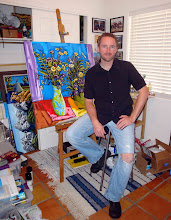
This week I have just finished three new paintings - a new Tumacacori mission painting that shows the mission from a distance through the shade of the trees, as well as two smaller works - one of the Tucson Barrio and another of the Sutherland Trail in springtime. Spring here in southern Arizona has been a wonderful inspiration to paint things as bright as paloverde blooms and brittlebrush flowers that are all around us.
The other day I found myself thinking about the kinds of things that get in the way of an artist doing their work. Oh sure, we have all been privy to those occasional feelings of "if I could have only..." and for the most part I think that's a useless emotion. I always loved a beautiful line from the Live song "Run to the Water" that goes "today we lived a thousand years, all we have is NOW." But at the same time I realize that obstacles do exist, and though I have tried not to make too big a deal out of it, the biggest thing that gets in the way of what I want to do in my life is, and has been, my health.
Some of you know - some may not, that I have had back pain for many years. This little adventure came to a head in the middle of 2009 when a schwanomma tumor was found in my spine, right in the middle of my back. It was actually growing inside the sheath of my spinal cord, and gradually had pressed my spinal chord down to a very fine filament which was all the remained to transmit nerve signals to my lower body. 4 days after it's discovery I was rushed into surgery, and was delighted that the surgery was a success. Recovery was slow and painful, but I gradually got back all the feeling that I'd lost in my legs, and the terrible ordeals of nausea, weakness, shaking, etc in my lower body was gone. But back pain persisted and still does to this day - partially because we know that my last MRI revealed inflammation still in my spinal cord. However I am able to do about 80% of all I could do before, and as it regards life in general - things have gotten much better. Still, on many days I paint, activities as menial as squeezing paint out of the tubes and putting it onto the palette can start the pain. A dull, stinging pain that weakens the muscles in the center of my back and makes it hard to breathe. So many paintings of mine - how many I couldn't know, have been produced while in regular, and sometimes very extreme pain. I've never wanted the works to reflect pain, mind you. I've always preferred that they represent a rejection of a pain-filled mentality. A striving for something beautiful despite the discomfort experienced while making it. I told my wife a few months ago that few people will likely ever appreciate how much physical discomfort has gone into the making of my paintings - yet this is so mostly because I try to de-emphasize it. Some know about it, some don't. Yes, I am a chronic pain sufferer. And I am also very aware that many people have to endure physical ordeals worse than mine, and that has to make you keep perspective.
But, the story doesn't end there. (I wish it did, ha!) In 2007 I had a golf ball sized cyst removed from my jaw. It had corroded a good deal of my jawbone and required surgery to take out. Add 2 more dental surgeries. Countless abscesses in my crowded teeth - more than I can count. Swollen jaws because of it. Add bad eyes - so bad that I can't see beyond the tip of my nose without strong contact lenses. (Just like a painter to be so blind, right) Add a deviated septum in my nose that makes it hard to breathe, and hard to sleep. Add periodic sleep troubles and the resulting exhaustion. Add lactose intolerance. Add tinnitus, ie, chronic ringing in my ears - also a disturber of sleep. And that's just what I can think of...not that the details of each of these things are important, per se. The overall result is that getting me ready and healthy to paint requires all the coordination of a space shuttle launch - and frequently I have painted when I felt horrible, lower than dirt.
At the same time - painting in spite of all these things has been something that helped me through the worst of moments. A mere 2 weeks after my back surgery in 2009 I was back to work on "Giants of the Desert III", stiff, barely able to move - and thinking to myself so this is what it feels like to be cut inside.
I could not go without saying that in addition to painting pulling me through all this discomfort - my lovely wife and son have had the same affect. The fact that I take care of our son during the week has forced me, on many days, to forget my own aches and troubles, and concentrate on taking the best care of him that I could. He was so much good therapy, because a kid just wants to be a kid - to have fun and go to the park and do kid things. My desire not to have him miss these things made me pick myself up, time and time again.
But that's life, isn't it? We could wish to be beautiful, or taller, or to have spines without tumors in them - but wishing alone would never do. The key thing is simple, plain old wisdom. That we do the best with what we have, and that's the most we can ask for. In my case, trusting the best of my paintings are preserved and appreciated by the countless collectors who have bought them - then the pain that marked their creation won't have defined them, and it won't have defined me.
www.neilmyersart.com
Wednesday, May 11, 2011

Sunday, April 17, 2011
The Artist's Life - The Truth
This week I am working on a 30 x 48 inch panoramic painting of Montrose Canyon, a steep, rugged canyon in Catalina State Park, very close to our house. The painting is now into it's 2nd week, and when I think of the way that works of mine can stretch out, I still marvel sometimes at those artists that do works (many of them pretty good, no doubt) in 2 or 3 hours! My paintings can commonly take up to 3 weeks to do, depending on size. The big "Arizona the Beautiful II" that was sold at Marshall-LeKAE Gallery took a full month to finish - with nothing else on the easel and no diversions. Something that was on my mind this week was to perhaps share a little truth with you guys about the real state of an artist's life. I remember an article in a Tucson newspaper about how the state was displacing some low-rent artist studios in downtown Tucson, and what suprised me was not the content of the article, but the veritable torrent of abuse that flowed from the commenters logging on to the news site and basically just calling artists bums, lazy, get a job you loser type things. The reason I say this is quite shocking because I can tell you that almost all artists I know work very, very hard at their craft - some of us all the time. Sometimes no days off, nights, weekends, the entire bit. And when you do your taxes and look over your accounts at the end of the year, there is often a feeling like a protracted punch in the gut - and that feeling means that you could only be doing this if you love it. In art, you don't know when you are going to sell work, so you spend as little as you can get by with most of the time. When you do sell work, you have to immediately look at your obligations, how much for supplies to keep things going, how much for advertising and countless other required things - put tires on the car and buy yourself a couple of pairs of jeans, and then buckle down again. It is difficult, and it is uncertain, but it seems to me that if a person chooses to do this, as I have, and many others have - we make a sincere choice because we feel we almost have to. It's by no means a choice based on laziness or avoidance of work - on the contrary, it's a lot of work, with uncertain rewards and uncertain recognition. You have to love something if you are going to carry that much uncertainty and, oh yes - don't forget! Make beautiful and lasting works. And I think these things are mostly true for the other mid-career level artists, like myself. The others I know don't live in any fancy manner. Beautiful works, you may be suprised to know - come out of very modest, badly lit apartments. Paintings are carried around in old cars, and most of us don't wear gucci :) (Ok, now let's be fair, I probably wouldn't be caught dead in Gucci even if I could afford it.) Or the other thing is that artists have to have some other mode of income or stability alongside of their artwork. In my own case, my lovely wife has a normal job that keeps our family balanced - and I return the favor of her hard work by taking care of our son Liam during the week. A lot of artists I know have side jobs or trades to help them get thru - or the love of a partner who will feed them when things are slow. I worked part time at Barnes and Noble for quite awhile after moving to Arizona. But don't take any of this as a complaint - by no means. This is just the reality of a life that I and some of my friends live. I've been very fortunate to have been published in magazines, have my work collected by serious art collectors from all over, and to have been supported by wonderful galleries and sales people who really believed in the work. I do quite well, overall. However the uncertainty is always with you. So for anyone who might be tempted to stereotype artists as some kind of lazy bums, I'd suggest they ask themselves if they would deal with such a life and still be able to make beautiful works? Because there is no way to understand the life of the artist without understanding that you accept the difficulties that come with it - and the only people with the willpower to see it thru are the ones who can pull that plow and make something beautiful grow around them, despite everything else beating down on them. It is not a business for the lighthearted. But when it works, when things click - there is NOTHING like it in the world!
Sunday, April 3, 2011
Always a Good Time to Say Thanks
This week I am working on a slew of projects, mostly doing touch up work on paintings that were completed over the past month. Seven paintings are finished for my upcoming group of works themed on France and Provence in particular. Those paintings are getting their final touches as we speak, and as soon as I have some of them ready to be viewed, I will post them. What is most important to me is to take the chance to say thank you to the wonderful collectors and art lovers who have made March 2011 one of the most amazing months in my art career. At last count 15 paintings have sold, due in large part of the exposure my work received in the March 2011 issue of Phoenix Home and Garden Magazine . I've had the great good fortune to gain an entirely new group of collectors as a result of my inclusion in this beautiful magazine - and I once again send my thanks to the editors and staff of Phoenix Home and Garden. Some new things that I am working on; when the touch ups on the France paintings are finished, hopefully in the next few days, I will plunge ahead into new Spring and Summer themed Arizona works. This season I am hitting the trails, and walking in those wild, hot, snake infested thorny areas where the greatest paintings come from. I had realized recently that my a combination of my health troubles, which were acute from 2008-early 2010 had actually meant that I was not hiking as much, and therefore not taking photos and getting those original images for new works. Now, thankfully I am in better health, and I have already been out into new areas of Catalina State Park - and I'm planning a couple of new works based on scenes from a very cool part of Arizona that not so many people know - Texas Canyon. Texas canyon is an amazing canyon full of giant, round, tumbledown boulders. A rough and beautiful place. I'm all too excited to get the images onto canvas. Here in Southern Arizona spring is most certainly upon us - the birds are singing and the flowers that have the guts to bloom, despite our lack of rain, are popping out all over the place and coloring our landscape of ochres and sienna and greens. The first Paloverdes are blooming as well, and it will not be long before the land around us will be bathed in that lovely blazing yellow. Any of you folks who are able, be sure to get to Cobalt Fine Arts to see the 3 person show that I am in down there. And be sure to visit the old Tumacacori mission while you are there... ...now back to the studio!
Wednesday, January 19, 2011
Moving into 2011, New Horizons on the Canvas

This week I am working on the 2nd painting is a series of paintings themed on Provence and the South of France. This one is my first rendition of Olive Trees, a subject so beautiful, and so dear to the two painters I admire the most, Jean-Claude Quilici and Vincent Van Gogh. Along with the director of the Marshall-LeKAE Gallery, I've hit upon doing a small display - a small late summer show of 8 to 10 paintings, all themed along the lines of the places in Provence that were painted by Van Gogh and Cezanne. Some of you may know that I spent a six months in Aix-en Provence as a student in 1996, and have seen many of these places with my own eyes. I am excited to do some paintings inspired by this beautiful and historic region. I too have walked this hills and the alleyways frequented by Cezanne, Van Gogh, and many others - and their charm was not lost on me, and still affects me to this day. A lot of what I have done in my paintings of the American West was to take an inspirational spark from the Provencal colorists, and plant it here in the American soil.
We are also in the process of organizing a three artist show at Cobalt Fine Arts in Tubac, featuring myself, Paul Sheldon and Fred Collins. The opening reception is planned for March 26th, and one of my featured paintings, "The Flowers of Fall" is already sold, but will be on display for the opening.
Also, I'd like to remind everyone that I will be featured in the March issue of Phoenix Home and Garden Magazine, and I encourage you all to, pick up a copy. The staff and editors of Phoenix Home and Garden have been a delight to work with, and I am very happy to be featured in this sharp, beautiful publication.
As a last note, I wanted to take a moment to ask all of you to remember the recent victims of the terrible shooting here in Tucson. On that day, my wife and son were shopping at another store only 500 yards away and they saw emergency vehicles rushing past them as they were driving home. Typically, I'm not one given to big pronouncements on this blog - and it is pretty clear that there have been deep political underpinnings to both this act of murder as well as the consequent debate over what it has meant. But I am among the camp who believes, without a doubt, that we have calm down and learn to be civil to one another again. I always loved what Edward Murrow said, "we must not confuse dissent with disloyalty". I do believe that voilent speech does affect people who are already angry and disaffected - for whatever reason. We therefore owe it to our children and our neighbors to stop letting anger dominate our discourse. This great land of ours will survive the discussion. And let's do all we can to also assure that a duly elected official can fulfill the roles that they have been elected to do - without the threat of violence against them. Gabrielle Giffords and the other victims, both living and dead, did not deserve to have their lives shattered by bullets.
Our hearts and are with Mrs Giffords and the other victims, as they recover, and as the families of the lost mourn and make the effort to go on with thier lives.
Let's remember our neighbors in Tucson.
Wednesday, October 27, 2010
Fiji, From the Eyes of an Artist
I have heard it said that travel is lethal to every form of ignorance known to humankind. True enough. When I was a small boy I was fascinated by the globe at my great-grandmother's house, so much so that she wrote my name on the bottom of it and promised it to me when she passed on. Today that same old brown globe sits on a shelf just to right of my desk, where I am writing this, and it is currently turned in such as way as to show the vast South Pacific, with New Zealand, Fiji, New Caledonia, Vanuatu, the Solomons, and countless other islands featured. As some of you may know, my wife and I lived in New Zealand for four years, and we both share a love and fascination with the locales of the South Pacific. Such a love of the region took us to Fiji just a week and a half ago - and I though it might be nice to recap some of the sights and sounds of Fiji for the readers of this column.
Let me first say that as it happens that you have to sometimes get thru the nightmare to arrive at the dream - this was the case in our trip down to Fiji. A short time after takeoff from Los Angeles, a man on the airplane had a violent seizure. Doctors were called for (luckily 4 of them were on the plane), they consulted and advised the captain to turn the plane around back towards LA, where the nearest hospital could be found. So what was supposed to be a 10 hour ride to Fiji turned into a 15 hour ordeal with a cranky toddler. For all those parents out there, you can well imagine what that was like with an 18 month old boy! However there was one shining spot on the trip itself - my wife and I thought we recognized a lady who was on our flight from Tucson to LA. Both of us tossed it around in our minds, and then as we were about to get off the aircraft it hit us...she was one of the actresses on the show "Private Practice". It was Amy Brenneman. At some point when we were at baggage claim at LAX we ended up again beside her and her family; both she and her daughter were watching our son Liam take his chance to run around and play with the luggage and she said "He's so cute!" At that point I said "Pardon me Ma'am, but are my wife and I imagining things or are you one of the ladies from 'Private Practice?' She nodded yes with a smile. I shook her hand and said "Nice to meet you", and told her how much we enjoyed the show. I've never been one to gush over celebs or actors, but running into someone like Amy Brenneman makes life interesting from time to time. I worked in hotels for many years, and enjoyed meeting some pretty interesting people in entertainment and politics.
In any event, after the 15 hour ordeal from LAX to Nadi, Fiji, we finally arrived. Wiped out but wide eyed, as you can imagine. The taxi ride in from the airport to the resort was one of the most eye opening things - and it reminded me a lot of Vanuatu. Though Fiji clearly had better infrastructure that Vanuatu, many part of it were still quite poor and many Fijians life without comforts that we all take for granted. Even as simple as running water. It's also eye opening to see how dirty and unkept poor towns can be. With little money to keep things clean or pave sidewalks and do necessary repairs, again these are all things we don't even think about in America and many western style countries. But if the towns may have been a little rough and life rudimentary - Fijian's more than made up for it by their warm welcome and beautifully friendly attitude.
Of course we stayed on a resort at Denarau Island, so yes we enjoyed Fiji on the high end. But there were many acts big and small that even resort employees didn't need to do. For example, the Fijian greeting "Bula" was common among everyone you'd meet on the resorts and other places. It was such a warm greeting that after awhile, you'd hear the guests children saying "Bula!" to staff and to others. Another amazing thing about Fijians is their love of family. Our son got kissed by more strangers during his week in Fiji than in his entire life before! Passing security on the way OUT of the country, he got kissed on the cheeks twice by ladies working there. At the resort, one of the doormen actually learned the baby sign for "more" so that he could ask Liam if he wanted to ride on the golf cart with him! One of my best memories of Fiji will always be standing with Liam in front of the Sheraton at Denarau Island and seeing this big, dark Fijian man pull up on a golf cart, look at Liam right in the face and put his hands together making the baby sign for "more"! What was clear was how much the people of the island love children, even those who are not their own. Quite a contrast to how kids are sometimes treated as nothing more than a nuisance to some in our culture.
Of course, being a landscape artist, it was the landscape that filled my eyes everywhere we visited. Fiji was green in many places, but still parched brown and dry in others. The islands were in desperate need of rain by the time we arrived, and the rains that plagued us for the first 3 days of the trip were quite welcome to the locals. In the countryside stretched near endless fields of sugarcane, a huge part of the Fijian economy. Cassava and others things were grown as well. But sugarcane, by it's very presence, appeared to be king. During the days when it rained the entire landscape took on a bit of a foreboding aspect - and when you looked on the fields and mountains in the dark, ominous clouds, it looked almost scary. But the break of the rains after the 3rd day opened up the Fiji that all the tourists know - gleaming and beautiful. Tropical, green, and alive.
We took 2 day trips that got us off the resort and out into the Fijian countryside. One was a trip to the Garden of the Sleeping Giant, a lovely botanical garden nestled in next to dark, volcanic mountains. There we browsed some of the most lovely orchids you've ever seen, as well as a lily pond in the middle of the jungle - something that seemed more a product of a fairy tale that realty. Even in the rain, the scene was beautiful. With dark, volcanic hills towering above the dripping wet jungle below.
Our 2nd day trip was out to a resort island called Robinson Crusoe Island. Here was a long, lovely island that was still quite small and quaint. The boat ride out there, winding its was through mangroves and other lovely scenes was equally memorable. The island itself is a small tourist island, and when we arrived we were treated to traditional greetings as well as a Kava ceremony. Kava, as some of you may know, is a drink that is enjoyed my many different island cultures in the South Pacific, but it has the most ritualistic significance for Fijians. Kava is offered as a gift of respect between tribes, and also when one wants to visit a Fijian village it is considered proper to offer a gift of Kava to the chief. In the old days, if the chief accepted you were safe - if he did not, then you better run like hell because you might be dinner for the tribe later that evening!
While on the island I went out for a snorkel while my wife and son enjoyed the beach. Snorkling was difficult on the reef which was probably a mile or so offshore, however it was still a great experience even when fighting the currents. All the colors of the fish and corals below were wilder and more intense than any artist's palette.
While I was there, I found myself thinking of something that I had told art lovers before - that I love lots of different scenes that I find around the world. I love the jungles equally as I do the deserts. Mountains as much as the seashores. I have been called a Southwestern painter because of where I live, and I don't altogether reject that notion - because my work has blossomed best in Arizona, New Mexico, and the American West in general. Just the same, though - a jungle in Fiji or a seashore in New Zealand are equally beautiful and interesting to me. Many people aren't aware that I've done 2 paintings of the giant Moai of Easter Island - and they were some of my favorites - both sold. I once told my wife when we were discussing unusual or exotic landscapes how much I enjoyed strange places, or visually challenging places, but I also said "of course the most radical landsapes aren't here, they are on other planets." Which might well explain my own fasciantions with the pictures taken by space probes of Venus's surface, and those on Mars, the moon, and Saturn's moon Titan.
Overall, I would rate Fiji an incredible experience. Travel is something that is good for the soul, and I'm sure that it's absolutely necessary for an artist. The challenge to the eye that travel brings for an artist is crucial to helping them understand their own work, and rise to the challenges of tackling new scenes that they have the good fortune to experience. Stagnation is an enemy for an artist, and the thrill of new places is often the perfect antidote. Fiji did that for me, and I hope to go back again.
www.neilmyersart.com
Let me first say that as it happens that you have to sometimes get thru the nightmare to arrive at the dream - this was the case in our trip down to Fiji. A short time after takeoff from Los Angeles, a man on the airplane had a violent seizure. Doctors were called for (luckily 4 of them were on the plane), they consulted and advised the captain to turn the plane around back towards LA, where the nearest hospital could be found. So what was supposed to be a 10 hour ride to Fiji turned into a 15 hour ordeal with a cranky toddler. For all those parents out there, you can well imagine what that was like with an 18 month old boy! However there was one shining spot on the trip itself - my wife and I thought we recognized a lady who was on our flight from Tucson to LA. Both of us tossed it around in our minds, and then as we were about to get off the aircraft it hit us...she was one of the actresses on the show "Private Practice". It was Amy Brenneman. At some point when we were at baggage claim at LAX we ended up again beside her and her family; both she and her daughter were watching our son Liam take his chance to run around and play with the luggage and she said "He's so cute!" At that point I said "Pardon me Ma'am, but are my wife and I imagining things or are you one of the ladies from 'Private Practice?' She nodded yes with a smile. I shook her hand and said "Nice to meet you", and told her how much we enjoyed the show. I've never been one to gush over celebs or actors, but running into someone like Amy Brenneman makes life interesting from time to time. I worked in hotels for many years, and enjoyed meeting some pretty interesting people in entertainment and politics.
In any event, after the 15 hour ordeal from LAX to Nadi, Fiji, we finally arrived. Wiped out but wide eyed, as you can imagine. The taxi ride in from the airport to the resort was one of the most eye opening things - and it reminded me a lot of Vanuatu. Though Fiji clearly had better infrastructure that Vanuatu, many part of it were still quite poor and many Fijians life without comforts that we all take for granted. Even as simple as running water. It's also eye opening to see how dirty and unkept poor towns can be. With little money to keep things clean or pave sidewalks and do necessary repairs, again these are all things we don't even think about in America and many western style countries. But if the towns may have been a little rough and life rudimentary - Fijian's more than made up for it by their warm welcome and beautifully friendly attitude.
Of course we stayed on a resort at Denarau Island, so yes we enjoyed Fiji on the high end. But there were many acts big and small that even resort employees didn't need to do. For example, the Fijian greeting "Bula" was common among everyone you'd meet on the resorts and other places. It was such a warm greeting that after awhile, you'd hear the guests children saying "Bula!" to staff and to others. Another amazing thing about Fijians is their love of family. Our son got kissed by more strangers during his week in Fiji than in his entire life before! Passing security on the way OUT of the country, he got kissed on the cheeks twice by ladies working there. At the resort, one of the doormen actually learned the baby sign for "more" so that he could ask Liam if he wanted to ride on the golf cart with him! One of my best memories of Fiji will always be standing with Liam in front of the Sheraton at Denarau Island and seeing this big, dark Fijian man pull up on a golf cart, look at Liam right in the face and put his hands together making the baby sign for "more"! What was clear was how much the people of the island love children, even those who are not their own. Quite a contrast to how kids are sometimes treated as nothing more than a nuisance to some in our culture.
Of course, being a landscape artist, it was the landscape that filled my eyes everywhere we visited. Fiji was green in many places, but still parched brown and dry in others. The islands were in desperate need of rain by the time we arrived, and the rains that plagued us for the first 3 days of the trip were quite welcome to the locals. In the countryside stretched near endless fields of sugarcane, a huge part of the Fijian economy. Cassava and others things were grown as well. But sugarcane, by it's very presence, appeared to be king. During the days when it rained the entire landscape took on a bit of a foreboding aspect - and when you looked on the fields and mountains in the dark, ominous clouds, it looked almost scary. But the break of the rains after the 3rd day opened up the Fiji that all the tourists know - gleaming and beautiful. Tropical, green, and alive.
We took 2 day trips that got us off the resort and out into the Fijian countryside. One was a trip to the Garden of the Sleeping Giant, a lovely botanical garden nestled in next to dark, volcanic mountains. There we browsed some of the most lovely orchids you've ever seen, as well as a lily pond in the middle of the jungle - something that seemed more a product of a fairy tale that realty. Even in the rain, the scene was beautiful. With dark, volcanic hills towering above the dripping wet jungle below.
Our 2nd day trip was out to a resort island called Robinson Crusoe Island. Here was a long, lovely island that was still quite small and quaint. The boat ride out there, winding its was through mangroves and other lovely scenes was equally memorable. The island itself is a small tourist island, and when we arrived we were treated to traditional greetings as well as a Kava ceremony. Kava, as some of you may know, is a drink that is enjoyed my many different island cultures in the South Pacific, but it has the most ritualistic significance for Fijians. Kava is offered as a gift of respect between tribes, and also when one wants to visit a Fijian village it is considered proper to offer a gift of Kava to the chief. In the old days, if the chief accepted you were safe - if he did not, then you better run like hell because you might be dinner for the tribe later that evening!
While on the island I went out for a snorkel while my wife and son enjoyed the beach. Snorkling was difficult on the reef which was probably a mile or so offshore, however it was still a great experience even when fighting the currents. All the colors of the fish and corals below were wilder and more intense than any artist's palette.
While I was there, I found myself thinking of something that I had told art lovers before - that I love lots of different scenes that I find around the world. I love the jungles equally as I do the deserts. Mountains as much as the seashores. I have been called a Southwestern painter because of where I live, and I don't altogether reject that notion - because my work has blossomed best in Arizona, New Mexico, and the American West in general. Just the same, though - a jungle in Fiji or a seashore in New Zealand are equally beautiful and interesting to me. Many people aren't aware that I've done 2 paintings of the giant Moai of Easter Island - and they were some of my favorites - both sold. I once told my wife when we were discussing unusual or exotic landscapes how much I enjoyed strange places, or visually challenging places, but I also said "of course the most radical landsapes aren't here, they are on other planets." Which might well explain my own fasciantions with the pictures taken by space probes of Venus's surface, and those on Mars, the moon, and Saturn's moon Titan.
Overall, I would rate Fiji an incredible experience. Travel is something that is good for the soul, and I'm sure that it's absolutely necessary for an artist. The challenge to the eye that travel brings for an artist is crucial to helping them understand their own work, and rise to the challenges of tackling new scenes that they have the good fortune to experience. Stagnation is an enemy for an artist, and the thrill of new places is often the perfect antidote. Fiji did that for me, and I hope to go back again.
www.neilmyersart.com
Friday, October 8, 2010
Keeping it New

This week I am working on a large 30 x 40 in landscape from one of my favorite places in Arizona - Catalina State Park. As luck would have it, it seems that something is blooming there almost all the time, and some of the most extraordinary yellows can be found among the flowers lining trails like the Sutherland Trail.
Recently I finished reading the book "The Genius in all of us" by David Shenk, and in that book the author makes the very compelling argument that talent - or what some may call 'genius', is something that is much more the product of work, conditioning, and overall concerted effort - and that the old adages about a person being born with a certain ability are over exaggerated and often just plain wrong. He details sports figures, and countless others that had surprisingly humble beginnings, and who honed their crafts to such an extent that they become the best in their respective abilities.
With the information in this book, it seems to me that one could say that ability is something that is developed and made. Art is no different. I might concede that as a young man, I was moved by art on a level of instinct, before I had any other conceptions or ideas about it. But my own experience in becoming an artist, and becoming an exhibiting artist with some good credits to his name - that has been a product of nothing but work, work, work. I think sometimes people get the idea that the artist is a listless person who just daubs a few things on canvas and tries to swindle the world into thinking it's the work of genius. Nothing could be further from the truth. My mentor, the artist Jean-Claude Quilici, said in an interview that "painting is a manual craft, and you learn it by doing it." Well said. Sure there are prodigies in art, like anything else (I was not one of them :) however the book also details how prodigies are the result of people being in certain situations that allowed them to be taught well, and for their skills to grow at a very early age. Mozart's father was a music teacher...surprise surprise. Picasso's father exposed him to thorough lessons in art and draftsmanship. Even my mom taught me about drawing and shading and such - and I was not without some roots. Growing up as I did, looking at her drawings and paintings from the 1970s.
As I was thinking about this book, my conception of my own painting style lead me to conclude that it was horribly rigid. That is, what I do, I do the same way almost every single time. By no means is the image the same - but the execution, and my own learning about my craft had solidified into something like iron - inflexible. Always there but without the air of experimentation. So when I read in this book about how one of the characteristics of successful people is that they are never satisfied with their current skill level - I decided to devote at least a portion of my time to artistic experimentation. I bought pastels and have begun experimenting with them, and am looking to do both watercolors and a few figure paintings - mostly portraits. I've completed 3 portraits and 4 pastel paintings, and subsequently found myself enjoying what I was doing - because it was new and fresh, and for the fact that I was having to challenge myself to learn how to get adequate effects from the new mediums.
The other day as I was in the studio staring at the three portraits I had completed, our 18 month old son walked in and pointed straight at my self-portrait and said "Da da!" with a big smile on his face. And even though a tough assessment has led me to conclude that my portraits are a bit amateurish and need work - I find myself thinking that if my self portrait was immediately recognizable to an 18 month old boy, then there must be at least enough content there to keep working on it and refine it. Few people know that one of my first art sales ever was a portrait of the painter Renoir. Funny how we circle back to our roots, isn't it?
To me, the best artists adapt themselves to multiple mediums, and that is something that I want to continue to work on and explore. It goes without saying that my oil on canvas landscapes have built my art career - and I would not presume to know if galleries I show with would have the desire to show watercolors and pastels by me. But all I can know for now is that the experimental urge is good to for me, good for my sanity - and I believe that it will ultimately be good for my art.
www.neilmyersart.com
Friday, July 23, 2010
The Music of the Doors, A Statement of Art
 This week I have just finished a new painting of an orange tree dangling over Oak Creek in Sedona. A heavy, colorful piece that has all the peculiarity of one of my works - where even the water or the leaves give off the feeling of weighing a hundred tons.
Those who have read my blogs will know that I am a great appreciator of what seem to me to be true and powerful artistic statements, even if the aritsts in question are not oil painters or visual artists. I've long admired the Candyland-like fantasies of the architect Gaudi. And among a legion of amazing artists that I admire and respect are found countless musicians. One of which stands alone, The Doors.
The first and most obvious thing about The Doors is the persistence and the longevity of the music that they created. "Unknown Soldier" could tell the story of an American soldier in Afghanistan just as well as its implied references to soldiers and the militarism and violence of the Vietnam era. The cry "What have they done to the earth? What have they done to our fair sister?" that rings out in "When the Music's Over" could well tell the story of an oil-stained gulf coast beach today. It could well be a statement in agony over the destruction of so many irreplacable natural habitats on our planet.
Timelessness demonstrates the power of an artistic statement. Those statements that are too much a product of the time that they were expressed in tend to dissipate with the passing of that particular time. The music of the Doors is powerful because it is an inter-generational commentary by sensitive individuals, who were deeply concerned with the art of what they were saying. Some regard Jim Morrison as an American poet - and I share this feeling. Though it should not be overlooked that Robbie Krieger wrote some of the Doors' best known songs, most notably the immortal "Light my Fire." If you read Morrison's published notebooks and poems, such as "Wilderness" and "The American Night", then you realize that his sensations and words were not always a product of the rational, but in the images that they created, powerful visions were let loose on the consciousness of those who read them in print - and those who heard them in Doors concerts. Morrison was reported to have said that "real poetry doesn't say anything, it just ticks off the possibilities."
Frequently, when I allowed myself to think about my own paintings in a deeper way - I articulated in my mind a dual standard that I always wanted to strive for. That standard was beauty and originality. I think the Doors and their music also lines up nicely with this idea of a creative aspiration. Of course many of the lyrics and sentiments in the music of the Doors were dark, even darkened Dionysian visions of America and our reality. But I don't count that as ugly - I think that's beautiful. Disturbing images, or even disturbing songs can stir the mind to beauty just as much as an any other cliche of beauty can. And songs like "Summer's Almost Gone" as well as "Crystal Ship" are indeed quite beautiful on the surface. It has seemed to me that the poignant words of Morrison, and the carnavalesque feeling of Ray Manzarek's organ went hand in hand in making songs that could range you for the depths of joy, sadness, confusion, even apocalyptic sensations.
What does the music of the Doors say to artists of all varieties? Primarily, I think it drives home, with punishing insistence, the reality that there really is NO substitute for originality in the creative arts. When you realize how much timeless substance exists in the songs of the Doors, you realize that a true statement of creation - as I've mentioned above, is timeless and inter-generational. So if you wish to hang your hat with the gods of the creative arts - it should be obvious that you ought to aim for the timeless and the original. Take a lesson from the Doors, and the fact that we are still talking about them today.
www.neilmyersart.com
Subscribe to:
Posts (Atom)