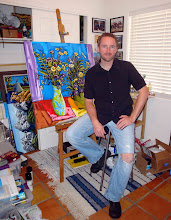
Welcome to creativity blog #3, this one featuring California based painter Ken Christensen. I have always been a great fan of Ken's work, and I even have one of his paintings hanging on the wall of our family room - alongside the best works of my artist friends. Ken has an extensive body of work and throughout his paintings I have always felt that he was one of the best at striking a near perfect 'tension of details', as I like to call it. By that I mean he adds just enough detail to preserve the visual scene, but his works still show traces of the joyful spontenaiety of a sketch. Ken was integral in the creation of the "New Fauves" group of artists - which I might add is the only group of artists that I have formally affilliated myself with in my entire art career. This is a group of painters who all feel their roots in Fauvism and Expressionism - who sense, as I do, the great debt that we owe to artists like Van Gogh and the Fauvist painters that followed him. I was also delighted to find that Ken knew of and appreciated the work of my mentor and friend, the artist Jean-Claude Quilici.
Here is the Q and A with Ken, enjoy!
Ken Christensen
Artist - Writer
http://www.kenchristensen.net/pages
1) What personal habits do you have that you feel make you more creative?
One of the things that keeps me creative is going for long walks.
Everything you need to know is in nature. Nature reveals its secrets
slowly so you have to be patient. You can pass by the same scene many
times but at one special moment a new vision of the same thing can be
revealed. It's impossible to find a subject to paint by driving around
in a car. I have to see things on foot, one step at a time. And in art
light is always the real subject. So at every time of day, when the
light is different there is always a different subject. There can be
nothing at one time of day to paint and at another time when the sun is
in a different position something remarkable may reveal itself.
We are always standing on the shoulder of
giants and most good ideas spring out of something earlier by someone
else.
Another habit that feeds my creativity is sketching. Sketching
is art in its purest form. When I sketch I'm not thinking of sales or
finished work; I'm just having fun. When you're having fun, good things
happen. When I sketch I am being more personal in what I choose to
portray. It is the personal in art that really sets
the greats apart. One must have a unique vision and art succeeds as
much as you are being yourself. Sketching whatever catches your eye
allows this personal vision to flourish.
2) Who are the creative artists, in any field, that inspire you the most?
I'm a huge Neil Young
fan. In literature Henry Miller has had a huge influence on me. In art,
Van Gogh has been my hero since childhood, not only for his art but for
his life and convictions. His letters are one of the great works of
world literature and very inspiring. The artist I've known personally
that has influenced me the most is my friend Manuel Gil in Paris. Manuel
is Spanish but has lived in Paris thirty years or more. He showed me
what a true artist is. He has an energy and enthusiasm for art that I
have rarely encountered. It reminds me of what I know of Picasso who
could create art out of anything, by picking up whatever was at hand.
Manuel turned me on to other techniques like woodblock printing, pastel
portraits, monotypes, and other things. Like Picasso,
Manuel is also an original thinker with surprising opinions on a wide
range of subjects. He is a wild bohemian but also a true nobleman who
has a sensitivity and insight beyond the majority.
3) What do you do when you are not feeling creative? Or - how to you get yourself back to a point where you are feeling creative?
As I was
saying, the first step in trying to find the urge to paint or some
creativity is to go for a long walk. A very long walk will always sort
things out. The other thing I do is to switch techniques. If I'm getting
burned out or bored with oil painting I will switch to watercolor for a
week or weeks. I also go back to sketching , the source for all further
creative endeavors. Lastly, if I'm still stuck I will force myself to
do something. Just working will release my creative juices. Without fail
I always feel better by doing something, anything. Just doing something
will snap you out of your lethargy and get the juices flowing.
4) What are some creative outlets that you enjoy outside your own respective creative field?
I write. I've written five books. I just finished another one, "Between the Covers: Reading, Writing, and Romance"
which is a memoir told through my connection to books, reading, collecting, running a bookstore, and writing.
5) For someone who has talent in a creative
field, how would you suggest they go about converting that talent into
something original - something that stands out from the crowd?
As
I said, great art is always personal. It sounds too simple but the
ultimate advice is to be yourself. Trust yourself that your idle
thoughts are worthy of developing. There is room at the top for any
style in any field if it is original. It depends if your goal is to
create art or to make money. They are often very different. In terms of
creativity and quality art then one must trust oneself and do whatever
you damn please.
Links
Official website: http://www.kenchristensen.net/pages
New Fauves website: http://www.newfauves.com/pages
Showing posts with label Watercolor. Show all posts
Thursday, May 9, 2013
Friday, October 8, 2010
Keeping it New

This week I am working on a large 30 x 40 in landscape from one of my favorite places in Arizona - Catalina State Park. As luck would have it, it seems that something is blooming there almost all the time, and some of the most extraordinary yellows can be found among the flowers lining trails like the Sutherland Trail.
Recently I finished reading the book "The Genius in all of us" by David Shenk, and in that book the author makes the very compelling argument that talent - or what some may call 'genius', is something that is much more the product of work, conditioning, and overall concerted effort - and that the old adages about a person being born with a certain ability are over exaggerated and often just plain wrong. He details sports figures, and countless others that had surprisingly humble beginnings, and who honed their crafts to such an extent that they become the best in their respective abilities.
With the information in this book, it seems to me that one could say that ability is something that is developed and made. Art is no different. I might concede that as a young man, I was moved by art on a level of instinct, before I had any other conceptions or ideas about it. But my own experience in becoming an artist, and becoming an exhibiting artist with some good credits to his name - that has been a product of nothing but work, work, work. I think sometimes people get the idea that the artist is a listless person who just daubs a few things on canvas and tries to swindle the world into thinking it's the work of genius. Nothing could be further from the truth. My mentor, the artist Jean-Claude Quilici, said in an interview that "painting is a manual craft, and you learn it by doing it." Well said. Sure there are prodigies in art, like anything else (I was not one of them :) however the book also details how prodigies are the result of people being in certain situations that allowed them to be taught well, and for their skills to grow at a very early age. Mozart's father was a music teacher...surprise surprise. Picasso's father exposed him to thorough lessons in art and draftsmanship. Even my mom taught me about drawing and shading and such - and I was not without some roots. Growing up as I did, looking at her drawings and paintings from the 1970s.
As I was thinking about this book, my conception of my own painting style lead me to conclude that it was horribly rigid. That is, what I do, I do the same way almost every single time. By no means is the image the same - but the execution, and my own learning about my craft had solidified into something like iron - inflexible. Always there but without the air of experimentation. So when I read in this book about how one of the characteristics of successful people is that they are never satisfied with their current skill level - I decided to devote at least a portion of my time to artistic experimentation. I bought pastels and have begun experimenting with them, and am looking to do both watercolors and a few figure paintings - mostly portraits. I've completed 3 portraits and 4 pastel paintings, and subsequently found myself enjoying what I was doing - because it was new and fresh, and for the fact that I was having to challenge myself to learn how to get adequate effects from the new mediums.
The other day as I was in the studio staring at the three portraits I had completed, our 18 month old son walked in and pointed straight at my self-portrait and said "Da da!" with a big smile on his face. And even though a tough assessment has led me to conclude that my portraits are a bit amateurish and need work - I find myself thinking that if my self portrait was immediately recognizable to an 18 month old boy, then there must be at least enough content there to keep working on it and refine it. Few people know that one of my first art sales ever was a portrait of the painter Renoir. Funny how we circle back to our roots, isn't it?
To me, the best artists adapt themselves to multiple mediums, and that is something that I want to continue to work on and explore. It goes without saying that my oil on canvas landscapes have built my art career - and I would not presume to know if galleries I show with would have the desire to show watercolors and pastels by me. But all I can know for now is that the experimental urge is good to for me, good for my sanity - and I believe that it will ultimately be good for my art.
www.neilmyersart.com
Subscribe to:
Posts (Atom)