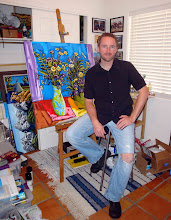
It was with great sadness that I was told a few days ago of the passing of the artist Paul Sheldon. Mesia Hachadorian, the director of Cobalt Gallery, called me this past Friday and informed me that Paul had died very suddenly the previous Wednesday. We both shared the shock and sadness of the moment - that horrible and huge feeling you get when your mind has to try to process your world going forward - without one of your friends in it.
I thought back and I could not remember specifically when I had met Paul. I ran into him coming and going from the Max Gallery when he and I were both represented there. I got to know him a bit better when he came on board at another gallery where I also showed work, Cobalt Fine Arts in Tubac. Paul and Cobalt Gallery did very well together, and it was there that I ran into him regularly, during demonstrations and other occasions. At some point I began to kid him by saying "Well Paul, we should at least be friends because when we both kick over they'll say that we were two of the best Arizona colorist painters!" It was all a joke at the time - I could not have imagined that I would now be writing a blog and he would no longer be with us.
As artists Paul and I shared one thing that was unmistakable - a great love of color and a curiosity to see what extreme color statements could do in the confines of a painting. I don't know if Paul would have identified with Fauvists, as I have, because I never actually heard him talk of painting movements or where he thought he fell in the greater scheme of things. I actually almost appreciated that because many of us who have found our style that we love and are known for - many of us don't spend that much effort worrying about how we will be remembered on exactly where we fit. We just do our work and go at it with the sense that it doesn't require that much talking about. Paul seemed very much that way. He just painted and didn't expound. Sure he did demonstrations of his work, as we all do - but he was never preachy or self-consumed. It was more like a sort of 'have a look if you want' mentality that I very much respect.
I last saw Paul a few months ago when we got together to play music. He played the hammer dulcimer. He dropped by our house, set up his instrument in our son's play area and he and I ran thought a series of tunes matching my 12 string guitar to his dulcimer. After a lot of fooling around we decided that "Tequila Sunrise" by the Eagles and "Too Sober to Sleep" by Justin Rutledge were the best songs for the two instruments, and we practiced them a few times. Paul had a great natural ear for music.
At about that moment I was on my way to look for a gallery in Santa Fe around that time, and we talked a few times on the phone quite extensively about ideas for showing work - and he and I even discussed a possible trip through Colorado to look for galleries. Paul had just gotten himself a fine new truck and was eager to make a big trip of it. It stands in my mind now that we all have that in our lives. Those plans we want to get to but never come to fruition. The lesson - if you have a mind to do something, do it before anything else gets in the way. You may not have tomorrow to take a road trip with a friend and see the mountains of Colorado.
There is one great consolation when we think about the life of an artist who has left us - the work. The work will remain as long as people care to preserve it. So many lives come and go on this earth, people spend their time and they are gone with little more evidence than the gravestone. Artists have a buffer against their mortality in their work; and so we can look again, maybe even with new eyes, and be thankful for the beautiful colors and glowing images that an artist leaves us. He put himself into those works, so he will, by default, remain with us.
Paul, if I could speak to you I would say thank you for your friendship and thank you for the work that you have left us to enjoy for many years to come. I was very glad to know you - and if it happens that there is something on the other side for us when this life is over, I hope it's full of neon-cowboys, Arizona sunsets, and old Western Movies.
Thank you Paul.
http://www.psheldon.com/
Tuesday, August 7, 2012
Wednesday, July 11, 2012
Saguaros - and NO I Don't Get Tired of Painting Them!
Hello everyone - sorry I've been a little absent. I tend not to blog like a madman. I prefer to write something when I actually have something to say, rather than all to the reams of drivel and blabber floating around out there on the internet.
This week I am working on a new 30 x 40 of Saguaros on a hillside of blooming brittle-brush. This painting, and a legion of others that are sitting and drying in the studio gave me the idea for this blog post - some thoughts about one of our great Arizona icons, the Saguaro cactus.
Since we are planning a saguaros show of my paintings at the Marshall-LeKAE Gallery in Scottsdale for March of 2013, I thought it might be nice to reflect a little on the giant cactus that has been so much the centerpiece of countless paintings by me - and other Arizona artists.
I remember once talking to Max Mikesell, who formerly ran the Max Gallery in Tucson some years back, and I remember Max saying that it seemed to him that some artists who paint saguaros hadn't even looked at them. Almost as if they had some general idea of what a saguaro should look like; two upturned arms, very "roadrunner and coyote" kind of landscape stereotype. And he mentioned that even though my saguaro themed works weren't strictly realistic, they still showed evidence that I had taken some time to look at them...and indeed I have.
What is most important if you are an artist painting Saguaros is the realization that they provide on of the most prominent verticals in a landscape dominated by big skies, small, round trees, and huge horizons. Saguaros cast your eyes up to the vertical, and thus balance a landscape much the way that a pine tree might well do back east in the woods. But the cool thing about saguaros is their amazing shapes and individual character. I've told people that they might well be one of the few plants that I think actually have personality. You see them swell with the summer rains. You see them hold up and hold firm when monsoon storms rip through the area. And you see them lord over the landscape like giants - standing tall and proud even in the hottest, most brutal parts of Arizona summer. I have called some among the series of saguaro paintings that I've done "Giants of the Desert", and it seems to me that they are indeed giants who stand over us in the fiery heat of our surroundings. When you come to know them and the fact that they grow so slowly that they are frequently 50 to 75 years old before they even sprout a single arm - you then realize that in mature saguaro forests, you may be looking at 150 or 200 year old plants. Plants whose duration dwarfs the lifetime of humans. I remember a biologist saying that was one of the problems of long term saguaro studies; that it is hard to study them in a sustained way because that might take three generations of scientists. Imagine...
(I'll note for the record also that people still get a laugh at me because I have the habit of saying "Sa-Guaros" with a hard "G". Whereas most of the locals say "sah-wa-ros". Oh well, I didn't grow up here, and some habits die hard.)
For me, I guess it's fair to say that I've set myself up and studied them as intently as Monet did Rouen Cathedral, or his poplars. I have never gotten tired of looking at them, and always been keen to understand the unique personality of the plants as I studied them.
I love the world in all it's landscapes and variety. But there will always be a soft spot in my heart for these wonderful "Giants of the Desert."
www.neilmyersart.com
This week I am working on a new 30 x 40 of Saguaros on a hillside of blooming brittle-brush. This painting, and a legion of others that are sitting and drying in the studio gave me the idea for this blog post - some thoughts about one of our great Arizona icons, the Saguaro cactus.
Since we are planning a saguaros show of my paintings at the Marshall-LeKAE Gallery in Scottsdale for March of 2013, I thought it might be nice to reflect a little on the giant cactus that has been so much the centerpiece of countless paintings by me - and other Arizona artists.
I remember once talking to Max Mikesell, who formerly ran the Max Gallery in Tucson some years back, and I remember Max saying that it seemed to him that some artists who paint saguaros hadn't even looked at them. Almost as if they had some general idea of what a saguaro should look like; two upturned arms, very "roadrunner and coyote" kind of landscape stereotype. And he mentioned that even though my saguaro themed works weren't strictly realistic, they still showed evidence that I had taken some time to look at them...and indeed I have.
What is most important if you are an artist painting Saguaros is the realization that they provide on of the most prominent verticals in a landscape dominated by big skies, small, round trees, and huge horizons. Saguaros cast your eyes up to the vertical, and thus balance a landscape much the way that a pine tree might well do back east in the woods. But the cool thing about saguaros is their amazing shapes and individual character. I've told people that they might well be one of the few plants that I think actually have personality. You see them swell with the summer rains. You see them hold up and hold firm when monsoon storms rip through the area. And you see them lord over the landscape like giants - standing tall and proud even in the hottest, most brutal parts of Arizona summer. I have called some among the series of saguaro paintings that I've done "Giants of the Desert", and it seems to me that they are indeed giants who stand over us in the fiery heat of our surroundings. When you come to know them and the fact that they grow so slowly that they are frequently 50 to 75 years old before they even sprout a single arm - you then realize that in mature saguaro forests, you may be looking at 150 or 200 year old plants. Plants whose duration dwarfs the lifetime of humans. I remember a biologist saying that was one of the problems of long term saguaro studies; that it is hard to study them in a sustained way because that might take three generations of scientists. Imagine...
(I'll note for the record also that people still get a laugh at me because I have the habit of saying "Sa-Guaros" with a hard "G". Whereas most of the locals say "sah-wa-ros". Oh well, I didn't grow up here, and some habits die hard.)
For me, I guess it's fair to say that I've set myself up and studied them as intently as Monet did Rouen Cathedral, or his poplars. I have never gotten tired of looking at them, and always been keen to understand the unique personality of the plants as I studied them.
I love the world in all it's landscapes and variety. But there will always be a soft spot in my heart for these wonderful "Giants of the Desert."
www.neilmyersart.com
Saturday, April 28, 2012
The "Tension" of Details in a Painting
This week I am working on two new Saguaro paintings intended for a show in March of next year. Some of you guys may know that I have to work on paintings far in advance of their delivery date due to the fact that the paint is so thick that it needs extended time to dry. Good thing I have the super-dry Arizona air to help me there...
Recently I exchanged paintings with a wonderful California painter named Ken Christensen. Ken is a member of the "New Fauves" painters group; a group of contemporary artists working roughly in the Fauvist manner. ( you can visit Ken's website at http://kenchristensen.net/pages/art?section_id=2 ) When I saw the beautiful painting that Ken sent me, I found myself thinking about how much and how little detail is necessary in a painting. I found myself thinking this because Ken struck such a perfect balance of essentials - without feeling compelled to paint the hair on a fly's neck from a mile away.
This is what I refer to as the "tension" of details. It's a little like tuning a guitar or violin - the strings reach a point where they are of the right tension and the sound of an instrument in tune comes pleasantly to your ears. Ken's paintings do this very, very well. He may be one of the best I've seen yet. Though I am still a devoted admirer of my mentor Jean-Claude Quilici, who also strikes a beautiful balance of detail and non-detail in his work. Awhile back Ken mentioned to me via email that when he lived in France one of his favorite painters was Jean-Claude Quilici - a fact that put a smile on my face and perhaps told me that Ken too had taken a lesson in Quilici's own ideas about how much detail was essential for painting.
Much of this, I am sure, boils down to temperament. I am a painter who delights in essentials. Broad swaths of color, thick paint, etc. I get uncomfortable with smaller and smaller details - though the sensible side of me knows that details are essential. I would be most happy putting on paint with a trowel if I could - but I know that small touches can enhance the bigger ones. So I usually press on all the while trying to balance the little with the big. Though I see the big more prominently. I still marvel at painters who can do a painting in a day. Commonly I will work a week on a painting. I remember one December a few years ago, I worked on one painting all month. People tell me this is a long time - but I think about Michelangelo lying on his back working on the Sistine Ceiling for 4 years and it seems like nothing at all.
Too little detail in a painting can be irritating and unsatisfying, at least to my mind. Case in point, the longer I've lived the less I actually liked the great Fauvist master Matisse. A few years ago my wife and I saw a show of works at the Phoenix Museum of Art and there were several Matisse paintings featured; honestly, some of them looked like bad preliminary sketches. Like he had simply blobbed on some shapes with a turpentine wash coat and to my surprise - signed them! My wife even shaking her head. Mind you, that is not to say that Matisse's entire body of work is bad or irrelevant - not at all. But that those we saw were very low quality, and not reflective of some of the better Matisse paintings I've seen in the past. I've always believed that those artists we commonly consider "Masters" can't simply be considered so because their name is in the corner of the paintings. You must earn it every time. Every time. A true master, if he were a baseball player, for example, would step up to the plate and try to hit the ball over the fence every time. He would try to put it out of the stadium if he could. At no point should you step up to the artistic plate and think that you can maintain things if you only hit a double.
On the too much detail thing, I don't really feel the need to call anyone to account. Realists, if they are good at what they do, have already proven that they can paint and have excellent powers of observation. One that comes to mind who is a great talent is the artist Mario Robinson (http://marioarobinson.com/ What Mario can do with only his pencil - such portraits that will leave you breathless and amazed. Mario's work is more than realism because his portraits evoke a mood and sensibility which is hard to describe - but which is plainly evident when you see them. It is realism, yes, but MORE than realism, and that's a great feeling to evoke. Another "more than realist" painter who is well known but whose work I only just saw in person recently at the Scottsdale Salon, is Joseph Todorovitch. His painting "Receive" was breathtaking. Joseph is no secret in the art world, but it was the first that I had seen of one of his original oils with my own eyes, and it left a deep impression on me, even after viewing nearly 200 works at the Scottsdale Salon. Most realists who are good at what they do have proven that they can paint - though realism is not the temperament I seek in my own work, and I openly reject realists who think that those working in other forms of painting are not as skillful as they are. One can point out, in fairness, that there are realist artists who don't paint every hair and grain of wood - but who work in realism generally. They too have extended the frame of realism as it is sometimes considered.
The crux of this "tension of details" discussion is really this - that an artist must find the working style that aligns best with their temperament. Perhaps what is most enjoyable is seeing the variety of temperaments at work when you see the myriad of different ways that emotion is put down on canvas or paper. It's like looking for poetry. Too many words and it's prose - too few words and it's not poetry. That is the "tension". That's the beauty.
www.neilmyersart.com
Recently I exchanged paintings with a wonderful California painter named Ken Christensen. Ken is a member of the "New Fauves" painters group; a group of contemporary artists working roughly in the Fauvist manner. ( you can visit Ken's website at http://kenchristensen.net/pages/art?section_id=2 ) When I saw the beautiful painting that Ken sent me, I found myself thinking about how much and how little detail is necessary in a painting. I found myself thinking this because Ken struck such a perfect balance of essentials - without feeling compelled to paint the hair on a fly's neck from a mile away.
This is what I refer to as the "tension" of details. It's a little like tuning a guitar or violin - the strings reach a point where they are of the right tension and the sound of an instrument in tune comes pleasantly to your ears. Ken's paintings do this very, very well. He may be one of the best I've seen yet. Though I am still a devoted admirer of my mentor Jean-Claude Quilici, who also strikes a beautiful balance of detail and non-detail in his work. Awhile back Ken mentioned to me via email that when he lived in France one of his favorite painters was Jean-Claude Quilici - a fact that put a smile on my face and perhaps told me that Ken too had taken a lesson in Quilici's own ideas about how much detail was essential for painting.
Much of this, I am sure, boils down to temperament. I am a painter who delights in essentials. Broad swaths of color, thick paint, etc. I get uncomfortable with smaller and smaller details - though the sensible side of me knows that details are essential. I would be most happy putting on paint with a trowel if I could - but I know that small touches can enhance the bigger ones. So I usually press on all the while trying to balance the little with the big. Though I see the big more prominently. I still marvel at painters who can do a painting in a day. Commonly I will work a week on a painting. I remember one December a few years ago, I worked on one painting all month. People tell me this is a long time - but I think about Michelangelo lying on his back working on the Sistine Ceiling for 4 years and it seems like nothing at all.
Too little detail in a painting can be irritating and unsatisfying, at least to my mind. Case in point, the longer I've lived the less I actually liked the great Fauvist master Matisse. A few years ago my wife and I saw a show of works at the Phoenix Museum of Art and there were several Matisse paintings featured; honestly, some of them looked like bad preliminary sketches. Like he had simply blobbed on some shapes with a turpentine wash coat and to my surprise - signed them! My wife even shaking her head. Mind you, that is not to say that Matisse's entire body of work is bad or irrelevant - not at all. But that those we saw were very low quality, and not reflective of some of the better Matisse paintings I've seen in the past. I've always believed that those artists we commonly consider "Masters" can't simply be considered so because their name is in the corner of the paintings. You must earn it every time. Every time. A true master, if he were a baseball player, for example, would step up to the plate and try to hit the ball over the fence every time. He would try to put it out of the stadium if he could. At no point should you step up to the artistic plate and think that you can maintain things if you only hit a double.
On the too much detail thing, I don't really feel the need to call anyone to account. Realists, if they are good at what they do, have already proven that they can paint and have excellent powers of observation. One that comes to mind who is a great talent is the artist Mario Robinson (http://marioarobinson.com/ What Mario can do with only his pencil - such portraits that will leave you breathless and amazed. Mario's work is more than realism because his portraits evoke a mood and sensibility which is hard to describe - but which is plainly evident when you see them. It is realism, yes, but MORE than realism, and that's a great feeling to evoke. Another "more than realist" painter who is well known but whose work I only just saw in person recently at the Scottsdale Salon, is Joseph Todorovitch. His painting "Receive" was breathtaking. Joseph is no secret in the art world, but it was the first that I had seen of one of his original oils with my own eyes, and it left a deep impression on me, even after viewing nearly 200 works at the Scottsdale Salon. Most realists who are good at what they do have proven that they can paint - though realism is not the temperament I seek in my own work, and I openly reject realists who think that those working in other forms of painting are not as skillful as they are. One can point out, in fairness, that there are realist artists who don't paint every hair and grain of wood - but who work in realism generally. They too have extended the frame of realism as it is sometimes considered.
The crux of this "tension of details" discussion is really this - that an artist must find the working style that aligns best with their temperament. Perhaps what is most enjoyable is seeing the variety of temperaments at work when you see the myriad of different ways that emotion is put down on canvas or paper. It's like looking for poetry. Too many words and it's prose - too few words and it's not poetry. That is the "tension". That's the beauty.
www.neilmyersart.com
Wednesday, February 29, 2012
'Master', Signal of Achievement, or Meaningless Word in the Arts?
This week I am working on a new 36 x 48 in. painting of poppies in bloom at the foot of the Catalinas. On Saturday of this week I'll be doing a paint in gallery demonstration at Cobalt Fine Arts in Tubac. Anyone free to stop in will be most welcome - the Cobalt Gallery has some of the best contemporary artists in Southern Arizona.
Today I wanted to write a brief bit on a word that has echoed in my head for years - the word 'master'. In the arts, the term is used, in it's most basic sense, as a kind of reverence for someone who is generally accepted to be extremely skillful, unique, original - or all of these things. Of course when we speak of "the old masters" we know that we are talking about those artists who have filled the museums that we all enjoy. Yes, the term is a kind of reverence, and in MOST cases, at least with regards to the artists of the past, it is a term that is justified.
But what about today? I must admit that the word 'master' as it relates to living artists is a term that is frequently misused. One of the prime ways that it is misused is when an artist refers to themselves as one. When you call yourself a master, in your promo materials, in your bio materials, etc - you are claiming to be both the soapbox and the person standing on it. I think that being deemed a 'master', if the word is to be used at all, is a designation that should be left to others, not to the artist themselves.
It seems to me that if you call yourself a 'master' then you are greasing the slopes towards arrogance. I once told a friend about the day that I realized what the difference was between arrogance and confidence; it's simply the manner. An arrogant person believes that they are great and seems intent to tell you all about it - and to surround themselves with people who may be cowed into uncritical adoration. A confident person offers up the fruit of their abilities, will defend their visions with equal gusto - but a confident person will never beat another person over the head with what they have done. They will simply say "Here it is. I believe in this. I believe in myself." I have heard, firsthand and second hand, the diatribes of arrogant so called-masters. Some so self-assured as to insult those who disagree with them on matters like politics. This is nuts for an artist, because art is a kind of middle ground where people of all backgrounds and all beliefs can stroll the same turf. Art is truly a unifier. Even myself, I will admit to a rare comment or two on politics, but the last time I did speak on a particular matter, I also said that I know I am speaking to people with lots of different views, and I want my friends to know I respect our differences. I trust that as long as we are civil, we can even profit from the discussion. A great piece of art doesn't have party affiliations. And it shouldn't.
There is only one man I would call a 'master', and that is Jean-Claude Quilici. He has been my dear friend, cohort, and inspiration for many years. He is my master, and as long as I live I don't suspect that I'll have another. But one of the main reasons I call him my 'maitre' as we'd say in French, is that I have NEVER heard him refer to himself that way. He is a painter. Many think he is a master. But I would dare say he spends probably not an second of his time thinking of himself that way. That's the key.
It's a little like the explanation I remember Jean-Paul Sartre gave when he refused the Nobel Prize for Literature. He said that it was a way in which the literary establishment kills your career by saying that you are, in essence, finished, and that you have nothing more to say. He later said that he believed his work was more alive in his later years because he refused the prize. I.e., he refused to admit he had reached any kind of plateau - and he just kept working. I feel that the use of the world 'master' in art represents the same kind of plateau effect. And I still think it is more sensible term for others to consider when one's life's work is finished.
Whether or not people will one day call me a master, I don't worry about that. I don't want to let anyone kill what I hope is an upward progression in my work by admitting that I've reached some pinnacle. All that is illusory, in my mind. I only concern myself that I should put my head down when one painting is finished, and then start thinking about the next thing - and so on and so forth. Art is many paths - many trails. I am only on one of them. My fellow artists on are others. (Some insist that their trail is the only one in the woods - but some of us know better.) Where I started and where I end up is really only something that others will decide when my life is over. So it's best not to worry about being a 'master', or putting people into a state of hollow adoration while you are alive. There will be a point, of course, when my life and all the paintings are done - then people can say whatever they want!
Today I wanted to write a brief bit on a word that has echoed in my head for years - the word 'master'. In the arts, the term is used, in it's most basic sense, as a kind of reverence for someone who is generally accepted to be extremely skillful, unique, original - or all of these things. Of course when we speak of "the old masters" we know that we are talking about those artists who have filled the museums that we all enjoy. Yes, the term is a kind of reverence, and in MOST cases, at least with regards to the artists of the past, it is a term that is justified.
But what about today? I must admit that the word 'master' as it relates to living artists is a term that is frequently misused. One of the prime ways that it is misused is when an artist refers to themselves as one. When you call yourself a master, in your promo materials, in your bio materials, etc - you are claiming to be both the soapbox and the person standing on it. I think that being deemed a 'master', if the word is to be used at all, is a designation that should be left to others, not to the artist themselves.
It seems to me that if you call yourself a 'master' then you are greasing the slopes towards arrogance. I once told a friend about the day that I realized what the difference was between arrogance and confidence; it's simply the manner. An arrogant person believes that they are great and seems intent to tell you all about it - and to surround themselves with people who may be cowed into uncritical adoration. A confident person offers up the fruit of their abilities, will defend their visions with equal gusto - but a confident person will never beat another person over the head with what they have done. They will simply say "Here it is. I believe in this. I believe in myself." I have heard, firsthand and second hand, the diatribes of arrogant so called-masters. Some so self-assured as to insult those who disagree with them on matters like politics. This is nuts for an artist, because art is a kind of middle ground where people of all backgrounds and all beliefs can stroll the same turf. Art is truly a unifier. Even myself, I will admit to a rare comment or two on politics, but the last time I did speak on a particular matter, I also said that I know I am speaking to people with lots of different views, and I want my friends to know I respect our differences. I trust that as long as we are civil, we can even profit from the discussion. A great piece of art doesn't have party affiliations. And it shouldn't.
There is only one man I would call a 'master', and that is Jean-Claude Quilici. He has been my dear friend, cohort, and inspiration for many years. He is my master, and as long as I live I don't suspect that I'll have another. But one of the main reasons I call him my 'maitre' as we'd say in French, is that I have NEVER heard him refer to himself that way. He is a painter. Many think he is a master. But I would dare say he spends probably not an second of his time thinking of himself that way. That's the key.
It's a little like the explanation I remember Jean-Paul Sartre gave when he refused the Nobel Prize for Literature. He said that it was a way in which the literary establishment kills your career by saying that you are, in essence, finished, and that you have nothing more to say. He later said that he believed his work was more alive in his later years because he refused the prize. I.e., he refused to admit he had reached any kind of plateau - and he just kept working. I feel that the use of the world 'master' in art represents the same kind of plateau effect. And I still think it is more sensible term for others to consider when one's life's work is finished.
Whether or not people will one day call me a master, I don't worry about that. I don't want to let anyone kill what I hope is an upward progression in my work by admitting that I've reached some pinnacle. All that is illusory, in my mind. I only concern myself that I should put my head down when one painting is finished, and then start thinking about the next thing - and so on and so forth. Art is many paths - many trails. I am only on one of them. My fellow artists on are others. (Some insist that their trail is the only one in the woods - but some of us know better.) Where I started and where I end up is really only something that others will decide when my life is over. So it's best not to worry about being a 'master', or putting people into a state of hollow adoration while you are alive. There will be a point, of course, when my life and all the paintings are done - then people can say whatever they want!
Wednesday, December 14, 2011
Unknown Places
This week I am working on a 30 x 48 inch vertical Saguaro landscape for some clients in Scottsdale, AZ. I was never a great fan of narrow, vertical paintings but I find that I like them better and better the bigger the size gets. A 30 x 48, trusting you place the subject matter on canvas well, is a large, plunging vertical and it creates a great feel of size and verticality.
I wanted to be honest with folks reading this blog that the reason there are not thousands of blog posts by me is that I typically reserve my comments for when I actually have something that I think may be useful to say. These people who tweet or blog every time they brush their teeth or take out the trash just drive me nuts. I think that anytime you write something you should at least litmus test it in your mind to see if it's either vaguely amusing - therefore providing a little brightness to someone's day who could use it - or it should be useful and shed a little light.
I have written at great length about originality in art, and the need to seek and express new sensations that are both personal and universal at the same time. (Frequently, if a piece of music, literature, or art is only one of those things - it's not very good, in my opinion.) A couple of weeks ago I found myself enthralled by a book about the 1789 mutiny on the ship The Bounty. The book was the more recent title by Caroline Alexander. Though the book has some long, tiresome descriptions of the sailors captured and put on trial for their roles in the mutiny...what interested me most was what happened to the mutineers who went on to settle Pitcairn Island - a remote island outpost in the Pacific. It was very interesting to read about how a group of Englishmen, with some Tahitians that they essentially kidnapped - created a small society on this remote island, far detached from any part of what was the modern world at the time. What followed after those men settled on Pitcairn and burned the ship - was a fractious period where many of them killed one another, or were killed by the Tahitians that they settled the island with.
What I am getting at here was the realization that I had to admit to myself that one of the most interesting periods of history, in my eye, was the colonial period. One favor, however, that modern history and a common regard for human rights has given to us is to also realize that for Europeans to settle in places like America, Africa, South America, and the South Pacific, the wholesale disenfranchisement and often murder of the natives was required, and even celebrated by some. This should not be painted for anything other than what it was. Jared Diamond's fabulous book "Guns, Germs and Steel" did a great job telling this story. However there did emerge from the colonial period in history something unique and of use to everyone, including artists. The entering into spaces and places unknown to the Western World.
It is not, of course, that natives of all continents didn't do this as well. They have always done this - what was compelling in this case was what Europeans did when they ventured into new places with the technologies of their ocean going ships and the written languages and narratives that could capture and record what the far off world was really like, for the enthrallment of people of all nations.
If I had been alive then I might have been a willing participant in the age of exploration - but what was revealed to learned eyes came at the cost of the genocide and subjugation of entire regions full of native peoples. Whatever light was shed, cast a pall of darkness at the same time. I would have loved to explore and see such amazing places as they were being revealed - but I could not have raised my hand in anger against anyone who was there before me. Europeans had, far too often, convinced themselves that any kind of horror was justified if so called 'civilized' men were the culprits.
I should say also that my interests in 'unknown spaces' has found a great deal of enjoyment in the exploration of space and the planets. When a space probe opens it's lenses for the first time on planets like Mars, or moons like Titan - I am one of the first to want to see what they see.
Even when I was a kid I would explore wooded areas around where I lived for miles and miles. Until I knew every tree, and even until I could guide my friends great distances through the woods in the dark. It was all great fun to me...
However much a stretch the comparison might be - I think it is still useful. The same drive that would make someone disembark from a ship, or travel with Lewis and Clark across the American West, or penetrate the deepest jungles of Africa or the Pacific - the same interest and curiosity should exist within the heart of the artist. With all the world of knowledge at our backs, it seems to me that the canvas is still an unknown space, and we are getting to know our world, interior and exterior, each time we set out to explore that imagery.
Happy Holidays to Everyone!
www.neilmyersart.com
I wanted to be honest with folks reading this blog that the reason there are not thousands of blog posts by me is that I typically reserve my comments for when I actually have something that I think may be useful to say. These people who tweet or blog every time they brush their teeth or take out the trash just drive me nuts. I think that anytime you write something you should at least litmus test it in your mind to see if it's either vaguely amusing - therefore providing a little brightness to someone's day who could use it - or it should be useful and shed a little light.
I have written at great length about originality in art, and the need to seek and express new sensations that are both personal and universal at the same time. (Frequently, if a piece of music, literature, or art is only one of those things - it's not very good, in my opinion.) A couple of weeks ago I found myself enthralled by a book about the 1789 mutiny on the ship The Bounty. The book was the more recent title by Caroline Alexander. Though the book has some long, tiresome descriptions of the sailors captured and put on trial for their roles in the mutiny...what interested me most was what happened to the mutineers who went on to settle Pitcairn Island - a remote island outpost in the Pacific. It was very interesting to read about how a group of Englishmen, with some Tahitians that they essentially kidnapped - created a small society on this remote island, far detached from any part of what was the modern world at the time. What followed after those men settled on Pitcairn and burned the ship - was a fractious period where many of them killed one another, or were killed by the Tahitians that they settled the island with.
What I am getting at here was the realization that I had to admit to myself that one of the most interesting periods of history, in my eye, was the colonial period. One favor, however, that modern history and a common regard for human rights has given to us is to also realize that for Europeans to settle in places like America, Africa, South America, and the South Pacific, the wholesale disenfranchisement and often murder of the natives was required, and even celebrated by some. This should not be painted for anything other than what it was. Jared Diamond's fabulous book "Guns, Germs and Steel" did a great job telling this story. However there did emerge from the colonial period in history something unique and of use to everyone, including artists. The entering into spaces and places unknown to the Western World.
It is not, of course, that natives of all continents didn't do this as well. They have always done this - what was compelling in this case was what Europeans did when they ventured into new places with the technologies of their ocean going ships and the written languages and narratives that could capture and record what the far off world was really like, for the enthrallment of people of all nations.
If I had been alive then I might have been a willing participant in the age of exploration - but what was revealed to learned eyes came at the cost of the genocide and subjugation of entire regions full of native peoples. Whatever light was shed, cast a pall of darkness at the same time. I would have loved to explore and see such amazing places as they were being revealed - but I could not have raised my hand in anger against anyone who was there before me. Europeans had, far too often, convinced themselves that any kind of horror was justified if so called 'civilized' men were the culprits.
I should say also that my interests in 'unknown spaces' has found a great deal of enjoyment in the exploration of space and the planets. When a space probe opens it's lenses for the first time on planets like Mars, or moons like Titan - I am one of the first to want to see what they see.
Even when I was a kid I would explore wooded areas around where I lived for miles and miles. Until I knew every tree, and even until I could guide my friends great distances through the woods in the dark. It was all great fun to me...
However much a stretch the comparison might be - I think it is still useful. The same drive that would make someone disembark from a ship, or travel with Lewis and Clark across the American West, or penetrate the deepest jungles of Africa or the Pacific - the same interest and curiosity should exist within the heart of the artist. With all the world of knowledge at our backs, it seems to me that the canvas is still an unknown space, and we are getting to know our world, interior and exterior, each time we set out to explore that imagery.
Happy Holidays to Everyone!
www.neilmyersart.com
Friday, September 9, 2011
Fortunate Tunnel Vision
This week I am working on a large 36 x 48 in. oil painting of a blooming desert spring scene - based on a photograph by the amazing photographer Paul Gill. This is the fourth Paul Gill image that I have painted, and all I can say is that his vision is a twin of my own - being that he looks for scenes in a landscape nearly identical to the ones I look for.
I found myself thinking about something that I was writing earlier this week - a sort of idea of artistic tunnel vision. I remember Paul Stanley of Kiss saying something to the effect that if you really want to succeed, stop listening to people! At first that comment seems counter intuitive. But when you stop and think about it, the realization comes that if you are really reaching - if you are going for something creative, bold, and original - you need the strength to cling to your own vision and see it through. You need to be able to shut out certain noises and criticisms and focus hard on what you feel you have to do.
I relate to Paul's advice quite well - because I have shared with a few artists my own loathing of the traditional settings for criticisms. I mean this mainly in regards to artists criticizing others' work. I have long preferred the harsh critiques of myself to myself - and that also of my wife, who is equally unsparing. Because it seem to me that when a group of artists sit around and take apart a painting - which is like taking apart a piece of sincere emotion - they are bringing to the table their own preferences about what art should be. And thus leveling their aim at the artwork of people who may not share their personal sensibilities - all the while trying to bend the art being critiqued to something of their own vision. In this way it seems to me that the artist-critic seems to want to take possession of a work they are looking at. Burn it with their own brand, so to speak.
And it is not to say that I think a work escapes criticism - not at all. When it hits a gallery wall or makes its way into a magazine or publication, you can damn sure be certain that it will be critiqued. I expect and welcome that. But what arrives there for the critique is nothing other than a product of my own visions - and it has been bent or altered to suit nobody but myself. In doing that, I feel nearer to my own vision of what a painting should be. Because it seems to me that when you feel that you are doing something truly different, you have to put the idea forth to the public directly, with the hopes that it will connect with sensitive individuals. This has happened for me, and for that I am very fortunate. But I am also sure that it happened because I was stubborn and persistent in not allowing my ideas to be diluted and watered down to suit other artists.
What Paul Stanley really knows about creativity is implicit in what he said about not listening to others; because if you would have told a member of the public in 1972 that in the following year a band would emerge, wearing kabuki style white face paint - with smoking guitars, spitting blood, fist pounding rock anthems, etc etc - they might well have laughed at you. But so many years and a zillion album and ticket sales later nobody laughs at the original KISS idea that Paul Stanley was a part of.
Now you might like KISS or you might not, but you can't even BEGIN to argue that they are somehow unoriginal!
That's creativity!
www.neilmyersart.com
I found myself thinking about something that I was writing earlier this week - a sort of idea of artistic tunnel vision. I remember Paul Stanley of Kiss saying something to the effect that if you really want to succeed, stop listening to people! At first that comment seems counter intuitive. But when you stop and think about it, the realization comes that if you are really reaching - if you are going for something creative, bold, and original - you need the strength to cling to your own vision and see it through. You need to be able to shut out certain noises and criticisms and focus hard on what you feel you have to do.
I relate to Paul's advice quite well - because I have shared with a few artists my own loathing of the traditional settings for criticisms. I mean this mainly in regards to artists criticizing others' work. I have long preferred the harsh critiques of myself to myself - and that also of my wife, who is equally unsparing. Because it seem to me that when a group of artists sit around and take apart a painting - which is like taking apart a piece of sincere emotion - they are bringing to the table their own preferences about what art should be. And thus leveling their aim at the artwork of people who may not share their personal sensibilities - all the while trying to bend the art being critiqued to something of their own vision. In this way it seems to me that the artist-critic seems to want to take possession of a work they are looking at. Burn it with their own brand, so to speak.
And it is not to say that I think a work escapes criticism - not at all. When it hits a gallery wall or makes its way into a magazine or publication, you can damn sure be certain that it will be critiqued. I expect and welcome that. But what arrives there for the critique is nothing other than a product of my own visions - and it has been bent or altered to suit nobody but myself. In doing that, I feel nearer to my own vision of what a painting should be. Because it seems to me that when you feel that you are doing something truly different, you have to put the idea forth to the public directly, with the hopes that it will connect with sensitive individuals. This has happened for me, and for that I am very fortunate. But I am also sure that it happened because I was stubborn and persistent in not allowing my ideas to be diluted and watered down to suit other artists.
What Paul Stanley really knows about creativity is implicit in what he said about not listening to others; because if you would have told a member of the public in 1972 that in the following year a band would emerge, wearing kabuki style white face paint - with smoking guitars, spitting blood, fist pounding rock anthems, etc etc - they might well have laughed at you. But so many years and a zillion album and ticket sales later nobody laughs at the original KISS idea that Paul Stanley was a part of.
Now you might like KISS or you might not, but you can't even BEGIN to argue that they are somehow unoriginal!
That's creativity!
www.neilmyersart.com
Monday, August 22, 2011
Oasis by the Shore
This week I am working on a painting of the Saint Francis of Assisi church in Taos, New Mexico. The amazing photographer Paul Gill granted me permission to attempt some paintings from his photos, and this painting is one derived from his photo. Paul is one of the most talented photographers in our region, and has a wonderful knack for finding the most drama and color in our Southwestern Landscape. Visit his website at: http://paulgillphoto.zenfolio.com/
I wanted to write a brief note to share a wonderful place that I was fortunate enough to visit a few weeks ago; Torrey Pines State Reserve. ( www.torreypine.org ) This is a stunning place where a large stretch of Southern California coastline has been set aside because it is one of the few remaining habitats of the rarest pine tree in the United States, the Torrey Pine. This 2,000 acre preserve sits right on the coastline within the city limits of San Diego, CA. My wife and son and I went there in the early morning and hiked several trails - one leading down to the coast, above beautiful cliffs that plunged right down into the blue of the sea. It was really special - and all the while I was there I kept telling my wife what a great treasure it is to have an unspoiled stretch of Southern California coastline - very valuable real estate - kept wild and natural as it would have appeared before the rapid development of the area. I urge anyone with some time to visit Torrey Pines and take a walk there. It was a beautiful little oasis in a Southern California that is frequently little more than a sea of cars and fumes and crowds of people.
Also, for those of you who are closer to my area, you should try to visit Catalina State Park - the Arizona Poppies are blooming along with several other species of wildflowers and the banks of washes and other areas are now coated with lovely shades of pale-pastel orange and yellow. Even some purples and whites mixed in. If you can brave the heat before the monsoon rains, there are some amazing scenes to be sketched, painted, or photographed.
www.neilmyersart.com
I wanted to write a brief note to share a wonderful place that I was fortunate enough to visit a few weeks ago; Torrey Pines State Reserve. ( www.torreypine.org ) This is a stunning place where a large stretch of Southern California coastline has been set aside because it is one of the few remaining habitats of the rarest pine tree in the United States, the Torrey Pine. This 2,000 acre preserve sits right on the coastline within the city limits of San Diego, CA. My wife and son and I went there in the early morning and hiked several trails - one leading down to the coast, above beautiful cliffs that plunged right down into the blue of the sea. It was really special - and all the while I was there I kept telling my wife what a great treasure it is to have an unspoiled stretch of Southern California coastline - very valuable real estate - kept wild and natural as it would have appeared before the rapid development of the area. I urge anyone with some time to visit Torrey Pines and take a walk there. It was a beautiful little oasis in a Southern California that is frequently little more than a sea of cars and fumes and crowds of people.
Also, for those of you who are closer to my area, you should try to visit Catalina State Park - the Arizona Poppies are blooming along with several other species of wildflowers and the banks of washes and other areas are now coated with lovely shades of pale-pastel orange and yellow. Even some purples and whites mixed in. If you can brave the heat before the monsoon rains, there are some amazing scenes to be sketched, painted, or photographed.
www.neilmyersart.com
Subscribe to:
Posts (Atom)