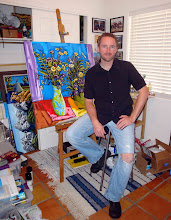
This week I am working on a painting that is slated to be a gift to the city of Oro Valley. Can't reveal much in the way of details…more to come later. I am also framing a group of works that will go to Cobalt Fine Arts for a small paintings show that I am in with my dear friend the artist Natasha Isenhour - called "Jewel Tones."
One thing that has been on my mind recently was a question put to me by a friend who is an aspiring writer…and that was the question about "selling out", i.e., having your art or what you do affected by selling. The question wasn't loaded, and it was well meant. But it did cut to the chase over the issue of the role of selling work and how that affect the creation of it.
I'll just come right out and say it, because the older I get the more honest I am - I LOVE selling work! I love it. The fact that people pay notable sums of money to collect my paintings is one of the most gratifying experiences in my life. It tells me many things - primarily that the modes of expression that I have tapped into are not just my own. And that when others see it something resonates inside of them, and they can then visualize the work in their homes or in some meaningful space. That is wonderful - and having galleries back you because you have a reputation of selling, also a great compliment.
As to whether selling works affects my work - I can also be honest and say YES it does cross my mind, the fact of wondering whether a work might sell or not. The way I see it, an accountant likes to get paid. A teacher likes to get paid. A doctor likes to get paid - why should an artist not like to make his or her modest sum? I think this is fine. It's totally normal. My wife once made the point that in the vast majority of cases when one of my works sells, she said it is obvious why. It is more detailed, more colorful, the contrasts are sharper - something is notable and raises the bar in those paintings, and as she said, those paintings are often the ones that sell.
However the caution that I work under is simple…I do not let the fact that certain works sell dominate the selection of new works. It's ok to do something that is your bread and butter kind of work - that's fine. But one must always keep an eye to the creation of new images. All the time. You have to remain an artist and the cash signs can't be the first things that decorate your goggles you see the world through. The creation of new images is important also because when you consider your work in retrospect, even those 'bread and butter' paintings that you know collectors want and buy - even they were original works dreamed up, composed, and painted out of nothingness. They too were new at some point, so you can't close down that regenerative process by which new works are made.
There is a sense that I have noticed - that an artist has to be so avant garde as to be a misunderstood pauper - and then they get some kind of stamp of legitimacy. I think that is a bunch of crap. I have seen artworks that don't communicate anything at all. That seems to me to be representative of a breakdown in the relationship with the viewer. And I am sure many such artists comfort themselves in the fact that they are doing something ahead of their time - so much so that nobody gets it. Again, I don't believe that. I have always said that an artist is free to go out on a limb if they want to; but that they can't turn around and blame everyone else if the crowd doesn't want to go out on the limb with them. And from my experience in the art world, sales are not terribly common out there on the limb. I stick a little closer to the tree…
Lastly I would say that it should not be unsaid that ART IS WORK. Maybe that's why they call it artwork. It is not gratuitous leisure. It is work. If anyone has the temptation to trivialize art, they probably have never wrestled with the difficulties of created a meaningful and complicated piece of work. After I have spent three or four weeks on a single painting I feel that it is a wonderful reward when the work finds a home and makes someone else's living or working space beautiful. I'm very happy that I can make a very modest living at it. No, visions of dollars signs shouldn't ever be allowed to dominate your process. But YES, selling is a great thing. It gives you the confidence to dream big - and in many ways, helps you be more creative, more fulfilled, and able to be full of faith that you can make something equally great to the things that have come before.
www.neilmyersart.com
Showing posts with label Art. Show all posts
Showing posts with label Art. Show all posts
Thursday, November 28, 2013

Monday, July 22, 2013
A Late Night Chat with Jason Isbell
In the past I've talked about a wide variety of subjects related to the arts and creativity. More recently I have been delighted to see the rising star of a singer-songwriter who I have long believed to be one of the best in America - and that's Jason Isbell. Jason's most recent Cd "Southeastern" has been gaining rave reviews and we have seen him on shows like David Letterman, and heard him on NPR's Fresh Air, among other places. Jason is also now married to another of my favorite songwriters Amanda Shires, who will have a new CD out in August. Good fortune has it that I met Jason twice, and I thought it might be fun to tell the story of those encounters.
Sometime around 2003 a friend gave me a CD by an Alabama band called the Drive by Truckers. There were good songs all throughout the CD, but one stood out strongly and that was the now legendary song "Outfit." This was one of Jason Isbell's breakthrough tunes with the band, and he went on to pen other knockout songs like "The Day John Henry Died", "Danko/ Manuel", "Goddamn Lonely Love" and "Never Gonna Change."
Not too long after he went solo, I was happy to hear that he and his band were going to play Club Congress in downtown Tucson. I made plans to go and even took Jason a small gift - a laminated bookmark made out of the actual autograph of the author Chuck Palahniuk. I remember seeing Jason stepping into the club and at some point pulled him aside, said hello, etc and asked him if I had heard correctly that he was a big fan of Chuck Palahniuk. He said yes - and I gave him the autographed bookmark, and let him carry on getting ready for the show. He was gracious, mellow, and very thoughtful. When he got on stage he put on a killer good show and we talked once more before we left. By that time I had a few beers in me and was feeling chipper - but I still remember what I told him when I left him that particular time - I told him "You are a poet. Like Townes Van Zandt or Ray La Montagne. Keep up what you are doing."
The second time Jason and his band played Club Congress I made plans to be there, and again Jason put on a helluva show. I remember he had a cold or sore throat and was coughing pretty hard - not just a smoker's cough, but a sick man's cough. Poor guy was pretty sick it seemed, but then he jumped on stage and threw down again and it was a great show. You'd think his vocals would have suffered but you couldn't tell a lick of difference. I guess after those years of hard living and traveling with the Drive by Truckers he had gotten a good taste of what it meant to carry on and be a road warrior. Sick. Well. Hungover, or anything else.
After that show it was very, very late and I was gonna say hello to Jason but he had disappeared outside the backstage door at Club Congress. It was a chilly night out - an odd night for Tucson for sure, quite cold. On my way out I decided to walk around the side of the building and could see a group of people by the backstage door. Jason was among them and I walked up to them, stuck my hand out and said "Hey Jason - I'm the artist Neil Myers. Just wanted to say a quick hello." And he said "Oh yeah. I remember you. I think I've seen some of your work online." People were starting to dissipate and go home and he said "How's the art business?" And I told him a little about how things were going. He listened intently, smoking his cigarette and coughing hard from time to time - still suffering his sore throat. At times I can be a bit of a talker, so we leaned against the rails and I talked about art and songwriting and he mostly listened. It's hard to describe the vibe of Mr Isbell. But perhaps the best way to say it is the feeling that he is absorbing stories - yours and other people's. Behind the glow of his ever present cigarette, there in the dark were two keen eyes paying close attention. He wasn't shy. Not in the slightest. But he listened to even small talk with a sense of acute attention.
For the next twenty or thirty minutes the survivors of the late night show came and went, some said hi to him and asked him about the meanings of some of his songs. I remember someone asking him about "Chicago Promenade" and he didn't really seem to feel he could explain what it meant. He just sort of gently brushed the issue aside and was very sweet to the person who asked it. He always thanked people who came to the show, and those who popped around back of the club to wish him well. We stood for a while and chatted with Jimbo Hart - and Jason introduced me to Browan Lollar, his guitarist who is also an artist and a friend I still chat with here and there. We talked about songwriters and the Dillinger gang, who were caught all those years ago right there at club congress. And at one point there was nobody left out there behind the club. It was getting bitterly cold and though Jason gave every indication he was happy to chat all night - I remember telling him that he better get back inside before the cold made his throat worse. I didn't want to be the reason his throat went to hell for the next few shows. We shook hands and parted very amicably - and I remember telling him as he went in the door "Oh, I forgot to ask you - do you know the songs of Justin Rutledge?" He said he didn't and I told him to check him out if he got a chance. He said "Justin Rutledge", to make a mental note and we parted ways.
I drove home still shivering from the freezing cold desert air. But I had that great satisfaction of having had an enjoyable talk with someone who I knew was very special. And in turn, when critics and so many others now find themselves getting on the long train of Isbell appreciators - I am almost amused at how long many of us had been following his work before his latest CD. And how many of us knew that this songwriter was unique.
Jason if you read this, I want to congratulate you on your sobriety, your continually beautiful and meaningful songs - and for that cold night by the railroad tracks at 1am talking about songs and life. You have proved yourself the poet I always thought you were, and we thank you for sharing your talent with the rest of us.
Neil
www.jasonisbell.com
www.amandashiresmusic.com
www.neilmyersart.com
Sometime around 2003 a friend gave me a CD by an Alabama band called the Drive by Truckers. There were good songs all throughout the CD, but one stood out strongly and that was the now legendary song "Outfit." This was one of Jason Isbell's breakthrough tunes with the band, and he went on to pen other knockout songs like "The Day John Henry Died", "Danko/ Manuel", "Goddamn Lonely Love" and "Never Gonna Change."
Not too long after he went solo, I was happy to hear that he and his band were going to play Club Congress in downtown Tucson. I made plans to go and even took Jason a small gift - a laminated bookmark made out of the actual autograph of the author Chuck Palahniuk. I remember seeing Jason stepping into the club and at some point pulled him aside, said hello, etc and asked him if I had heard correctly that he was a big fan of Chuck Palahniuk. He said yes - and I gave him the autographed bookmark, and let him carry on getting ready for the show. He was gracious, mellow, and very thoughtful. When he got on stage he put on a killer good show and we talked once more before we left. By that time I had a few beers in me and was feeling chipper - but I still remember what I told him when I left him that particular time - I told him "You are a poet. Like Townes Van Zandt or Ray La Montagne. Keep up what you are doing."
The second time Jason and his band played Club Congress I made plans to be there, and again Jason put on a helluva show. I remember he had a cold or sore throat and was coughing pretty hard - not just a smoker's cough, but a sick man's cough. Poor guy was pretty sick it seemed, but then he jumped on stage and threw down again and it was a great show. You'd think his vocals would have suffered but you couldn't tell a lick of difference. I guess after those years of hard living and traveling with the Drive by Truckers he had gotten a good taste of what it meant to carry on and be a road warrior. Sick. Well. Hungover, or anything else.
After that show it was very, very late and I was gonna say hello to Jason but he had disappeared outside the backstage door at Club Congress. It was a chilly night out - an odd night for Tucson for sure, quite cold. On my way out I decided to walk around the side of the building and could see a group of people by the backstage door. Jason was among them and I walked up to them, stuck my hand out and said "Hey Jason - I'm the artist Neil Myers. Just wanted to say a quick hello." And he said "Oh yeah. I remember you. I think I've seen some of your work online." People were starting to dissipate and go home and he said "How's the art business?" And I told him a little about how things were going. He listened intently, smoking his cigarette and coughing hard from time to time - still suffering his sore throat. At times I can be a bit of a talker, so we leaned against the rails and I talked about art and songwriting and he mostly listened. It's hard to describe the vibe of Mr Isbell. But perhaps the best way to say it is the feeling that he is absorbing stories - yours and other people's. Behind the glow of his ever present cigarette, there in the dark were two keen eyes paying close attention. He wasn't shy. Not in the slightest. But he listened to even small talk with a sense of acute attention.
For the next twenty or thirty minutes the survivors of the late night show came and went, some said hi to him and asked him about the meanings of some of his songs. I remember someone asking him about "Chicago Promenade" and he didn't really seem to feel he could explain what it meant. He just sort of gently brushed the issue aside and was very sweet to the person who asked it. He always thanked people who came to the show, and those who popped around back of the club to wish him well. We stood for a while and chatted with Jimbo Hart - and Jason introduced me to Browan Lollar, his guitarist who is also an artist and a friend I still chat with here and there. We talked about songwriters and the Dillinger gang, who were caught all those years ago right there at club congress. And at one point there was nobody left out there behind the club. It was getting bitterly cold and though Jason gave every indication he was happy to chat all night - I remember telling him that he better get back inside before the cold made his throat worse. I didn't want to be the reason his throat went to hell for the next few shows. We shook hands and parted very amicably - and I remember telling him as he went in the door "Oh, I forgot to ask you - do you know the songs of Justin Rutledge?" He said he didn't and I told him to check him out if he got a chance. He said "Justin Rutledge", to make a mental note and we parted ways.
I drove home still shivering from the freezing cold desert air. But I had that great satisfaction of having had an enjoyable talk with someone who I knew was very special. And in turn, when critics and so many others now find themselves getting on the long train of Isbell appreciators - I am almost amused at how long many of us had been following his work before his latest CD. And how many of us knew that this songwriter was unique.
Jason if you read this, I want to congratulate you on your sobriety, your continually beautiful and meaningful songs - and for that cold night by the railroad tracks at 1am talking about songs and life. You have proved yourself the poet I always thought you were, and we thank you for sharing your talent with the rest of us.
Neil
www.jasonisbell.com
www.amandashiresmusic.com
www.neilmyersart.com
Thursday, May 9, 2013
Creativity Blog # 3, Artist Ken Christensen
Welcome to creativity blog #3, this one featuring California based painter Ken Christensen. I have always been a great fan of Ken's work, and I even have one of his paintings hanging on the wall of our family room - alongside the best works of my artist friends. Ken has an extensive body of work and throughout his paintings I have always felt that he was one of the best at striking a near perfect 'tension of details', as I like to call it. By that I mean he adds just enough detail to preserve the visual scene, but his works still show traces of the joyful spontenaiety of a sketch. Ken was integral in the creation of the "New Fauves" group of artists - which I might add is the only group of artists that I have formally affilliated myself with in my entire art career. This is a group of painters who all feel their roots in Fauvism and Expressionism - who sense, as I do, the great debt that we owe to artists like Van Gogh and the Fauvist painters that followed him. I was also delighted to find that Ken knew of and appreciated the work of my mentor and friend, the artist Jean-Claude Quilici.
Here is the Q and A with Ken, enjoy!

Ken Christensen
Artist - Writer
http://www.kenchristensen.net/pages
1) What personal habits do you have that you feel make you more creative?
One of the things that keeps me creative is going for long walks. Everything you need to know is in nature. Nature reveals its secrets slowly so you have to be patient. You can pass by the same scene many times but at one special moment a new vision of the same thing can be revealed. It's impossible to find a subject to paint by driving around in a car. I have to see things on foot, one step at a time. And in art light is always the real subject. So at every time of day, when the light is different there is always a different subject. There can be nothing at one time of day to paint and at another time when the sun is in a different position something remarkable may reveal itself.
We are always standing on the shoulder of giants and most good ideas spring out of something earlier by someone else.
Another habit that feeds my creativity is sketching. Sketching is art in its purest form. When I sketch I'm not thinking of sales or finished work; I'm just having fun. When you're having fun, good things happen. When I sketch I am being more personal in what I choose to portray. It is the personal in art that really sets the greats apart. One must have a unique vision and art succeeds as much as you are being yourself. Sketching whatever catches your eye allows this personal vision to flourish.
2) Who are the creative artists, in any field, that inspire you the most?
I'm a huge Neil Young fan. In literature Henry Miller has had a huge influence on me. In art, Van Gogh has been my hero since childhood, not only for his art but for his life and convictions. His letters are one of the great works of world literature and very inspiring. The artist I've known personally that has influenced me the most is my friend Manuel Gil in Paris. Manuel is Spanish but has lived in Paris thirty years or more. He showed me what a true artist is. He has an energy and enthusiasm for art that I have rarely encountered. It reminds me of what I know of Picasso who could create art out of anything, by picking up whatever was at hand. Manuel turned me on to other techniques like woodblock printing, pastel portraits, monotypes, and other things. Like Picasso, Manuel is also an original thinker with surprising opinions on a wide range of subjects. He is a wild bohemian but also a true nobleman who has a sensitivity and insight beyond the majority.
3) What do you do when you are not feeling creative? Or - how to you get yourself back to a point where you are feeling creative?
As I was saying, the first step in trying to find the urge to paint or some creativity is to go for a long walk. A very long walk will always sort things out. The other thing I do is to switch techniques. If I'm getting burned out or bored with oil painting I will switch to watercolor for a week or weeks. I also go back to sketching , the source for all further creative endeavors. Lastly, if I'm still stuck I will force myself to do something. Just working will release my creative juices. Without fail I always feel better by doing something, anything. Just doing something will snap you out of your lethargy and get the juices flowing.
4) What are some creative outlets that you enjoy outside your own respective creative field?
I write. I've written five books. I just finished another one, "Between the Covers: Reading, Writing, and Romance" which is a memoir told through my connection to books, reading, collecting, running a bookstore, and writing.
5) For someone who has talent in a creative field, how would you suggest they go about converting that talent into something original - something that stands out from the crowd?
As I said, great art is always personal. It sounds too simple but the ultimate advice is to be yourself. Trust yourself that your idle thoughts are worthy of developing. There is room at the top for any style in any field if it is original. It depends if your goal is to create art or to make money. They are often very different. In terms of creativity and quality art then one must trust oneself and do whatever you damn please.

Links
Official website: http://www.kenchristensen.net/pages
New Fauves website: http://www.newfauves.com/pages
Here is the Q and A with Ken, enjoy!

Ken Christensen
Artist - Writer
http://www.kenchristensen.net/pages
1) What personal habits do you have that you feel make you more creative?
One of the things that keeps me creative is going for long walks. Everything you need to know is in nature. Nature reveals its secrets slowly so you have to be patient. You can pass by the same scene many times but at one special moment a new vision of the same thing can be revealed. It's impossible to find a subject to paint by driving around in a car. I have to see things on foot, one step at a time. And in art light is always the real subject. So at every time of day, when the light is different there is always a different subject. There can be nothing at one time of day to paint and at another time when the sun is in a different position something remarkable may reveal itself.
We are always standing on the shoulder of giants and most good ideas spring out of something earlier by someone else.
Another habit that feeds my creativity is sketching. Sketching is art in its purest form. When I sketch I'm not thinking of sales or finished work; I'm just having fun. When you're having fun, good things happen. When I sketch I am being more personal in what I choose to portray. It is the personal in art that really sets the greats apart. One must have a unique vision and art succeeds as much as you are being yourself. Sketching whatever catches your eye allows this personal vision to flourish.
2) Who are the creative artists, in any field, that inspire you the most?
I'm a huge Neil Young fan. In literature Henry Miller has had a huge influence on me. In art, Van Gogh has been my hero since childhood, not only for his art but for his life and convictions. His letters are one of the great works of world literature and very inspiring. The artist I've known personally that has influenced me the most is my friend Manuel Gil in Paris. Manuel is Spanish but has lived in Paris thirty years or more. He showed me what a true artist is. He has an energy and enthusiasm for art that I have rarely encountered. It reminds me of what I know of Picasso who could create art out of anything, by picking up whatever was at hand. Manuel turned me on to other techniques like woodblock printing, pastel portraits, monotypes, and other things. Like Picasso, Manuel is also an original thinker with surprising opinions on a wide range of subjects. He is a wild bohemian but also a true nobleman who has a sensitivity and insight beyond the majority.
3) What do you do when you are not feeling creative? Or - how to you get yourself back to a point where you are feeling creative?
As I was saying, the first step in trying to find the urge to paint or some creativity is to go for a long walk. A very long walk will always sort things out. The other thing I do is to switch techniques. If I'm getting burned out or bored with oil painting I will switch to watercolor for a week or weeks. I also go back to sketching , the source for all further creative endeavors. Lastly, if I'm still stuck I will force myself to do something. Just working will release my creative juices. Without fail I always feel better by doing something, anything. Just doing something will snap you out of your lethargy and get the juices flowing.
4) What are some creative outlets that you enjoy outside your own respective creative field?
I write. I've written five books. I just finished another one, "Between the Covers: Reading, Writing, and Romance" which is a memoir told through my connection to books, reading, collecting, running a bookstore, and writing.
5) For someone who has talent in a creative field, how would you suggest they go about converting that talent into something original - something that stands out from the crowd?
As I said, great art is always personal. It sounds too simple but the ultimate advice is to be yourself. Trust yourself that your idle thoughts are worthy of developing. There is room at the top for any style in any field if it is original. It depends if your goal is to create art or to make money. They are often very different. In terms of creativity and quality art then one must trust oneself and do whatever you damn please.

Links
Official website: http://www.kenchristensen.net/pages
New Fauves website: http://www.newfauves.com/pages
Wednesday, March 6, 2013
Creativity Blog # 1, Singer-Songwriter Joanna Smith
Creativity. It means a lot of different things to different people.
I have begun to realize, the longer I have been an artist, that
creativity is really what most interests me - above and beyond the
technical capabilities of being able to paint a hand perfectly, or play a
scale on guitar, or write a coherent paragraph - or act out those
compelling lines. At some point it occurred to me; since I have been
fortunate enough to have some personal contacts with highly creative
people in various fields - ie, the arts, music, etc, I thought it might
be interesting to write up a set of questions on creativity and ask
those same questions to different people. So we could see the
variations in their creative processes and how they view the act of being creative.
This is the first profile in what I hope will be an extended series of blogs on creativity!
This week's Q and A is with RCA Nashville recording artist Joanna Smith. A few years back I stumbled onto several tracks by her on myspace. I remember the first song I heard by her was a tune called "Let me Kiss You Again" and immediately I was hooked. It was delicate, sweet, beautiful and crafty - and I found that she had an entire group of wonderful songs. Perhaps my ultimate compliment to her is this - I am NOT a big country music fan. I grew up in the south but was always a rock and 'southern rock' kind of guy. But this girl had me hooked. I always wanted to hear more. And sure, she IS country - but she didn't hide behind any of the cliches of country music. In fact she reinforced the fact that country, as a genre, is very wide and has room for all kinds of artists working under that stylistic umbrella. She is an original. When I first heard her I realized that, despite her being young in years, she was a very mature as a songwriter, and a very well polished performer. And I have to say this too, she is an absolutely lovely person. That matters a lot. I met her at a show in Phoenix in 2011 and saw she was a charismatic performer, as well as being a natural with people one on one. As a true artist herself, she was kind enough to answer my Q and A for our first blog on creativity...

Joanna Smith
Singer-Songwriter
Official website is: http://www.joannasmithofficial.com/us (This link has a direct link to her latest video, which is a must see, called "We Can't Be Friends". Do check it out!)
Her music is also available on itunes!
1) What personal habits do you have that you feel make you more creative?
Caffeine!!!! I love to have my morning cup of coffee and dig into a song idea I may have previously written down. I get my brain going by first writing in my diary.
2) Who are the creative artists, in any field, that inspire you the most?
Springsteen, hands down. Steinbeck.
3) What do you do when you are not feeling creative? Or - how to you get yourself back to a point where you are feeling creative?
I hate that feeling! I stress about it! I feel like I'll never feel
creative again, and surely it's the end of the world. But then I remind
myself.... it always comes back.
4) What are some creative outlets that you enjoy outside your own respective creative field?
Studying others' creativity. I love art of all kinds and it inspires me to make my own.
5) For someone who has talent in a creative field, how would you suggest they go about converting that talent into something original - something that stands out from the crowd?
Always, always be you. Be
open to the journey. You may start by imitating others' work, then have
what you do be criticized at which point make necessary changes as you
see fit. Be open to criticism but listen to your gut. This is the most
natural thing, it takes time and years of experience to be better at
it. "It" being just being yourself.
Links and info:
Check out Joanna's latest release, the EP "Be What it Wants to Be" available on iTunes
Look for Joanna on tour with Maranda Lambert this spring! Visit http://www.joannasmithofficial.com/us/home
Here is Joanna Smith's latest music video "We Can't be Friends"
www.neilmyersart.com
This is the first profile in what I hope will be an extended series of blogs on creativity!
This week's Q and A is with RCA Nashville recording artist Joanna Smith. A few years back I stumbled onto several tracks by her on myspace. I remember the first song I heard by her was a tune called "Let me Kiss You Again" and immediately I was hooked. It was delicate, sweet, beautiful and crafty - and I found that she had an entire group of wonderful songs. Perhaps my ultimate compliment to her is this - I am NOT a big country music fan. I grew up in the south but was always a rock and 'southern rock' kind of guy. But this girl had me hooked. I always wanted to hear more. And sure, she IS country - but she didn't hide behind any of the cliches of country music. In fact she reinforced the fact that country, as a genre, is very wide and has room for all kinds of artists working under that stylistic umbrella. She is an original. When I first heard her I realized that, despite her being young in years, she was a very mature as a songwriter, and a very well polished performer. And I have to say this too, she is an absolutely lovely person. That matters a lot. I met her at a show in Phoenix in 2011 and saw she was a charismatic performer, as well as being a natural with people one on one. As a true artist herself, she was kind enough to answer my Q and A for our first blog on creativity...

Joanna Smith
Singer-Songwriter
Official website is: http://www.joannasmithofficial.com/us (This link has a direct link to her latest video, which is a must see, called "We Can't Be Friends". Do check it out!)
Her music is also available on itunes!
1) What personal habits do you have that you feel make you more creative?
Caffeine!!!! I love to have my morning cup of coffee and dig into a song idea I may have previously written down. I get my brain going by first writing in my diary.
2) Who are the creative artists, in any field, that inspire you the most?
3) What do you do when you are not feeling creative? Or - how to you get yourself back to a point where you are feeling creative?
4) What are some creative outlets that you enjoy outside your own respective creative field?
5) For someone who has talent in a creative field, how would you suggest they go about converting that talent into something original - something that stands out from the crowd?
Links and info:
Check out Joanna's latest release, the EP "Be What it Wants to Be" available on iTunes
Look for Joanna on tour with Maranda Lambert this spring! Visit http://www.joannasmithofficial.com/us/home
Here is Joanna Smith's latest music video "We Can't be Friends"
www.neilmyersart.com
Sunday, February 10, 2013
Blinkers for an Artist
This week I am working on a new painting of Elephant Head Rock, a large formation in the Santa Rita Mountains just north of Tubac, AZ. Yesterday I was at Cobalt Fine Arts in Tubac, painting in gallery for the Tubac arts festival. A gloomy morning with snow on the ground gave way slowly to sunshine and a beautiful, cool day for the festival - which put smiles on the faces of most of the festival goers.
What I wanted to talk a bit about in this blog was something that has come up again and again in conversation with artists and collectors; and that's originality. Of course the seeking of originality is as old as the arts - and I do not pretend to cover new ground with it, rather only to share a bit more and maybe shed a little light.
For some time Bobby Lee Krajnik and I talked yesterday about originality in the arts, and she mentioned something that I found very interesting. She said that she had taken some workshops here and there, and heard some curious comments from instructors. One instructor who saw her work told her that he didn't want to change her style and work that style out of her. He felt that she had clearly arrived at something distinct, and he didn't want to change it by bending her too much to the instructor's will. Bobby Lee also relayed that another instructor had told her that frequently artists will take course after course and so many workshops that whatever instinct for personal style they had before gets diluted, and in the course of being affected by the styles of work demonstrated by the instructors - they never really find a personal style.
I shared with her what I have said to some other trusted people who were interested in how I devised the look of my own works; I told them that I do the reverse of taking courses and critiques and bouncing ideas off other artists. I put on blinkers and work like a monk. I try as hard as possible to shut out every other opinion of every other kind of art ever - and I try to answer the question: "How would I paint this scene?" Bobby Lee and I pretty much agreed that too much input from other artists allow them into your head, and at some point, if you don't clarify where your influences are coming from, you yourself are not painting - you and some other people are painting.
Of course, we all have our influences. When I look at other artist's work, I look primarily at Van Gogh and my friend Jean-Claude Quilici. I too glean something from those who came before me. I have found that other artists are wonderful in helping you learn the materiels needed to get certain effects, and with some of the kind of shop talk tips that are useful in the arts. But as regards to style, I still think that is a personal search - instruction can teach you a certain skill set. Style is a product of self reflection. It is not easy...
So my suggestion, if anyone might bother to ask - is that if you are one who likes to take courses, keep them in perspective in as much as they can increase your skill set and perhaps give you personal time with an excellent artist. But I would also suggest that you construct a kind of art that has a style that is built on your own self reflections - and visions that do not belong to anybody else.
So yes, spend some time shading and learning how to paint that eye, or head, or tree - but spend a little time dreaming. Spend some time, and a little paint and canvas, on that vision that is only yours. That thing only you can create - and only your neglect can supress.
www.neilmyersart.com
http://bobbyleekrajnik.blogspot.com/
What I wanted to talk a bit about in this blog was something that has come up again and again in conversation with artists and collectors; and that's originality. Of course the seeking of originality is as old as the arts - and I do not pretend to cover new ground with it, rather only to share a bit more and maybe shed a little light.
For some time Bobby Lee Krajnik and I talked yesterday about originality in the arts, and she mentioned something that I found very interesting. She said that she had taken some workshops here and there, and heard some curious comments from instructors. One instructor who saw her work told her that he didn't want to change her style and work that style out of her. He felt that she had clearly arrived at something distinct, and he didn't want to change it by bending her too much to the instructor's will. Bobby Lee also relayed that another instructor had told her that frequently artists will take course after course and so many workshops that whatever instinct for personal style they had before gets diluted, and in the course of being affected by the styles of work demonstrated by the instructors - they never really find a personal style.
I shared with her what I have said to some other trusted people who were interested in how I devised the look of my own works; I told them that I do the reverse of taking courses and critiques and bouncing ideas off other artists. I put on blinkers and work like a monk. I try as hard as possible to shut out every other opinion of every other kind of art ever - and I try to answer the question: "How would I paint this scene?" Bobby Lee and I pretty much agreed that too much input from other artists allow them into your head, and at some point, if you don't clarify where your influences are coming from, you yourself are not painting - you and some other people are painting.
Of course, we all have our influences. When I look at other artist's work, I look primarily at Van Gogh and my friend Jean-Claude Quilici. I too glean something from those who came before me. I have found that other artists are wonderful in helping you learn the materiels needed to get certain effects, and with some of the kind of shop talk tips that are useful in the arts. But as regards to style, I still think that is a personal search - instruction can teach you a certain skill set. Style is a product of self reflection. It is not easy...
So my suggestion, if anyone might bother to ask - is that if you are one who likes to take courses, keep them in perspective in as much as they can increase your skill set and perhaps give you personal time with an excellent artist. But I would also suggest that you construct a kind of art that has a style that is built on your own self reflections - and visions that do not belong to anybody else.
So yes, spend some time shading and learning how to paint that eye, or head, or tree - but spend a little time dreaming. Spend some time, and a little paint and canvas, on that vision that is only yours. That thing only you can create - and only your neglect can supress.
www.neilmyersart.com
http://bobbyleekrajnik.blogspot.com/
Thursday, October 18, 2012
Paris is for (Art) Lovers

However I did want to write a few lines about our recent trip to England and France. Last month my wife and I decided to take the opportunity to visit England, where my wife's brother is currently living and working, and use that as a chance to see as much of London as possible - as well as to pay a quick visit Paris for a few days.
When it comes to art, I am a little firm in believing that you haven't even begun to get a taste for the greatest art out there, until you have been to Europe. So much of the legacy of the greatest art ever made can be found in France, England, Italy, Germany, Spain, and countless other locations on the continent. As a student in Aix-en Provence, France in 1996 I was fortunate enough to be able to both see many of the works of the great Impressionist masters that I so adored, and to also see many of the places they painted. As my friend, the artist Jean-Claude Quilici remarked in an interview - many of the places where the greatest artists painted have hardly changed. Many of the villages, for example, in southern France, where Van Gogh, Cezanne, and others worked - many of them have been altered very little with the passage of time. So it presents the unique opportunity for an artist to both look at the best European works, and see the places where they are made.
Foremost in my mind, always, is Paris. Paris has been a nexus for world art for a very long time. It was the mecca of the Impressionist movement. And though many artists didn't live in Paris itself, the city was a source of both inspiration and exhibition opportunities, and was ringed with towns and villages that artists called home.
For me, coming back to Paris in 2012 was especially sweet. In 1996 I visited the city twice, pretty much taking the opportunity to see as many galleries and museums as possible. And also to meet up with my friend Jean-Claude Quilici. I was 20 years old then, a boy from small town North Carolina. Now I am 37, with a wife and son and another son on the way - and with an art career I could scarcely have imagined during those days when I haunted the Louvre and Musee d'Orsay back in 1996. I was pleased to find, on a personal note, that it was not as hard as I thought it was to speak French as well as I did back then. I remembered probably 88% of what I knew while I was living there, and got many compliments on how well I spoke. I probably shock people there because the feeling you get from the French is that they don't expect ANY American to speak French. It's always a pleasant surprise for them.
However during three days in Paris and the remainder of our days in London, I was reminded very directly why the act of pilgrimage isn't just a religious act - artists too, I think, must show a certain devotion to knowing their roots, and wherever possible, must go to the places where great works are, and where they were inspired. Though I am a self-taught artist, I have always thought that it is very important that you learn from the best. So rather than worry about some somebody who is a passing fad - I have always told myself, if you are going to be a painter, go learn from Monet, Manet, Renoir, Sisley, Pissarro, Van Gogh, Quilici, Gary Ernest Smith, Vlaminck, Derain, Cassatt, and many others. Start at the top and try to tap into the best.
At one point during this trip my wife and I went to take our 3 year old son to the restroom at the Musee d'Orsay, and in order to get back to the place where you can start your visit, you had to pass through the rooms that were stacked wall to wall with all the great masters of Impressionism. We walked right up to Manet's "Luncheon on the Grass" and I told my wife "If you can catch a glance, look around you. You are looking at the best of the best."
London also was not to be missed, and there were indeed some wonderful artistic gems to be found there. We visited the National Gallery, which also had an exceptional display of impressionist work - and I caught glances of other amazing works during our hurried visit there. One of Van Gogh's original "Sunflowers" is there, and when we walked in the door I was carrying our 3 year old son Liam - and Liam pointed to Van Gogh's Sunflowers and said "That painting looks like one of your paintings da da!" (He calls me 'da da' instead of dad) I've gotten some nice compliments on my work through the years; this one might have been one of the best.
Another gem which is a little off the beaten path is the Courtauld Gallery. This gallery touts itself as one of the finest small art museums in the world, and I think that title is WELL earned. You will find such masterworks there at Manet's "Bar at the Folie Bergere", which was the last large Manet completed at the end of his life. Van Gogh's self portrait with a bandaged ear was there also - which was very touching. I told my wife that it was quite something than Vincent wanted to document even one of the worst moments...the self-inflicted mutilation of his ear. He was so unsparing in his artistic view - even of himself. It made me think of Monet painting his wife Camille on her deathbed.
So yes, if you believe in doing great work, or that you want to attempt to - you have to see the masters of Europe. If you have to, see them at the best big-city gallery you can make it to, even in your own country. (Here in the states, galleries like the National Gallery in Washington DC, the Art Institute of Chicago, and the Met in New York come to mind) But if you can see those great works, and get the added uplift of walking those same cobblestone streets and enjoying making those footprints - your work and your life will ever be the wiser for it. Mine sure is....
www.neilmyersart.com
Thursday, February 25, 2010
My Favorite Artists Who are Not Oil Painters

This week I am working on a painting of the Rhyne building at Lenoir-Rhyne University in Hickory, North Carolina. I learned just recently that Lenoir-Rhyne, which is the university both I and my wife graduated from - that they are going to be awarding me their "Rising Star Award" for young alumni. After having such wonderful memories of my 4 years at Lenoir-Rhyne, from 1993 - 1997, I told them I would like to give them a painting provided that it would be well displayed. It is not certain as of yet, but it may end up in their library or alumni house.
Just the other day I was talking to the artist Paul Sheldon, and concluded that it was not really an accident that so many artists play music. For many of us it's a way to blow off steam. However it can also feel like what comes out thru music is the same kind of feeling that comes out through the paintings - only the means of expression are different. I've played guitar since I was about 13 years old. When my grandpa David Walters died in 1987, I was given his guitar - which I still have today, and I learned to play on it. He was quite a player and I heard that he used to play on radio shows with his friends.
So thinking about other artists who are NOT oil painters, here are some of my favorites...
1) Justin Rutledge. This guy is a poet with a guitar. I don't know anyone who would dispute this. A number of years ago I heard him on NPR, looked him up, and have been an admirer of his music ever since. Turns out, he enjoys art - and he and I are now friends by correspondence. If you were to describe Justin's music to anyone it would be difficult, because I've never heard anyone like him - but when you hear songs like "This Too Shall Pass", "Penny for the Band" and "Everyone's in Love" etc, it's easy to get hooked. He has a masterful sense of music and melody, with hands down the best lyrics that I've heard in music today. He has a new CD that will be released on May 4th called "The Early Windows", and I urge everyone to check it out. www.justinrutledge.com . You can find him on Myspace and Facebook as well.
2) Ansel Adams. I suspect that there are some people who have a kind of nostalgic view of Ansel Adams, as his images have become so much a part of Americana. But behind those stunning black and white photographs was a deeply complicated, sensitive, and extremely artistic person. I feel that all landscape painters, like myself, should do a study of Ansel and his way of working - his way of framing an image in the picture and his keen eye for granduer both big and small. Some of his images are so clear, so sharp and lucid - and then you can look at the date and see something like "1939" or "1941". It's astounding he got such images from old photographic technology. And his legacy of activism and environmentalism is truly inspirational, as he was one of those people who took it as a personal thing to fight hard for the preservation of our pristine wild places in America. Here is one of America's finest artists period, and I suggest all landscape artists make a good study of Ansel and it will make them better painters. www.anseladams.com .
3) Antoni Gaudi. My main feeling with regards to Gaudi is a true reverence for someone who bucked the conventional in the most extreme of ways - often in one of the most conservative art forms, that of architecture. Gaudi's structures seem to go from candy land childlike visions to the towering and awe inspiring "Sagrada Familia" in Barcelona. The fact that one could make buildings that seemed to undulate and flow like liquid - and that these were viable buildings that could stand the test of time - that is extraordinary. He is a true original.
4) Frank Lloyd Wright. Another true original in the field of archetecture. His homes and structures have frequently given me the feeling that I was looking at buildings that were easily 50, 75, or even a 100 years ahead of their times. Like Gaudi, Wright allowed himself the full reign of his imagination, and even though I hear that some of his buildings are not structurally stable, they leak, and have other problems - as an artist and an individual he was incredibly significant. It also emerges, once you learn a bit about him, that he was not always a nice guy - especially with regards to his family life. But the artist is there, and though I wouldn't want him for a dad and probably not even for a friend, he was unique and therefore notable.
5) KISS. The rock band Kiss has been a cultural phenomenon in America since the early 1970's. The reason I mention them as an artistic inspiration, is that they were the biggest and most flamboyant proponents of a kind of rock-theatre, the idea in general being to heighten the experience of a rock and roll concert by making the performance theatrical. Face makeup, explosions, dripping blood, flaming and smoking guitars, drum risers, etc - Kiss took some of the things they loved best about the act of performance and did it to the n'th degree. And to their credit they have countless fantastic songs that have stood the test of time even without regard to their performance style. I must admit, I've always preferred the original Kiss with members Paul Stanley, Gene Simmons, Ace Frehley, and Peter Criss. And I've recently soured a bit on Kiss recently because it has become abundantly clear that Gene Simmons is a massive egoist, who seems much more interested in stuffing dollars into his pockets than being a musical artist. This is not an issue of confidence, mind you. Most of us creative artists have to be stubbornly confident in order to create things. Arrogance, or, one could say, the belief that gravity doesn't affect you anymore - that does not make you a good artist. That makes you a bullheaded primadonna. But despite all this, I rank KISS very high on that list of original creative artists.
6) Carl Sandburg. The poetry of Carl Sandburg took a grip on me when I was in college, and that grip has never let go. His beautiful free verse style seemed to me to be an improvement on the groundbreaking work of Walt Whitman. Sandburg's work is something rooted very firmly in the soil of America, in the city streets of our towns and deeply connected to us generally. His work comes across, to me anyway, as a hybrid of prose and poetry. Sandburg once offered a definition of love as "The touch of two hands that foils all dictionaries." He was a true creative person, and someone who was dedicated to their own vision of poetry.
7) Jack Kerouac. I must admit that I go back and forth on Kerouac's work. And by that I mean that his form of spontaneous prose seemed at times to be rambling and rolling along with so little object as to just be words - and at other times it seemed to be some of the most sensitive and descriptive work since Proust. (Truman Capote once said of Keroauc's work "That's not writing! That's typing...") However the entire spectre of bop prosody was very original. It was at its best in works like "On the Road", "Big Sur" and "October and the Railroad Earth" and was less effective in other works. But it was original and thus retained an inherent power and freshness which has assured Kerouac legacy. Ginsberg, the poet, does get credit in this same spirit of work - but Kerouac was the most visionary of that group of writers. In 2008, a stroke of luck allowed me to see the original "On the Road" scroll that Kerouac wrote the book on - at the Palace of the Governors in Santa Fe, New Mexico. What a pleasure to see the breathless stream of words that Kerouac produced, that went on to be one of America's legendary books.
8) The Drive by Truckers . Around 2003 a good friend of mine gave me a CD by an Alabama band called the Drive by Truckers. I put it in the player in my car and immediately fell in love. I've since seen DBT twice in concert, met and spoke to Patterson Hood (who has a painting of mine that I sent him awhile back) and have not ceased to be impressed by this roughshod group of Southerners who seem to embody intelligent rock music with biting social commentary. DBT music is often narrative driven and full of stories - quite the antidote to a world full of jingles. Via DBT I also learned of an amazing songwriter who ranks equally good named Jason Isbell. I've spent time with Jason at two of his shows, and he's a great guy and a terrific songwriter. He used to be a member of DBT where he penned such knockouts as "The Day John Henry Died" and "Never Gonna Change," and he now tours and records with his band the 400 Unit.
9) Deanna Johnston. Back in 2005 my wife and I were watching the TV show "Rockstar INXS" and a blond lady stepped up to the mike to do the song "Should I Stay or Should I Go" by the Clash. When I heard this lady sing, I sat up straight. This woman had a power, a force like I'd not seen or felt since listening to Janis Joplin for the first time. Her voice had a punch that hit me immediately, subtle, powerful, and memorable. Her later performance of the song "Long Train Running" on the show literally blew the roof off the place. Sometime later I got in contact with Deanna and we have been friends by correspondence for around 4 years. Deanna continues to make great music and I would especially suggest you check out her EP of original songs "GFN", available at www.deannajohnston.net .
These are just a few musical, literary, and architectural artists that inspire me. All of them have a quality of distinction that is important to appreciate in the creative act. I've long believed that the impulse to create is more or less universal in most of us - however some grab a mike, or a guitar, or a drafting board or a pen to express it. Art is vast, for sure, and that's a fertile and beautiful landscape we can all appreciate.
www.neilmyersart.com
Thursday, January 7, 2010
Ten Years After, a Decade Between Canvases

This week I have finished doing a touch up job on a painting of two bouquets of wildflowers. This 36 x 36 inch painting was actually done in 2008, but I had hung it on my wall, feeling that - even after it was signed and initially considered done, that it needed something else. Trouble was, I didn't know what it was then - so I put it on my living room wall for around a year and now that I've just done the rework, I'm glad I did. A very mediocre work is now a tolerably good work, and so naturally I found myself reassured that it would not have been the right thing to put the work out in a gallery in 2008.
We have just celebrated the holidays, and a hair's breath after came the new year that is also leading us into a new decade. Of course every self-indulgent blogger with a keyboard and an itch in their brains is gonna take a moment and be philosophical about where they've been, and what has happened in the course of the previous ten years. As I explained to my infant son, that a year is actually quite meaningless in the cosmological sense, or in the greater sense of the world. In the span of the universe, a year isn't even one zillionth of a grain of sand on the beach of existence - however it is the human mind that assigns meaning to time as it relates to time on earth. I always liked the line from the Kansas song "Dust in the Wind" where they sing "nothing lasts forever but the earth and sky." And when I think of this I think of the beautiful rock peaks of the Catalina Mountains that gaze down on our home - and I remember that they looked exactly the same, virtually unchanged, as they did in old historical photos taken over a hundred years ago. The mountains care very little for human time.
So when I rewind ten years and remember where I was as we entered the year 2000, I was actually standing in the middle of Quay Street in downtown Auckland, New Zealand, with my wife and two friends, screaming and yelling with the thousands of revelers - and toting around a bottle of 101 Southern Comfort. That night I saw a long parade of craziness - a drunk girl walking on broken glass on Queen street. Another guy hurling a whiskey bottle from to top of the Hobson street bridge - and it actually HIT a guy down below on the shoulder. I got kissed by some random girl yelling "Happy New Year!" (Jelena didn't hold that against me...I didn't have a chance to fight the girl off! ...Or did I even try :) And I remember calling my mom later that night to let her know that the Y2K business didn't mean anything - everything was still functioning, in New Zealand anyway - and so it seemed the world would continue after all.
Around that time I was doing a handful of paintings of the North Shore bays in Auckland, trying to fancy myself a new Monet who was going to capture the various times of day on canvas, as the light glanced off the sea. But I quickly bogged down in not being entirely satisfied with the effects I was getting. I then began to do more writing than painting, and this trend continued, for the most part, until sometime in 2002. Jelena had been giving me subtile hints, like buying me canvases and leaving them on the seat of our car - and I began to rethink painting and have some original ideas. And when I showed some paintings to friends where I worked at the Sebel Suites - they started immediately wanting to buy them. And I sold them for some almost criminal bargains - being only too flattered at the time that people were crazy enough to pay what they did for those works. One painting, a painting of Otago on the South Island of New Zealand - even caused a prolonged argument between Jelena and I because she insisted that we keep it, even after several friends wanted to buy it. And we still have it today; it hangs in our living room.
So I guess we can say the seed had been planted - or more correctly, RE-planted at the end of our stay in New Zealand, in 2002 and early 2003. When I came to New Mexico in 2003, there was something firmer and more determined, and more vibrant in my works. Even I noticed it, and found myself curious to move along with it and see how it went. Now after countless shows and sales and successes, it all seems like a million years ago. And it's only with effort that I realize that it was only 7 or 8 years ago.
I don't really know if I can look over the past decade and say that great leaps have been made in the world at large. In some respects that is always true, as science and technology advance, to whatever extent we secure our own lives, without really contributing to a fullness of life - or giving it deeper meaning. But I, like many Americans who took it personally - was a different person after the 9/11 attacks. After the shock of the experience wore off a bit, what remained was the lesson that human depravity was alive and well. And that for every brave soul who would save a friend, or even risk themselves for a stranger - the black heart of human cruelty abounds to this day. The more I thought about it, it became clear to me that if humanity persists in being unable or unwilling to surmount the differences of nation, tribe, religion, and cultural and lifestyle differences, then there is no reason to believe that the world will change in the slightest. At least not in the ways that really can affect human happiness. So in one sense we have indeed advanced ourselves with lots of groovy gadgetry and apps that turn our phones into portable back-scratchers, etc - but we have not managed to secure peace and understanding for future generations. As my writings and concerns are largely about Art, I think that only when societies stabilize and learn to coexist with some quality of understanding, then art will thrive. I should be pleased entirely if no artist ever had to paint about war again - no more "Third of May"s by Goya, no more glistening bayonets to the horizon. But I know better, and do not expect such a fortune anytime soon.
Art will go on. Jim Morrison said in an interview that the music of The Doors could not help but reflect that chaos surrounding it; a very true and profound statement when one considers he was talking about the late sixties and all the cultural and societal changes, and the Vietnam War. And the Art of 2010 will no doubt do the same. I, on the other hand, actually hope that somewhere in my own work there will be some grasp of the larger span of time, and if one looks at my work and feels the heat of nature and color, then I would be fine if no concept of time was applied to it. A mountain painting in 1910 of 2010 ought to glow in paint, so as to tell us something grander about life in general.
I've always appreciated this quote from John Adams:
"I must study politics and war that my sons may have liberty to study mathematics and philosophy. My sons ought to study mathematics and philosophy, geography, natural history, naval architecture, navigation, commerce, and agriculture, in order to give their children a right to study painting, poetry, music, architecture, statuary, tapestry, and porcelain."
So let's hope that a world of "painting, poetry, music, etc" can replace the fragmented world we know today. Not for the reiteration of pipe dreams of fantasies, but for a better life for our children, and the countless generations to come. Let us work towards a foundation upon which art can rest firmly, and do its part to contribute to human fulfillment and human happiness.
I wish everyone a happy, healthy, and peaceful 2010!
www.neilmyersart.com
Sunday, April 26, 2009
Putting the Brushes Down in Order to Pick Them Back Up

This week, after a lot of struggles and a lot of fits and starts, I have finished a new 24 x 30 of the Abbey of Senanque, in France. This is one of the beautiful scenes of France, a country full of amazing subjects for paintings -with the old abbey nestled between green hills, and fields of lavender glowing in perfect rows of purple and violet.
However, I have to write a note to all my friends, family, and collectors to let you all know that I have decided to go on a very "low-work" hiatus from painting. This is my first real slowdown in work since 2003. As some of you guys may know, I have been struggling for years with lumbar-spinal arthritis. Recently I have had to admit that this chronic condition has taken so much from me that I am at risk of losing or ruining some of the most important people and enjoyments in my life. It is not my intention to bore all of you with some long litany of medical gripes. Lord knows, we've all had our problems and I happen to believe that most people don't really find a long medical confession that interesting...however I am also a believer that most of us can handle a little more truth than we are used to getting. So for all of you who want to know, I'll briefly tell you my situation.
After years of intermittent back trouble, I began to have severe problems sleeping in 2006. At first I could take an aspirin or two in the middle of the night to deal with it. Then that stopped having any effect. What was happening was that I was getting such pain in my back when I lay down flat, that it was waking me up and preventing restful sleep. Naturally, I was utterly exhausted, and the wear and tear began to show. I tried countless cures and remedies, conventional and unconventional. Acupuncture, massage, chiropractic treatment - medications and more medications. And still the problem has persisted - and has, in fact, gotten worse. Every night has been an agony of burning needles of pain, sharp and endless, coursing up the middle of my lower back. Other times I lay there in misery with dull, sore aches - as always, unable to sleep.
Recent tests have revealed that I have two bulging discs in my back, a herniated disk, and significant arthritic degeneration in the facet joints of my back. Friends who have not seen me in awhile have been shocked to find a skinny, hollow eyed version of me who limps and who stumbles and has bad balance. Now that I have lost a good deal of feeling in my right leg and some in my left foot, I have committed to an intensive course of physical therapy and rest, to try to rehabilitate the multiple, horrible problems with my back. This is what the neurological specialists have advised me to do.
So, the plan for the next 3 to 4 months is to take a very "low-work" schedule to focus on physical therapy and to be with my family, most notably my new 1 month old son Liam. If I can work myself into some kind of acceptable shape, I plan a full return to work in mid-summer. (Don't worry Jared, you'll still get your Catalinas painting, but it may take a little bit more time to complete :)
At the moment there are still an adequate number of paintings in all 3 of the galleries where I show work. And there are a handful that are drying and will soon be made available. After I finish the next commission piece I am working on, any further commissions or special projects will be given a realistic time frame for completion in coordination with the rehab of my back. I also plan to work, whenever possible, to complete the "Fire in the Rocks" book project, and will keep you all updated when it's available. My website will continue to be maintained and updated, so please don't hesitate to visit.
So, to all my wonderful friends out there who have supported me and encouraged me thru this very painful struggle, I love you guys and appreciate every ounce of your support. To my collectors and friends at the galleries, rest assured that I am not hitting the stop button...rather I'm gearing down to 2nd and will be driving in the slow lane for a few months.
My thanks to everyone - here's to a recovery of health, and to the next batch of canvases that will be waiting for a blazing rush of energy.
Saturday, April 18, 2009
Take a Walk in Santa Fe
 This week I am working on a painting of the Abbey of Senanque in Provence, France. After copying some of the masterworks of Provencal artists in my college days - this represents my first return to painting Provence in a very long time. It's been a joy to work at the root-source of my idols, namely Quilici and Van Gogh. It reminds me of the quote that my friend and mentor Jean-Claude Quilici made about my work, when he said "it's too bad that Provence is so far from where Neil lives!" In all honesty, Provence is the real origin of the kind of expressionist work that I and Jean-Claude do, so it seems natural that I should come back to it at some point.
 Several times this week, as my wife and I have been talking about our trips around the Southwest, the subject of Santa Fe has come up. Invariably, we start talking about how many beautiful days and evenings we've had on trips to this wonderful city. Honestly, if circumstances didn't have me based in Southern Arizona, my immediate 2nd choice for a place to live would be Santa Fe, New Mexico. We first saw the town briefly in 2003, and have made trips back there as frequently as we could manage.
There is some kind of unique confluence in Santa Fe - a kind of nexus of art, history, cross culture influences of native American, Hispanic, and Anglo American traditions. And the fact that Santa Fe is one of our oldest cities - also containing the oldest church in America, the San Miguel Mission which was built between 1610-1628. I painted the mission in 2004, and still have the painting. Santa Fe itself dates from 1610. The old churches and history are just one aspect - what seems so interesting is that the quaintness and the age of the town has been so well preserved. What is unfortunately true about America is a near obsessive need to bulldoze the old buildings and structures - but this hasn't gotten its way entirely in Santa Fe. Even the new buildings around town are built in the adobe style that was so well known to much of New Mexico and Arizona. Many of the homes around areas like Canyon Road also preserve this style. The end result is that Santa Fe still feels small, intimate, and it looks beautiful.
One obvious plus to spending time in Santa Fe is that you can walk around it. Most of the artsy parts of town, the main square, Canyon Road - these all have good sidewalks and are a reasonable distance apart. When I visit Santa Fe I find myself thinking of the terrible epidemic of obesity in America - and it occurs to me that some small responsibility for this should be placed on city planners. For example, there are many highly developed areas around Tucson (where we live) that have NO sidewalks at all. School kids get off the bus and walk home in the dirt beside the paved road. It seems to me that if you'd like to encourage your population to take an afternoon or morning stroll - or walk somewhere in lieu of driving, they need that basic convenience of a sidewalk. Even most small towns in North Carolina where I grew up had them - and it is another great aspect of visiting Santa Fe. Just park your car and walk around it. You'll find all sorts of nooks in town, with galleries, shops, restaurants, etc - places you'd have missed if you were zooming by in a car.
In 2007 I saw a special exhibit at the Palace of the Governors where the original scroll for the Jack Kerouac book "On the Road" was unrolled and put on display in a long, clear display case. Kerouac wrote the book in a frenzy of work in 1951 - and his style of writing was executed so fast that he didn't use conventional pages - he used a long scroll that could be unwound as he went. It's display was part of a special travelling exhibit taking the scroll around America. Always having been a fan of the beat generation and their new visions of life and writing - it was a special privilege to see this important piece of history on display in one of Santa Fe's most historic spots.
Another aspect of Santa Fe which I find interesting is it's inherent value as an artistic subject. Frequently on trips my wife and I wander along the back alleys of the downtown and the roads and driveways around Canyon Road - and from the photographs we took in these areas have come some of my best works, like "Spring Sunshine, Canyon Road", "Fence Shadows, Santa Fe" and "Pink Tree, Santa Fe." Visually, what is at work in Santa Fe - as you see the sunlight filtering off the adobe structures - is the same thing that is at work when you visit Taos Pueblo. Ochre and Sienna Earth colors in solid shapes, with light and shadow projected on them. Thus the homes around Canyon Road strike me artistically the same way the native American Pueblos do. And that's a great source for wonderful paintings.
When I travel, and then I think about it afterwards, I have to say that I don't remember things in a perfect stream of consciousness - but rather in individual scenes, or images. Like arriving in Santa Fe in 2007 while a soft springtime snow was falling on the town. My wife and I checked into our hotel and then walked over to a cafe with a terrace, where we watched the snow falling on some recently blooming flowers. Till all the adobe buildings were coated with white, and the town slowed down to a hush as the snow accumulated. Or I remember a gorgeous sunny morning during our trip to Santa Fe last year, where we bought muffins for breakfast and took them out to a bench on the square - sharing crumbs with the birds and watching vendors set up for the day. Travel is full of those kinds of moments, and for those of you who may be thinking about it - take it from me, those moments are very, very easy to find in a place like Santa Fe. Stay there a few days, and make a few memories of your own.
Friday, November 14, 2008
"Support the Arts, Buy a Painting"

This week I am working on a variety of small paintings, 8 x 10s and one 5 x 7 inch landscape. I have been telling friends that every vision for a painting that I've had in my head recently has been huge - and that I had set myself the contrary challenge of trying to do high quality small works, with all the feel of my large ones.
This week I have found myself thinking a great deal about something Jon Linton, the publisher of "Artbook of the New West" has frequently said; "Support the Arts, Buy a Painting." Jon would sign off his publisher's column in the magazine with that phrase - and perhaps it has been token phrase before the current economic crisis in America, but now it is becoming a question of survival for American artists.
Frequently I am hearing the alarm bells from all corners. Galleries struggling to make rent, buyers very hesitant. When purchases are made clients are going for small works or small handcrafted items. And it seems that the current situation in America is not just news, it is real and true economic reality, with many fine arts galleries feeling the pinch, many artists feeling the flattening sales climate, and I have been reading that even high end auctions houses such as Sothebys have been seeing works by historic masters go unsold, or be sold for much less than previously expected.
I know in the past when thanking collectors for their purchases I have said "art is not bread", in the sense that I know how fortunate a situation it is to have the luxury of enjoying fine paintings. In a situation like we now find ourselves in, most normal people will resign themselves to thinking about the basics, food, gas, insurance - the essentials. And something like art is sometimes seen as an optional commodity.
But as I have continued reading about the U.S. government's efforts to bail out our struggling banks and industries, I found myself remembering a visit to San Francisco in 2006. While my wife and I were there, we visited the historic Coit tower, and saw the amazing murals created by artists employed by the WPA. Beautiful murals, painted in the spirit and style of Diego Rivera, but exhibiting themes of America and California. And I know that when I thought about these murals later, and learned that the WPA had employed lots of artists on projects around the country, I was nearly reduced to tears. I told my wife "in the worst of times, the WPA did not forget the nation's artists." I wonder today if any national recovery programs will include the country's artists. I'm not sure that the public and political attention span would even take the time to remember the great works of the WPA artists. Or does today's generation even know?
But now, as I have some tinge of fear for what may become of American arts during the economic troubles - I think perhaps I was wrong...art IS bread. It is possible that it is a luxury that we give little thought to when times are good. We partake, buy a painting or a sculpture, sometimes without fully realizing the contribution of artists to the culture and richness of the human experience. Yes, art IS essential. It is perhaps most essential at the times when it is in danger of being marginalized. When we are all worried about the state of things, art is also a great consolation on the story of the human experience, the love of nature, and the wonders of being alive in the world.
So I will end with the phrase I've borrowed from Jon Linton: "Support the arts, buy a painting."
Buy the bread. Buy the groceries. Put the gas in the car and pay the power bill. Take care of the family and do what you have to do. But if you are ok, and if you are able, NEVER forget that blank wall in your home that cries out for a great vision.
My sincere thanks to all my friends and collectors for their support!
Friday, February 1, 2008
Tubac Arts Festival
This week I am working on two Sedona paintings. One is a dried tree with the red mountains of Sedona behind - the other is a series of three red-rock spires towering above a valley of pine trees. I've always enjoyed the color challenges brought out by painting landscapes of Sedona. You get every range of red to orange on your palette, and the colors are sometimes very hard to make. But if the paintings are forcibly executed and the harmonic qualities of the reds and ochres are achieved - then interesting images emerge.
At the moment I'm getting prepared for the Tubac Arts Festival, which runs from Feb. 6 - Feb. 10th in Tubac, AZ. Tubac is a lovely small town full of art galleries and a great history in our local art scene. It is situated just under an hour's driving south of Tucson, just above the Mexican border town of Nogales. I will be doing a demonstration tomorrow at Cobalt Fine Arts from 1-3pm. If you happen to be in Tubac tomorrow, drop by and say hello! There will also be an opening on the evening of Feb. 8th for myself, Fred Collins, and Natasha Isenhour.
I'm very happy that 4 of my paintings have sold before the opening has even happened - so I send my sincerest thanks to those collectors who've purchased my work.
And to give you all a bit of a scoop on one of my next projects, and I'm planning to do a painting of the Giant Sequoias of California. We had the pleasure of briefly visiting the Mariposa grove of Sequoias at Yosimite National Park in 2006. We walked down a path for a good distance to get to them, and as we did it had begun to rain. By the time we got there it was pouring rain, we were all soaking wet and the few photographs that we have from our time in the Sequoia grove have haunted me, and now my wife and I are trying to think of a way to sneak in another trip to the region to see Sequoia National Park. I see at least one painting - maybe more, of these great trees waiting to be done. And it occured to me that I'd seen photographers taking artful shots of the Sequoias, but I have never seen a painting of one. I have visions in my head of the giant bases of these trees rendered in thick paint, with their reddish-sienna colors shining through.
Thinking about the Sequoias, Redwoods, and the old growth forests of the west, one can easily see why such amazing forests MUST be preserved. I well remember those few minutes we spent in the pouring rain at the bases of these giant trees -and the feeling that I had, as if spending time among nature's gods. Everyone should feel this, and everyone should be concerned at the sound of chainsaws in our old growth forests.
http://www.neilmyers.homestead.com/
At the moment I'm getting prepared for the Tubac Arts Festival, which runs from Feb. 6 - Feb. 10th in Tubac, AZ. Tubac is a lovely small town full of art galleries and a great history in our local art scene. It is situated just under an hour's driving south of Tucson, just above the Mexican border town of Nogales. I will be doing a demonstration tomorrow at Cobalt Fine Arts from 1-3pm. If you happen to be in Tubac tomorrow, drop by and say hello! There will also be an opening on the evening of Feb. 8th for myself, Fred Collins, and Natasha Isenhour.
I'm very happy that 4 of my paintings have sold before the opening has even happened - so I send my sincerest thanks to those collectors who've purchased my work.
And to give you all a bit of a scoop on one of my next projects, and I'm planning to do a painting of the Giant Sequoias of California. We had the pleasure of briefly visiting the Mariposa grove of Sequoias at Yosimite National Park in 2006. We walked down a path for a good distance to get to them, and as we did it had begun to rain. By the time we got there it was pouring rain, we were all soaking wet and the few photographs that we have from our time in the Sequoia grove have haunted me, and now my wife and I are trying to think of a way to sneak in another trip to the region to see Sequoia National Park. I see at least one painting - maybe more, of these great trees waiting to be done. And it occured to me that I'd seen photographers taking artful shots of the Sequoias, but I have never seen a painting of one. I have visions in my head of the giant bases of these trees rendered in thick paint, with their reddish-sienna colors shining through.
Thinking about the Sequoias, Redwoods, and the old growth forests of the west, one can easily see why such amazing forests MUST be preserved. I well remember those few minutes we spent in the pouring rain at the bases of these giant trees -and the feeling that I had, as if spending time among nature's gods. Everyone should feel this, and everyone should be concerned at the sound of chainsaws in our old growth forests.
http://www.neilmyers.homestead.com/
Wednesday, January 16, 2008
Tubac Arts Festival & Jean-Claude Quilici

This week I am in the process of finishing a large 30 x 40 inch canvas of Taos Pueblo. This appealing symphony of ochre colors always serves as a reminder of what a challenge it is to paint a Pueblo structure and do it well. Many artists like to depict single Pueblo structures or homes of that style - I attempt, much like my mentor Jean-Claude Quilici, to capture the largesse of Taos and Acoma, and to pay proper homage to their beauty and uniqueness.
At this point in the exhibit season, many of us Southern Arizona artists turn our attention to the Tubac Arts festival. This year's festival runs February 6-10, and it features countless interesting attractions and artistic displays in historic Tubac, AZ. I will have paintings on display at Cobalt Fine Arts Gallery at 5 Camino Otero, so I encourage everyone to stop by. On display at Cobalt Fine Arts are some of the last remaining unsold pieces from a large group exhibited this past November - notably "Arizona The Beautiful" and "Saguaros Under a Monsoon Sky."
This week I had an interesting discussion with a musician friend of mine, and we were thinking about the issue of originality. I believe now, more than ever, true originality is urgently necessary for any kind of real creative success. With more than 6 billion people on planet earth , it is getting harder and harder to arrive at an idea that is truly new and invigorating - especially in the art world. Yet there are many cases in art history where painters actually drifted together, because they found they came to similar styles while working separately. Braque and Picasso realized that their own experiments in painting were leading them to analytical cubism - so they decided to collaborate. Monet and Renoir often placed their easels side by side in front of the subject, and came out with canvases that were in a similar spirit, but subtly different. The post-impressionists like Van Gogh and Gauguin and Toulouse-Lautrec drifted together as a sort of natural extension in deciding where to pick up from the impressionists. But I have never been a part of any group of artists, and in some sense I am happy for that. Working alone I feel I have managed to create something distinct - paintings that are not to be confused with any other Southern Arizona artist. And I have always been hyper-aware of how often I've walked in galleries in the west and seen a blur of indistinguishable paintings. It was sometimes as if the signatures on the paintings could have been inter-changed and nobody would notice.
That does not mean I have not had my own inspirations and my own master. From the very early days, around 1992 when I did my first oil paintings, I was always attracted to bright colored paint and the thick application of it. This occurred with no prompting, just a confirmation of instincts. And in about 1994 I had the pleasure of learning about contemporary French artist Jean-Claude Quilici. Quilici happened to be the cousin of one of my great friends, the French professor Dr. Augustin Quilici, from Lenoir-Rhyne College. Dr Quilici showed me Jean-Claude's work, and I was enthralled. This was it! This was the place to start.
Jean-Claude Quilici has garnered many accomplishments in his years of painting - for me, he offered regular friendship and encouragement, copies of books and of his works, as well as posters with full color reproductions. He was wise enough to offer encouragement and advice, but we never studied together and he never directed me to do this or that with my work. He did what a great artist should do, offer himself as an example if needed - but leave the student to find his or her own direction. I think Jean-Claude also knew that the discoveries that really matter are those we make alone in the studio, or in front of the subject - not something rambled over in a loud, raucous discussion of artists.
To this day, I can honestly admit that few things make me happier than seeing examples of Jean-Claude's work that I have not seen before. We've met twice, and we still keep in touch by mail. His work continues to soar in excellence and vibrancy - and I openly consider him my "maitre" and friend.
I do encourage everyone to make themselves familiar with the work of Jean-Claude Quilici, and by doing so, those of you with an interest in my work will see the seeds of inspiration that have given rise to my very own paintings.
Visit Neil's official paintings website at www.neilmyers.homestead.com
Subscribe to:
Posts (Atom)